TU Wien's Invisible QR Code Could Store 2 TB on One A4 Sheet
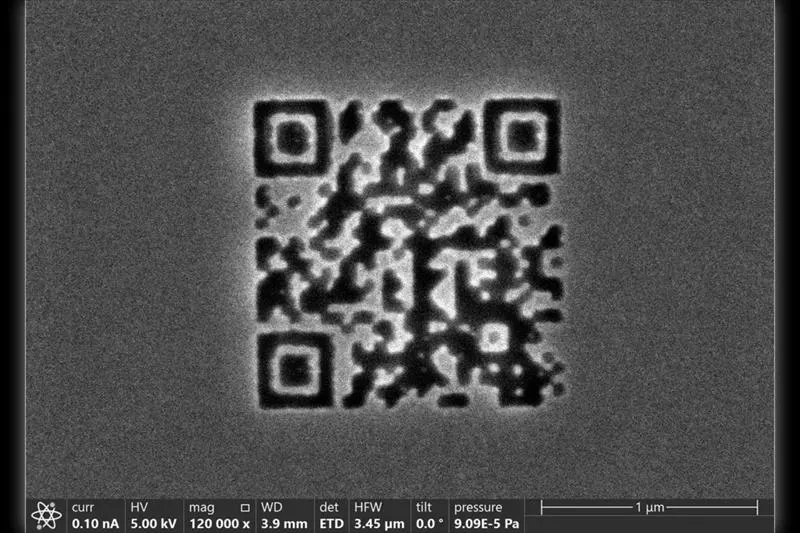
Researchers at TU Wien built a record-small QR code with 49 nm cells, invisible to the eye. At that scale, an A4 page could hold about 2 terabytes of data.
 SUMO· the number puzzle
 Dialo· learn languages by speaking
 ediviewer· read EDI files like documents
 giftdetect· the right gift in minutes
Scientists at TU Wien (Vienna University of Technology) have produced a QR code so small that no phone camera can read it. According to the team, its grid cells are only about 49 nanometres wide, making it smaller than a typical bacterium. The code holds the Guinness record as the smallest working QR code in the world, shrunk by 37 percent compared with the previous mark.
Why shrink a QR code this far?
The goal is data storage. If such tiny codes can be engraved into a stable medium, a single A4 sheet's worth of surface could hold roughly 2 terabytes. The medium would need no energy to maintain or to access.
QR codes suit archiving because of their built-in error correction, the reason a scribbled-on sticker often still scans. The format also supports four encoding modes: numeric, alphanumeric, byte-sized binary and kanji. It is not better than UTF-8 as a way of encoding text, but archives are meant to last decades or centuries, far longer than magnetic or electronic storage, and that robustness is what makes the format attractive.
Limits of the approach
The catch is the reading equipment. Visible light has wavelengths of about 380 to 750 nm, so the individual cells are too small for an optical microscope. An electron microscope is required.
In theory the codes could go smaller still. The smallest common format, version 1, is a 21×21 grid. With most atoms having a radius of roughly 0.1 to 0.2 nm, an atom-scale version would measure about 2.1 to 4.2 nm per side. Paul Mayrhofer, a professor at TU Wien's institute of materials science and technology, says that is possible but impractical: individual atoms do not reliably stay where they are placed, making atomic-scale storage fundamentally unreliable.
The team's code therefore sits at least an order of magnitude above that scale, with 49 nm cells, and works dependably under an electron microscope. For now, it points to a niche but credible route for long-term archival storage rather than a consumer technology.
Apps worth a look
SUMO: the number puzzleTap the right tiles, add them up, hit the target. Easy to learn, hard to master. Free, for all ages.
Dialo: learn languages by speakingTalk to an AI conversation partner; every sentence comes back corrected and explained in your language. 9 languages, A1 to C2.
ediviewer: read EDI files like documentsOpen EDIFACT and X12 messages, see every segment explained, convert to JSON/XML, export PDF and Excel. Runs locally, no upload.
giftdetect: the right gift in minutesPick who it is for, the occasion and their personality. The search engine reads product descriptions from local shops and ranks what fits. Free, no sign-up.
More from this day
See all →
Agibot Puts Six G2 Humanoid Robots to Work in a Shanghai Store

Kakao Bank Debit Cards Briefly Work With Apple Pay in South Korea
Sony Launches PlayStation Portal Player With Built-In Storage

Muji Delays Online Store Reopening After Credential Stuffing Attack
More in: Science
See all →
Kraków University of Technology Opens Wind Tunnel to Polish Athletes

South Korea to Launch Brain-Link BCI Project Group in 2027
Algae-Powered Soft Robot Arms Bend and Grip When Light Hits