Algae-Powered Soft Robot Arms Bend and Grip When Light Hits
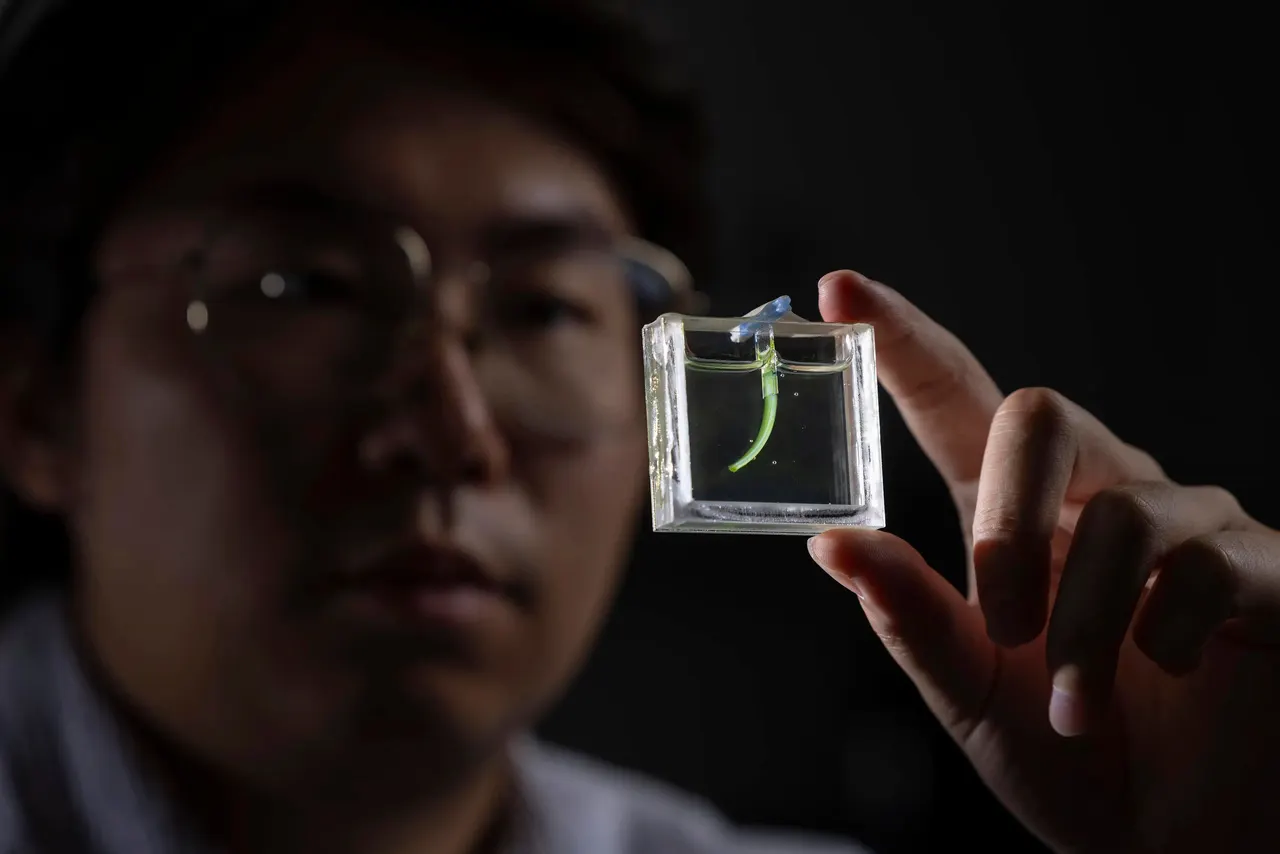
Researchers at Delft University of Technology built tiny soft robotic arms that move when algae on their surface photosynthesize, needing only light as an energy source.
 SUMO· the number puzzle
 Dialo· learn languages by speaking
 ediviewer· read EDI files like documents
 giftdetect· the right gift in minutes
A research team at Delft University of Technology in the Netherlands has built soft robotic arms that move because of living algae. When light hits the microbes on the arm's surface and they begin to photosynthesize, the arm bends.
The arms are about three-quarters of an inch long and roughly as thick as a credit card. Each consists of two hydrogel layers on which the algal cells live. One layer responds to changes in pH, which the algae's metabolism controls. In light, the algae absorb carbon dioxide and fix nitrogen, making the local environment more basic, and the responsive hydrogel swells. In darkness, they release carbon dioxide through respiration, pH drops back to the acidic side, and the hydrogel shrinks. The volume difference between the two layers produces the bending.
The pH-responsive layer changes a lot. According to the researchers, between pH 3 and 7 it was about 37 percent of its original weight, while at pH 11 it reached four times that weight.
Local effect, slow motion
Other pH-responsive soft robots exist, but they typically require changing the chemistry of all the surrounding liquid. The algal version acts much more locally, which makes it better suited to uses where environmental impact must stay minimal.
Speed is the drawback. The chemical shift starts about 20 seconds after light is applied and about 10 seconds after it goes dark, but significant bending takes several hours.
After the first proof of concept, the team built a four-fingered gripper that closes in light. It lifted a hollow metal sphere and released it when the light went off. A hook-shaped gripper picked up and set down a rubber ring. Both objects weighed far less than a small paperclip.
What comes next
The devices need no external energy besides light and no complex mechanical parts. "Microalgae are plantlike organisms that are largely self-sustaining," said Marie-Eve Aubin-Tam, who led the research, adding that this gives the actuator potential for long-term operation with minimal external input.
The team hopes the approach will lead to more autonomous, environment-responsive soft robots for automated agriculture, fluid control in lab-on-a-chip devices or underwater robotics. Because the algae are not genetically modified, the biosafety concerns often tied to microbe-based technologies do not apply.
Apps worth a look
SUMO: the number puzzleTap the right tiles, add them up, hit the target. Easy to learn, hard to master. Free, for all ages.
Dialo: learn languages by speakingTalk to an AI conversation partner; every sentence comes back corrected and explained in your language. 9 languages, A1 to C2.
ediviewer: read EDI files like documentsOpen EDIFACT and X12 messages, see every segment explained, convert to JSON/XML, export PDF and Excel. Runs locally, no upload.
giftdetect: the right gift in minutesPick who it is for, the occasion and their personality. The search engine reads product descriptions from local shops and ranks what fits. Free, no sign-up.
More from this day
See all →
Calogena wins €40 million EU grant for first commercial SMR

Windows 11 Registry Editor Gets a WinUI 3 Version as a Demo

JRH ASI to Finance Radar System Production for Ukrainian Partner

Budimex Tests Autonomous Rollers as Poland's Labor Shortage Bites
More in: Science
See all →
La Fe Hospital Transplants Heart in 70-Year-Old With Mechanical Pump
Spain gets 56% of power from renewables, but IEA flags a gap
Laser-Made Plasma Antenna Transmits Radio Waves From Thin Air