Laser-Made Plasma Antenna Transmits Radio Waves From Thin Air
Researchers at North Carolina State University used a laser to ionize air into a plasma channel that emitted radio waves, a proof of concept for future satellite antennas.
 SUMO· the number puzzle
 Dialo· learn languages by speaking
 ediviewer· read EDI files like documents
 giftdetect· the right gift in minutes
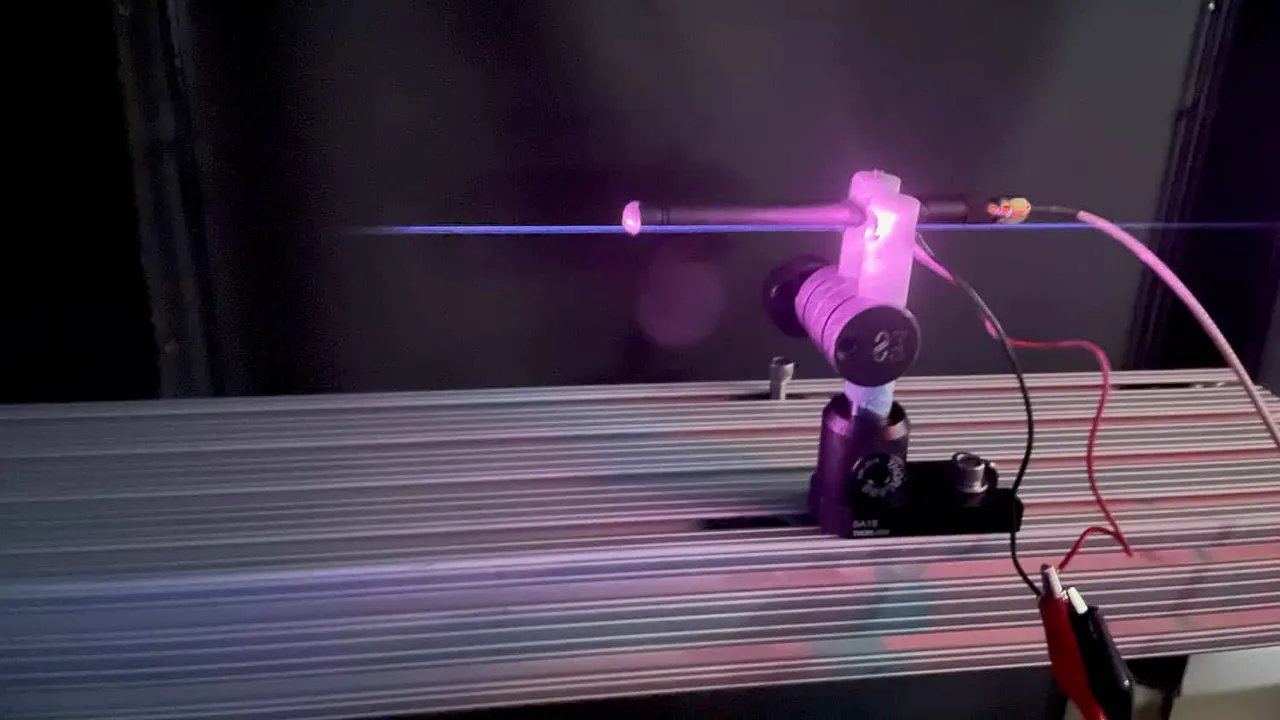
Researchers at North Carolina State University have built an antenna out of air. A laser ionized a narrow strip of air, and the resulting plasma channel emitted radio waves, a proof of concept that could one day let satellites create antennas instead of unfolding them.
How the plasma antenna works
Plasma is a state of matter in which some electrons are stripped from atoms or molecules. A suitably tuned laser beam can ionize a thin column of air and create such a channel. It contains free charge carriers, so it can respond to an electromagnetic field and, under certain conditions, act as an antenna.
The laser alone does not transmit anything. The team, led by Pryia Darshni, had to feed radio-frequency energy into the channel without disturbing it, and an ordinary wire could have damaged the delicate structure. The researchers instead placed a metal ring around the laser beam. It works as a capacitive coupling, allowing a radio generator to act on the plasma electrons without direct contact.
The length and direction of the antenna can be changed by adjusting the beam. Antenna geometry affects its characteristics and frequency range, and conventional designs may need mechanical changes for similar tuning. Here, in theory, laser control would be enough.
Limits of the experiment
The test used 30 MHz, which corresponds to a wavelength of about 10 metres. The received signal was 2.5 times stronger than in a setup where the laser did not create plasma. However, the receiving antenna sat only about 5 centimetres from the transmitter, so this was a near-field measurement, not long-range communication. The team also did not show that the plasma antenna can receive signals, though they see no fundamental obstacle.
Space use remains the open question. According to co-author Paul Franzon, low Earth orbit holds enough thin gas to form plasma. But the density is far lower than in a lab, which changes how the gas ionizes and how a channel can be sustained. The laser, its electronics, power source and control system also need energy, and without data on radiation efficiency and energy cost it is unclear whether the design would cut satellite mass.
Before plasma antennas could compete with metal ones, researchers must show transmission over longer distances, operation across frequency bands and stable emission at reasonable power consumption. The results were published in the IEEE Journal of Microwaves.
Apps worth a look
SUMO: the number puzzleTap the right tiles, add them up, hit the target. Easy to learn, hard to master. Free, for all ages.
Dialo: learn languages by speakingTalk to an AI conversation partner; every sentence comes back corrected and explained in your language. 9 languages, A1 to C2.
ediviewer: read EDI files like documentsOpen EDIFACT and X12 messages, see every segment explained, convert to JSON/XML, export PDF and Excel. Runs locally, no upload.
giftdetect: the right gift in minutesPick who it is for, the occasion and their personality. The search engine reads product descriptions from local shops and ranks what fits. Free, no sign-up.
More from this day
See all →
Calogena wins €40 million EU grant for first commercial SMR

Windows 11 Registry Editor Gets a WinUI 3 Version as a Demo
JRH ASI to Finance Radar System Production for Ukrainian Partner

Budimex Tests Autonomous Rollers as Poland's Labor Shortage Bites
More in: Science
See all →
Algae-Powered Soft Robot Arms Bend and Grip When Light Hits

La Fe Hospital Transplants Heart in 70-Year-Old With Mechanical Pump
Spain gets 56% of power from renewables, but IEA flags a gap