Temple wearable: Goyal's ₹85,000 device vs Apple Watch, Garmin
Deepinder Goyal's Temple, a forehead-worn tracker priced at ₹85,000, promises brain blood-flow signals and better heart-rate accuracy. Key claims still lack independent proof.
 SUMO· the number puzzle
 Dialo· learn languages by speaking
 ediviewer· read EDI files like documents
 giftdetect· the right gift in minutes
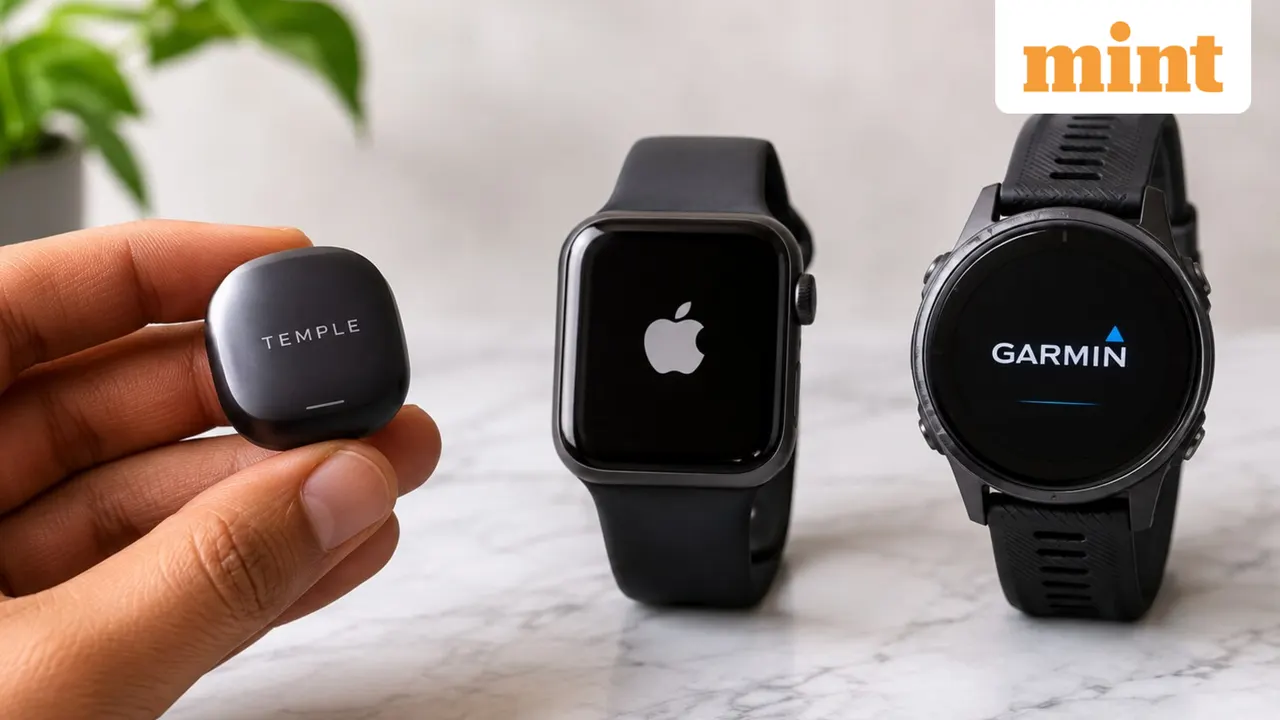
Deepinder Goyal's Temple, a wearable clipped to the side of the forehead, is open for pre-order in India at ₹85,000. It enters a market led by Apple, Garmin and Fitbit, and its central claims have yet to be verified independently.
Pre-orders opened on 1 November. Deliveries are expected in about three months, with the first batch made to order. The price covers lifetime access to the software platform, adhesive patches called Grips, a charging pod and personal onboarding.
What Temple measures
Temple uses optical sensors placed against the skin near the superficial temporal artery. It offers two metrics: BrainFlow, which tracks relative changes in blood circulation associated with the brain, and Entropy, a score from 1 to 250 meant to show how hard the body is working to maintain itself. According to Goyal, the score shifts with sleep, exercise, stress, food, caffeine and meditation.
Apple Watch and Garmin cover broader everyday ground: heart rate, workouts, sleep and activity, plus blood oxygen, ECG and heart-rate alerts on supported models. Garmin is known for GPS, training data and recovery estimates. Temple has no notifications, calls, apps or built-in GPS navigation. On price, the Apple Watch Series 12 starts at ₹56,900 and the Garmin Forerunner 970 is listed at ₹92,990, so Temple sits between them.
Claims under scrutiny
Goyal says Temple measures heart rate more accurately than leading wearables. In a company-shared study, it was compared with the Apple Watch Series 12, Garmin Forerunner 970, Fitbit Air, WHOOP MG and Oura Ring 5, using a Polar H10 chest strap as reference. Temple showed lower errors across exercise zones, with the Apple Watch closest. Goyal also claims it beat a conventionally worn chest strap in the most intense zones.
This is a company-led study, and independent testing is still needed. Goyal says the paper and data are available and that independent researchers are welcome to test the device.
BrainFlow is more contested. Doctors question whether a sensor near the temple can reliably capture circulation inside the brain, since the superficial temporal artery supplies the scalp and face. Two company-funded papers on BrainFlow have not been independently reviewed. Goyal describes Temple as a fitness and wellness product, not a medical device, and says it is not proven to diagnose or prevent disease.
For a conventional tracker, Apple Watch or Garmin remains the more familiar choice. Temple's value will depend on whether independent research backs its measurements and whether users find them useful day to day.
Apps worth a look
SUMO: the number puzzleTap the right tiles, add them up, hit the target. Easy to learn, hard to master. Free, for all ages.
Dialo: learn languages by speakingTalk to an AI conversation partner; every sentence comes back corrected and explained in your language. 9 languages, A1 to C2.
ediviewer: read EDI files like documentsOpen EDIFACT and X12 messages, see every segment explained, convert to JSON/XML, export PDF and Excel. Runs locally, no upload.
giftdetect: the right gift in minutesPick who it is for, the occasion and their personality. The search engine reads product descriptions from local shops and ranks what fits. Free, no sign-up.
More from this day
See all →
XPeng G6 and G9 Electric SUVs Go on Sale in Russia With Yandex
Yandex Market Launches 24/7 Live Shopping Streams in Its App

600,000 Nvidia H200 Chips Reportedly Stuck in Hong Kong Warehouse