Planet X2: Simulations Hint at a Super-Earth Beyond Neptune
A 4.5-billion-year simulation suggests an unseen planet heavier than Earth could explain why icy bodies beyond Neptune have such odd orbits. Nobody has seen it.
 SUMO· the number puzzle
 Dialo· learn languages by speaking
 ediviewer· read EDI files like documents
 giftdetect· the right gift in minutes
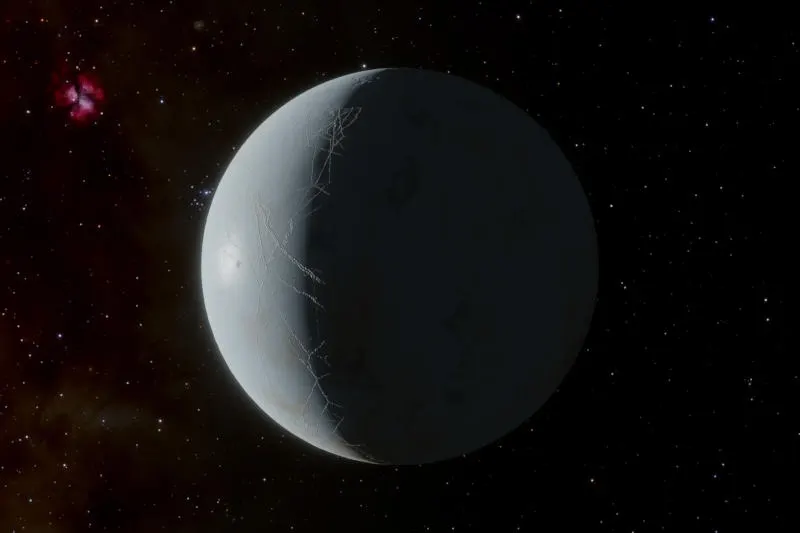
Something out past Neptune is arranging the furniture in strange ways, and a new simulation says it could be a planet nobody has spotted yet. Researchers are calling it Planet X2.
The team ran a model of the Solar System's evolution over 4.5 billion years. Their question: can the odd layout of icy bodies beyond Neptune be explained by one more, undiscovered planet?
Why are the orbits beyond Neptune so odd?
Most known Kuiper belt objects sit in a broad disc beyond Neptune. Further out, the order breaks down. Some icy bodies have orbits tilted by more than 45° relative to the plane where the planets orbit. Others are "detached": even at their closest to the Sun, they stay so far from Neptune that its gravity barely touches them.
The dwarf planet Sedna is the classic case. It never comes closer to the Sun than 76 astronomical units (1 AU is the Earth-Sun distance). Neptune orbits at about 30 AU.
What did the simulations find?
The best fit was a planet more massive than Earth, on a stretched orbit that never brings it closer than 200 AU to the Sun. Over billions of years, its gravity could tilt some orbits sharply while leaving others detached and fairly flat.
A planet the size of Mars or Earth did not work. Such lighter planets would have been flung out of the Solar System before they left a visible mark. That points to a super-Earth.
Planet X2 is more modest than the better-known "Planet Nine", proposed to explain why some distant objects have orbits pointing the same way. Last year astronomers using the Subaru telescope in Hawaii reported a Sedna-like object called "Ammonite", whose orbit seems to differ from its neighbours. Another study found that a passing star in the Sun's youth could also have produced Sedna-like orbits.
Is there really a new planet?
Not yet. Simulations are not a discovery, and there are plenty of ways to disturb a disc. Using data from the Dark Energy Survey, the team found that the most likely models explain the tilts and closest approaches fairly well. But the models produced too few objects with the longest orbits.
Finding Planet X2 would mean spotting an extremely distant world by its faint reflected sunlight, then tracking its motion across a series of images.
Apps worth a look
SUMO: the number puzzleTap the right tiles, add them up, hit the target. Easy to learn, hard to master. Free, for all ages.
Dialo: learn languages by speakingTalk to an AI conversation partner; every sentence comes back corrected and explained in your language. 9 languages, A1 to C2.
ediviewer: read EDI files like documentsOpen EDIFACT and X12 messages, see every segment explained, convert to JSON/XML, export PDF and Excel. Runs locally, no upload.
giftdetect: the right gift in minutesPick who it is for, the occasion and their personality. The search engine reads product descriptions from local shops and ranks what fits. Free, no sign-up.
More from this day
See all →



More in: Science
See all →
Iowa lead azide detonation: EPA finds zero airborne lead

Why coffee makes you poop: 50 people swallowed a SmartPill

Superwood: the treated timber InventWood says beats steel