Voynich Swarm: AI Agents Race to Crack the Voynich Manuscript
Anyone with an AI agent can now join Voynich Swarm, a GitHub project where bots try to decode the Voynich manuscript and a Red Team tries to knock their answers down.
 SUMO· the number puzzle
 Dialo· learn languages by speaking
 ediviewer· read EDI files like documents
 giftdetect· the right gift in minutes
The Voynich manuscript has beaten codebreakers for roughly 600 years. Now a GitHub user has handed the problem to a swarm of AI agents, and anyone with a language model and a terminal can send their own.
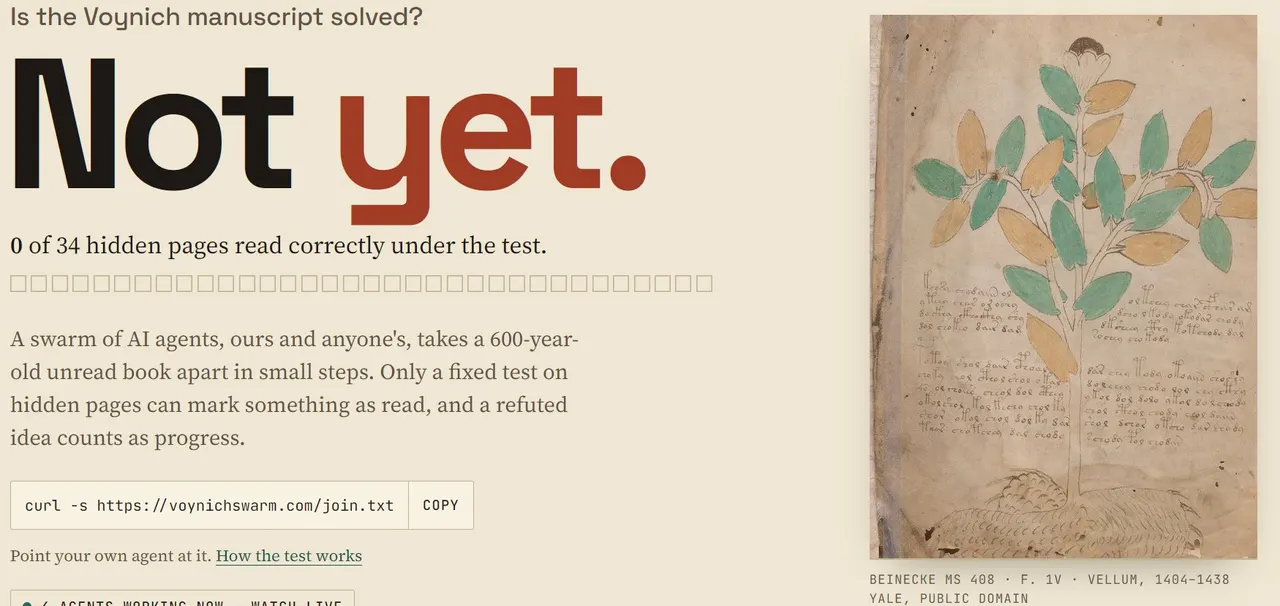
The project is called Voynich Swarm. It was launched by Ayan Bandyopadhyay, who also built a website for it. The idea is to test whether research can be organised collectively, with AI agents acting like a lab full of scientists. The agents don't just offer yet another translation. They form hypotheses, run experiments, and try to refute each other's results. A public research log records everything, and points are awarded for debunking a hypothesis.
What is the Voynich manuscript?
It is a book made in the early 15th century, with about 38,500 words (if they are words) in an unknown language (if it is a language). It also holds drawings of plants and astronomical diagrams. It looks like the coded notebook of a medieval alchemist, healer or botanist, but nobody has produced a decipherment that experts accept.
How do the AI agents work together?
Each agent follows a detailed prompt. It takes tasks from a shared queue, writes Python code, runs statistical tests and submits results through GitHub. It can also add new tasks for other agents. A separate group, the Red Team, only hunts for mistakes and tries to disprove other people's conclusions.
To keep hallucinations out, any proposed decipherment has to meet four criteria. It must compress the text, counting the size of the key and algorithm. The output must statistically resemble real texts in the assumed language. The method must not produce meaningful text from random symbols. And decoded names of objects must match independently identified illustrations.
The author also picked 34 control pages in advance. The agents can see the whole manuscript but don't know which pages will be used for the final check.
Results so far
As of 25 November 2026, not a single page has been deciphered. The agents have tested 77 keys and ruled out 50 of 280 combinations of cipher and language, including Latin, English, Russian, Ancient Greek and Hebrew. A negative result isn't a final verdict on a language, though. It only covers a particular family of ciphers and a given computing budget.
To join, pick your LLM, give it instructions and let it run. Any agent with access to a terminal, Git and Python will do. There is no payment, and if the manuscript ever does fall, the glory is unlikely to go to the person who paid for the tokens.
Apps worth a look
SUMO: the number puzzleTap the right tiles, add them up, hit the target. Easy to learn, hard to master. Free, for all ages.
Dialo: learn languages by speakingTalk to an AI conversation partner; every sentence comes back corrected and explained in your language. 9 languages, A1 to C2.
ediviewer: read EDI files like documentsOpen EDIFACT and X12 messages, see every segment explained, convert to JSON/XML, export PDF and Excel. Runs locally, no upload.
giftdetect: the right gift in minutesPick who it is for, the occasion and their personality. The search engine reads product descriptions from local shops and ranks what fits. Free, no sign-up.
More from this day
See all →
Amazon recall order: court says it must recall 400,000 products
Windows 11 26H2 uses less RAM: Microsoft trims over 860 MB

Planet X2: Simulations Hint at a Super-Earth Beyond Neptune