Photon Matrix Lab's AI Laser Turret Targets Mosquitoes for $988
A Chinese startup has revived a 2000s US idea, the Photonic Fence, as a brick-sized AI laser that shoots mosquitoes' wings off. It sells for about $1,000.
 SUMO· the number puzzle
 Dialo· learn languages by speaking
 ediviewer· read EDI files like documents
 giftdetect· the right gift in minutes
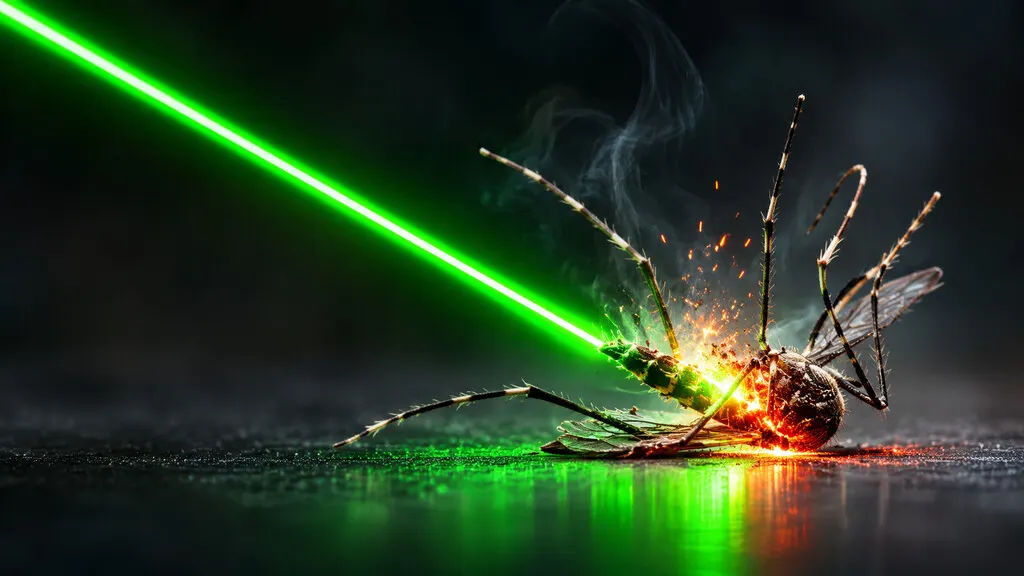
Photon Matrix Lab, a company based in Changzhou in China's Jiangsu province, is trying to bring a laser mosquito killer to homes. Its Laser Mosquito Air Defense System is about the size of a brick and combines laser sensors, cameras and artificial intelligence. The indoor version with an invisible infrared laser costs $988, and the outdoor version with a visible blue laser costs $1,088.
An idea from 2006
The concept comes from the United States. In 2006, Nathan Myhrvold, former Microsoft CTO and founder of Intellectual Ventures, asked engineers whether a laser could kill mosquitoes, as part of discussions on fighting malaria. Physicist Lowell Wood helped design the Photonic Fence, which detects insects, tells them apart from other animals and fires on them automatically. Working prototypes existed by 2009, and Myhrvold showed the technology at TED in February 2010. It never became a mass-market product.
How the new device works
The Chinese system uses lidar to emit roughly 100,000 low-power laser pulses per second across a two-dimensional plane in front of it. When it spots a tiny flying object, it calculates the trajectory and fires a stronger laser for about a hundredth of a second, aiming to burn the mosquito's wings. In a demonstration, the device brought down several insects in a row. They fell with their bodies apparently intact but unable to fly. Founder Wang Chuan said some can survive hours or even days without wings.
Safety and delivery doubts
Safety is the main obstacle. The company moved from class 3 to a class 4 laser, the most hazardous category, which can cause serious eye injury after very brief exposure. It says it added AI cameras to recognize people and pets, detection of reflective surfaces, and sensors that work in darkness. Users must pass a 15-question safety quiz and register a fingerprint. The company is seeking approvals in China, Europe and the US, but has not publicly shown the product is safe in all home conditions.
Demand has been strong. An Indiegogo campaign aiming for $20,000 raised more than $2.8 million, and the firm reports over 5,000 orders, mostly from Europe and North America. It planned 3,000 to 5,000 units a month. Development took three years instead of the planned three months. Mass production, once expected in July 2026, slipped, and in late September the company said it was still running pre-production tests, despite announcing first deliveries for October.
Apps worth a look
SUMO: the number puzzleTap the right tiles, add them up, hit the target. Easy to learn, hard to master. Free, for all ages.
Dialo: learn languages by speakingTalk to an AI conversation partner; every sentence comes back corrected and explained in your language. 9 languages, A1 to C2.
ediviewer: read EDI files like documentsOpen EDIFACT and X12 messages, see every segment explained, convert to JSON/XML, export PDF and Excel. Runs locally, no upload.
giftdetect: the right gift in minutesPick who it is for, the occasion and their personality. The search engine reads product descriptions from local shops and ranks what fits. Free, no sign-up.
More from this day
See all →
KT and Samsung Cut High-Speed Rail Dropouts by 29% With AI

OPENREC Raises 1.4 Billion Yen for mellow-fan Expansion

Replit Opens Japan Office as SMFL Launches Enterprise Vibe Coding

Fact Base raises ¥4.5 billion Series D for Zumen drawing tool
More in: Hardware
See all →
SpaceX Picks Qualcomm Dragonwing for Starlink Mobile 5G Towers
Apple Eases Chip Supply Strain as TSMC's 2 nm Yields Near 90%

Amazon Bans Account Over Nvidia DGX Spark Order, Others Report Similar