Philips P79: the cardboard 'app' for a 1980s vacuum still works
Long before smartphones, Philips shipped a cardboard slider that told you which suction setting to use on a Philips P79 vacuum. It still works on every OS.
 SUMO· the number puzzle
 Dialo· learn languages by speaking
 ediviewer· read EDI files like documents
 giftdetect· the right gift in minutes
Forty years ago Philips had a problem that today you would solve with an app. There were no smartphones, so the company made the app out of cardboard. Unlike plenty of modern apps, it runs on every operating system and has needed no update since.
The tool belonged to the Philips P79 vacuum cleaner, which reached shops in the 1980s. Its job was to answer one question: what suction power should you use on this surface? You slid an inner card until the thing you wanted to clean, say curtains, showed up in one window. Then you read the recommended mode in one of three windows next to it.
What was special about the Philips P79?
The cardboard is a nice curiosity, but the vacuum itself is the more interesting part. The P79 had an automatic mode, marked "Automatic" and "AUT", that adjusted suction to the surface being cleaned. Many modern vacuums do the same, but instead of a colourful screen the P79 gave feedback with green lights.
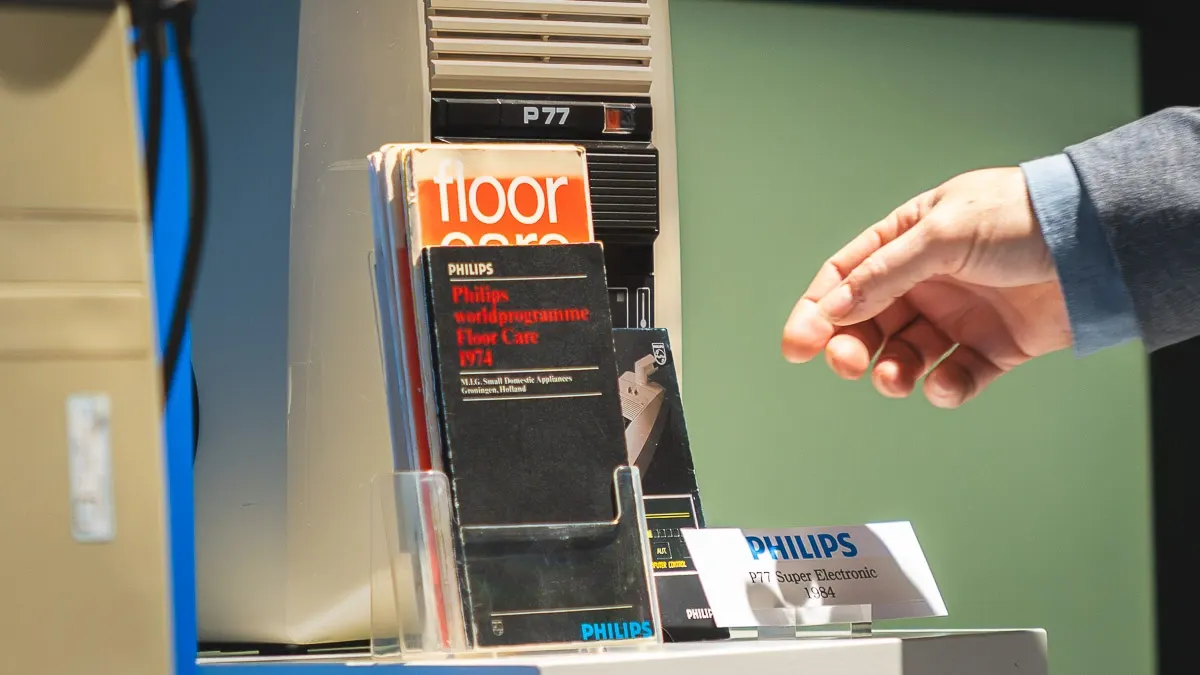
It looked much like the P77 from 1984, which offered up to 1,000 W and mostly manual power selection. The P79 carried the label "Computer Control" instead of "Super Electronic", so a computer picked the power for you.
How did the cardboard app work?
The card acted as a small database. The green marks lined up with other windows that mirrored the lights on the vacuum and showed what power to expect. If curtains appeared in the selection window, the power window showed "300". That number was also printed on one of the machine's buttons, the minimum mode. At the other end sat "1000", the maximum. In practice the card told you when it was better to leave automatic mode and pick something else yourself.
Some people argue that automatic power control is partly why these vacuums lasted decades. The motor ran at full power only when needed, not because the owner figured they had paid for maximum power and meant to use it.
Today's Philips PowerUp range, including PowerUp IQ, has a far better display and many more automated features. The concept, though, was worked out decades ago, including in Philips' centre in Drachten in the Netherlands, where the writer saw the new line.
Apps worth a look
SUMO: the number puzzleTap the right tiles, add them up, hit the target. Easy to learn, hard to master. Free, for all ages.
Dialo: learn languages by speakingTalk to an AI conversation partner; every sentence comes back corrected and explained in your language. 9 languages, A1 to C2.
ediviewer: read EDI files like documentsOpen EDIFACT and X12 messages, see every segment explained, convert to JSON/XML, export PDF and Excel. Runs locally, no upload.
giftdetect: the right gift in minutesPick who it is for, the occasion and their personality. The search engine reads product descriptions from local shops and ranks what fits. Free, no sign-up.
More from this day
See all →
Voyager 2 won't reach one light-day from Earth until 2035

Greek prison drones: a pistol got in even after the jammer worked

GTA San Andreas house in GTA 6: where to find it in Leonida

Google Willow chip wins 98.3% of a logic game classical tops at 88.9%
More in: Hardware
See all →
PS4 local LLM: a 2013 console runs Qwen3.5-9B at 39 tokens/s
Frostbite: an AI-designed CPU claims 4.59x better performance per watt
Supermicro lawsuit: ex-exec's husband was a top Nvidia VP