NC AI Unveils Compact Vision Model for Physical AI Robots
NC AI says its 3-billion-parameter model, Vacky Vision 3B, outscored six global open models on three robot and spatial-understanding benchmarks.
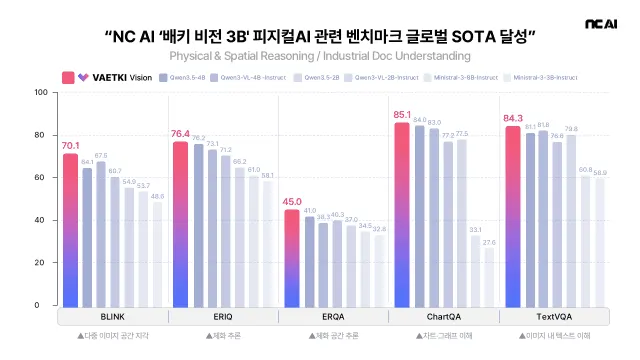
NC AI has developed a lightweight vision-language model that, according to the company, beats six global open models on spatial understanding despite its small size. The model, called Vacky Vision 3B, has roughly 3 billion parameters and averaged 63.8 points across three robotics and spatial benchmarks, the company said on November 3.
Vision-language models recognize objects and space in images and video and interpret their meaning. For a robot to carry out human instructions, it must know where objects are, how they move and what the work environment looks like. NC AI focused on keeping the model small because robots and production equipment have limited power and computing resources and cannot easily run large models.
Benchmark results
The evaluation used BLINK, ERIQ and ERQA. In standard response mode, which answers without extended reasoning, Vacky Vision 3B beat six open models in the 2–8 billion parameter range, including Alibaba Qwen and Mistral-family models. In a step-by-step reasoning mode it scored 63.2, which is 14.8 points above the 48.4 of the 8B-class Ministral 3 8B Reasoning. The company stressed that these figures reflect specific evaluation conditions and do not mean superior performance on every vision-language task.
The model also posted the highest scores among compared models on ChartQA and TextVQA, which NC AI plans to use for reading gauges, drawings and work orders. It processes eight frames from a four-second video to track movement and position changes.
Welding variant and industrial plans
NC AI also trained a welding-specific version, Vacky Vision 3B Weld. In internal tests, welding classification accuracy rose from 41.1 to 80.9, defect detection and condition reasoning from 39.3 to 69.8, and weld location and shape recognition from 5.3 to 72.5. These are benchmark results, not validation on real production lines.
The company says it built its own pretraining and two-stage fine-tuning pipeline on its own infrastructure. It is developing AI for autonomous welding robots with Hanwha Ocean, running humanoid robot trials with POSCO DX and building a world model with Hyundai Rotem.
Next, NC AI plans to add reinforcement learning, deploy the model as a perception module in robots and industrial equipment, and extend it into a vision-language-action (VLA) model that also decides actions. CEO Lee Yeon-soo said high-performance lightweight models are essential for physical AI to work in real time on limited hardware.
Apps worth a look
 SUMO: the number puzzle
Tap the right tiles, add them up, hit the target. Easy to learn, hard to master. Free, for all ages.
 Dialo: learn languages by speaking
Talk to an AI conversation partner; every sentence comes back corrected and explained in your language. 9 languages, A1 to C2.
 ediviewer: read EDI files like documents
Open EDIFACT and X12 messages, see every segment explained, convert to JSON/XML, export PDF and Excel. Runs locally, no upload.
More from this day
See all →
Apple: Hard to Predict When iPhone Duo Supply Will Catch Up
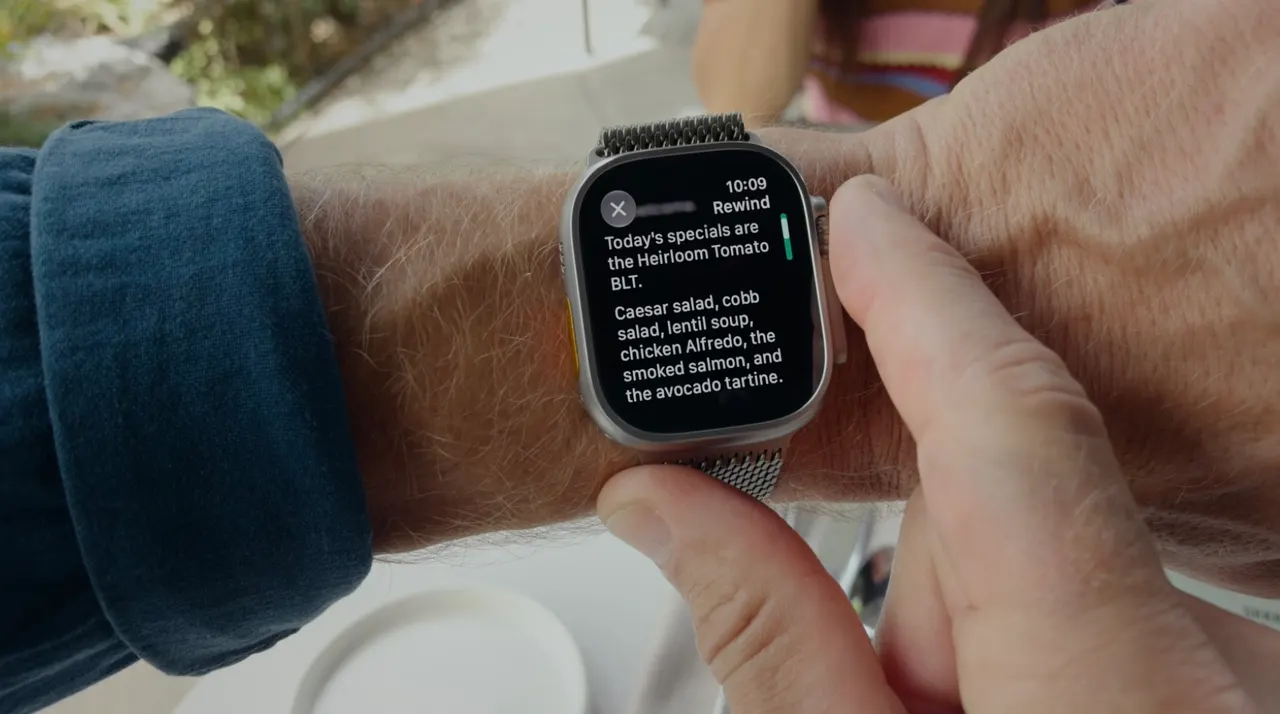
Apple Watch Audio Intelligence enters beta in iOS 27.3

MoneySmart reports customer data breach in Singapore and Hong Kong

Granter raises €1.6M to take its AI grant platform across Europe
More in: AI
See all →
OpenAI to shut down ChatGPT Classic desktop app on January 30
Claude Code Now Blocks Game Cloning and Some Reverse Engineering

Shigeru Miyamoto on Generative AI: "There Will Always Be a Role for Us"