Mount Tai Robot Challenge: 90 Teams Tackle 3,100 Stone Steps
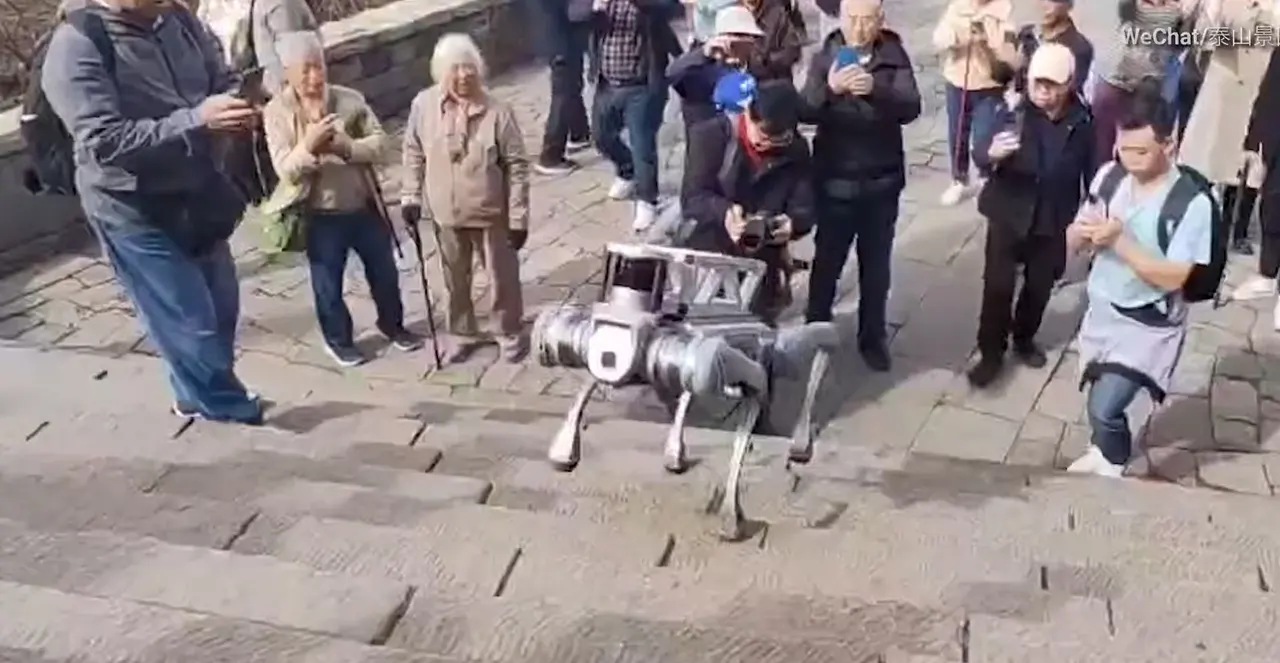
Nearly 90 teams sent humanoid and quadruped robots up Mount Tai's stone stairs, some carrying eggs and watermelons. A Unitree-group quadruped won the main race.
 SUMO· the number puzzle
 Dialo· learn languages by speaking
 ediviewer· read EDI files like documents
 giftdetect· the right gift in minutes
On 2 November, nearly 90 teams entered the World Mountain Robot Challenge on Mount Tai in China's Shandong province. Humanoid robots, quadrupeds and exoskeletons that assist human movement all faced real stone steps instead of a smooth indoor floor.
The main route ran 3.9 km from Hongmen to Zhongtianmen, with more than 3,100 steps and an elevation gain of about 600 metres. It was not a climb to the summit, only a section of the path leading toward it. A quadruped from Beijing Lingyi Technology, part of the Unitree group, won that race in 43 minutes and 41 seconds. According to CCTV, ordinary tourists need at least two hours. The fastest humanoid, from the Zhishen Lingyue team, finished in 27:26, but on a much shorter section.
Eggs and watermelons on the robot's back
Organisers separated speed events from transport events. In the latter, robots carried cargo including eggs and watermelons, and some machines hauled around 13 kg. The route was shorter, about 3.3 km and more than 2,100 steps, and results depended on both time and the condition of the load. The Lingshi team from Linxai Intelligence won in 1 hour, 51 minutes and 29 seconds. There were falls too: one humanoid toppled on the paving and needed engineers' help, and another tumbled down some stairs.
The control approaches differed. Uniubi AI engineers described using lidar, which scans terrain with lasers and builds a 3D map so the robot can recognise steps and plan its moves. The Genisom AI team used a mode without vision, relying on leg contact with the ground, joint load and body position to adjust each step and keep balance.
Beyond the race
Robots are already working on the mountain. In 2026, a machine carried water up the trail and waste back down, typically moving 30 to 45 kg with cameras and LiDAR, and running 4 to 6 hours per battery charge.
A record time does not settle whether a robot is useful. Reliability, energy use, supervision needs and maintenance costs matter more, and the real question is whether robots can do such work more cheaply and safely than people.
Apps worth a look
SUMO: the number puzzleTap the right tiles, add them up, hit the target. Easy to learn, hard to master. Free, for all ages.
Dialo: learn languages by speakingTalk to an AI conversation partner; every sentence comes back corrected and explained in your language. 9 languages, A1 to C2.
ediviewer: read EDI files like documentsOpen EDIFACT and X12 messages, see every segment explained, convert to JSON/XML, export PDF and Excel. Runs locally, no upload.
giftdetect: the right gift in minutesPick who it is for, the occasion and their personality. The search engine reads product descriptions from local shops and ranks what fits. Free, no sign-up.
More from this day
See all →
Citus Demonstrates GPS-Free Firefighter Tracking, Eyes Military Use

Google Cloud expands CodeMender and AI agent security tools

Operation Ghostbusters: 830,840 Suspected Ghost Students Found