Milky Way weighed at 1.19 trillion suns, with 11% uncertainty
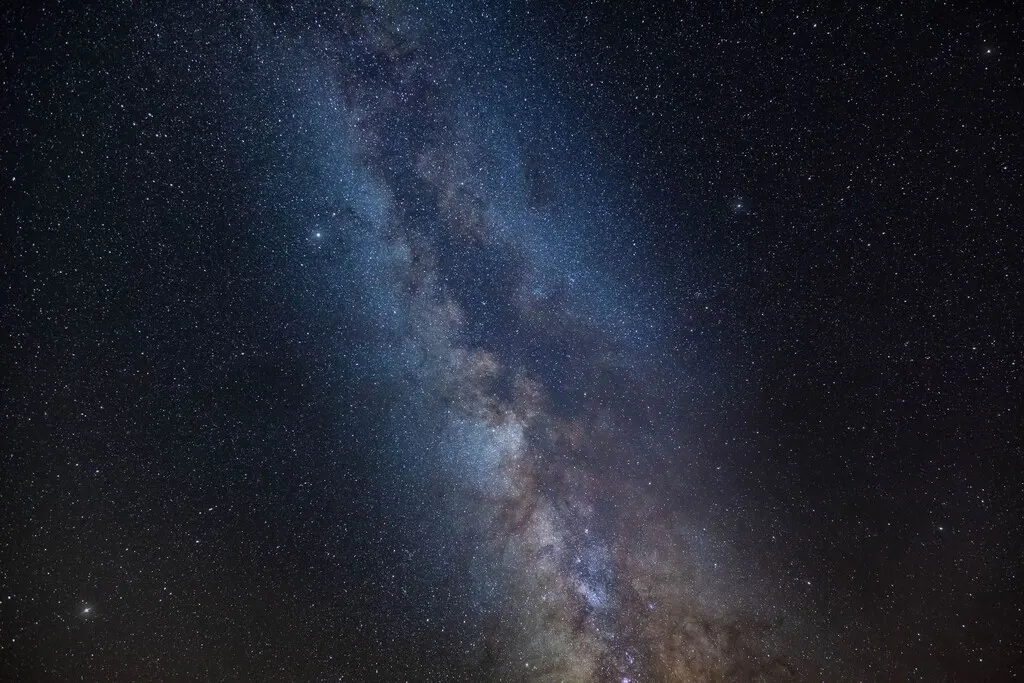
Astronomers combined DESI and Gaia data on 10,000 distant stars to weigh the Milky Way, dark matter included, with a margin of error of about 11%.
 SUMO· the number puzzle
 Dialo· learn languages by speaking
 ediviewer· read EDI files like documents
 giftdetect· the right gift in minutes
How much does the Milky Way weigh? A new estimate says 1.19 trillion times the mass of the Sun, and it comes with a smaller margin of error than earlier attempts: about 11%.
The number comes from a preprint (a study not yet peer reviewed) that combines two surveys. DESI, the Dark Energy Spectroscopic Instrument, is an international project that maps the Universe in 3D. Its spectrographs split starlight into its colours, and thanks to the Doppler effect they reveal whether a star is moving towards us (its light shifts to blue) or away (it shifts to red). Gaia, a European telescope, tracks star positions over the years, so it shows how they drift across the sky. Put both together and you get a star's motion in full.
How do you weigh a galaxy?
Adding up the visible stars is easy enough, but it misses most of the mass, because most of the Milky Way is dark matter. So the team looked at the galactic halo, the sparse cloud of old stars around the disc. Those stars are tugged by the gravity of everything in the galaxy, dark matter included.
The researchers studied more than 10,000 distant stars that DESI observed in its first three years, lying between roughly 30,000 and 310,000 light years from the galactic centre. They were blue horizontal branch stars and RR Lyrae stars, both old and with a known or very predictable true brightness. Compare that with how bright they look from Earth and you get their distance.
What is the Milky Way's mass, exactly?
The result is 1.19 trillion solar masses, ordinary and dark matter together, with about 11% uncertainty. For matter within roughly 260,000 light years of the centre, the uncertainty falls to 8%.
There was a catch. The four models used to read the stars assume a perfectly round galaxy, which real ones are not. So the team first tested them on six realistic simulated galaxies whose mass was already known, measured how far off the models were, and removed that error from the Milky Way result. It also suggests future models should treat our galaxy as less spherical.
Next, the researchers want to pin down the outer halo using even more distant stars and more Gaia data. DESI's second data release, which this study draws on, is due to become public soon, so any astronomer will be able to try their own calculations.
Apps worth a look
SUMO: the number puzzleTap the right tiles, add them up, hit the target. Easy to learn, hard to master. Free, for all ages.
Dialo: learn languages by speakingTalk to an AI conversation partner; every sentence comes back corrected and explained in your language. 9 languages, A1 to C2.
ediviewer: read EDI files like documentsOpen EDIFACT and X12 messages, see every segment explained, convert to JSON/XML, export PDF and Excel. Runs locally, no upload.
giftdetect: the right gift in minutesPick who it is for, the occasion and their personality. The search engine reads product descriptions from local shops and ranks what fits. Free, no sign-up.
More from this day
See all →
Wylsacom owns 30% of Immortal, the startup behind KloKlo AI bot
Nancy Grace Roman telescope: adopt a pixel of its first image

DAZN refund: court rules price hikes were unlawful

Uber robotaxi in Munich: how to ride a self-driving car now
More in: Science
See all →
VCN-01: a modified cold virus against pancreatic cancer

SSI Mantra robot: two surgeons run a beating-heart bypass

China's underwater data center off Shanghai runs on sea water