LHCb zeptoverse: first sign of a decay that happens once in 10 billion
The LHCb experiment at CERN has found first evidence of a decay so rare it occurs about once in 10 billion cases. It opens a window onto the zeptoverse.
 SUMO· the number puzzle
 Dialo· learn languages by speaking
 ediviewer· read EDI files like documents
 giftdetect· the right gift in minutes
Physicists at the Large Hadron Collider have spotted the first evidence of a particle decay that happens roughly once in every 10 billion tries. The result does not reveal a new particle. It does let researchers start probing the zeptoverse, a world of distances far smaller than anything they could reach before.
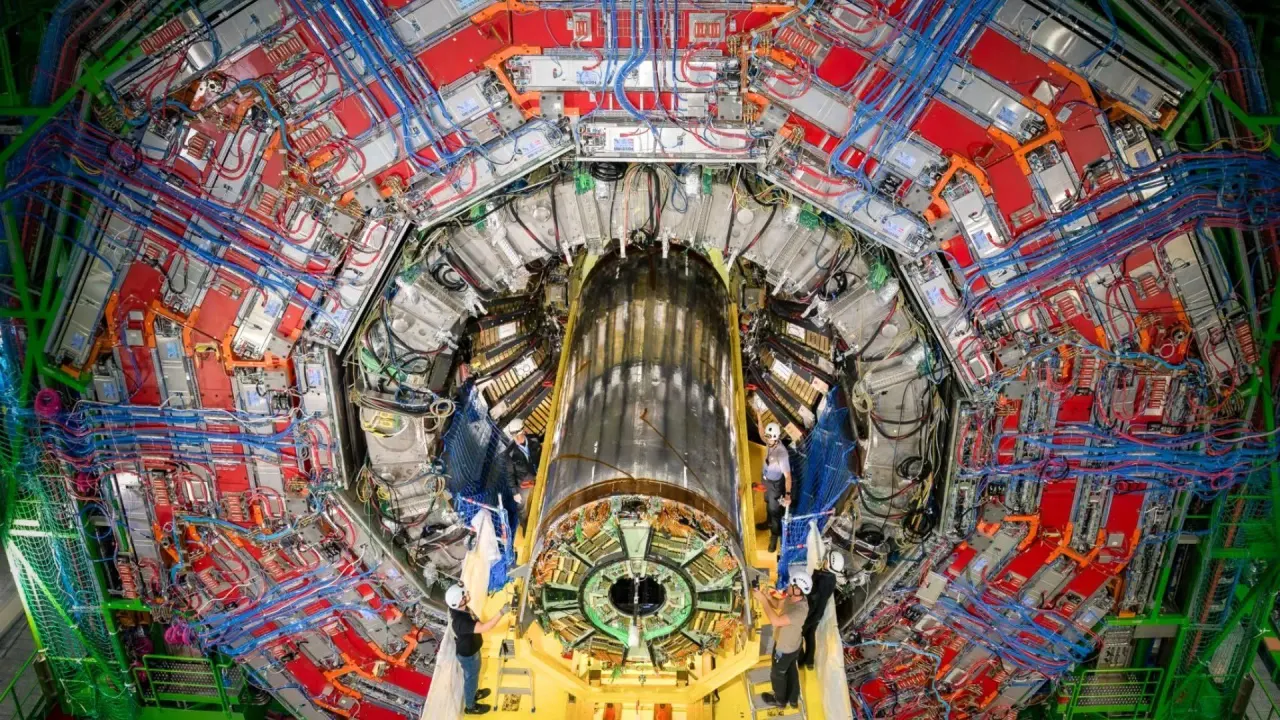
The finding comes from LHCb, one of the four main experiments at the LHC, the 27-kilometre ring buried under the Swiss-French border. LHCb is built to study particles containing the beauty (or bottom) quark. This time the team saw signs of a neutral B meson, written B⁰, decaying into a pair of muons, one positive and one negative. Muons are like electrons, only much heavier. Theorists predicted this decay decades ago, but nobody had enough data to confirm it.
What is the zeptoverse?
A zeptometre is one trillionth of a billionth of a metre. An atom is about a ten-billionth of a metre across, so a zeptometre is roughly 100 billion times smaller. No microscope can see that. Particle physics works differently: the more energy you pack into a collision, the smaller the distances and the subtler the effects you can examine.
Why does one rare decay matter?
The Standard Model, the best current theory of matter and its forces, predicts how often this decay should happen. If measurements ever differ clearly from that prediction, unknown particles or forces could be involved, even ones too heavy to appear in the collision itself, since they could nudge the decay through quantum effects. That is the kind of clue researchers want for dark matter and for the question of why matter outlasted antimatter after the Big Bang.
Two things made the result possible. LHCb restarted in 2024 after a major upgrade and can now collect data up to five times faster. And machine-learning algorithms helped pick out the telltale particle tracks from a huge background of look-alike events. Data from 2024 and 2025 was combined with earlier runs from 2011 to 2018.
Harry Cliff of the University of Cambridge said that a year of data now matches what used to take a decade, and that the gain comes not just from stronger collisions but from getting far more information out of the detector.
Apps worth a look
SUMO: the number puzzleTap the right tiles, add them up, hit the target. Easy to learn, hard to master. Free, for all ages.
Dialo: learn languages by speakingTalk to an AI conversation partner; every sentence comes back corrected and explained in your language. 9 languages, A1 to C2.
ediviewer: read EDI files like documentsOpen EDIFACT and X12 messages, see every segment explained, convert to JSON/XML, export PDF and Excel. Runs locally, no upload.
giftdetect: the right gift in minutesPick who it is for, the occasion and their personality. The search engine reads product descriptions from local shops and ranks what fits. Free, no sign-up.
More from this day
See all →
Kodak Slide Tag: a tiny e-ink photo frame that also tracks your keys

Work laptop for personal use: your employer may see more

Weak 4G indoors: Ookla finds Naples has the worst signal

Hebao H3: the Chinese robot boat that cleans lakes by itself
More in: Science
See all →
Underwater volcanic activity found near Challenger Deep
M87* black hole photo checked by AI, and Einstein holds up