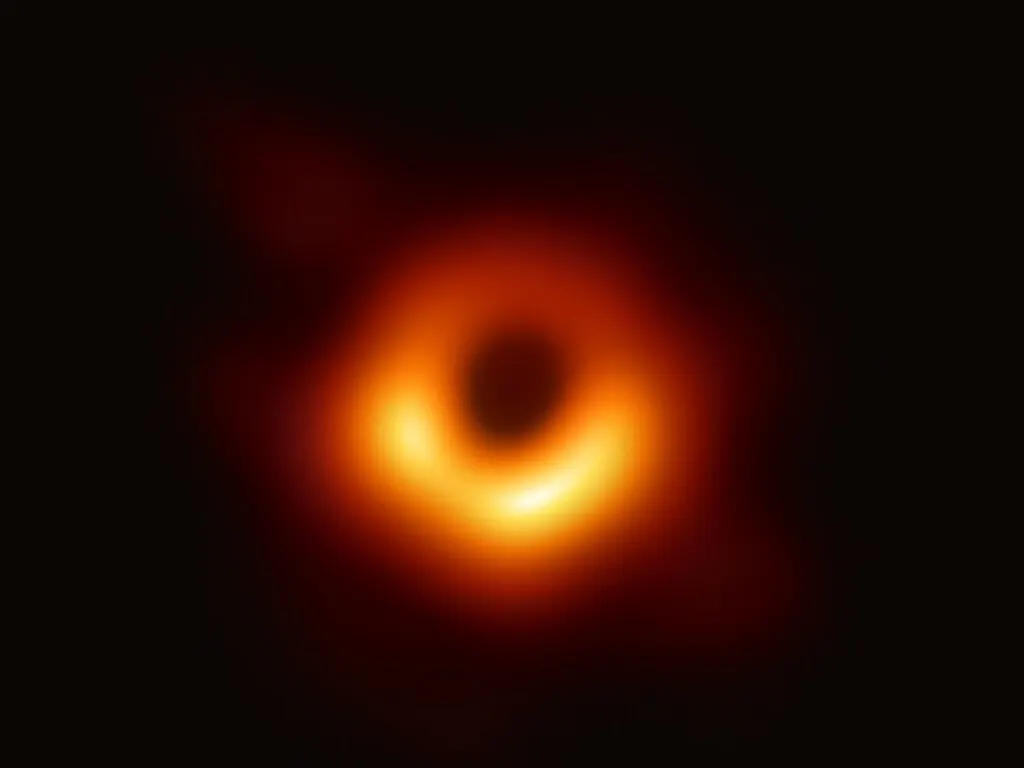
M87* black hole photo checked by AI, and Einstein holds up
A new machine learning method rebuilt the famous black hole image from scratch, with no idea what a black hole looks like. It matched the 2019 picture almost exactly.
 SUMO· the number puzzle
 Dialo· learn languages by speaking
 ediviewer· read EDI files like documents
 giftdetect· the right gift in minutes
The first photo of a black hole, released in 2019, has now been rebuilt from scratch by an independent team. The result is almost identical to the original, which is good news for the image and for Albert Einstein.
Strictly speaking, the picture shows the silhouette of the black hole M87*, not the thing itself. That was always the most anyone could hope for. Still, a result like that needs a second opinion to rule out error or coincidence, and the check has taken a while to arrive.
Why could the M87* image have been wrong?
Two reasons. M87* sits 55 million light years away. And the image came from the Event Horizon Telescope (EHT), a network of telescopes spread across the planet that work together as one giant instrument called an interferometer. Every one of those telescopes sits beneath the atmosphere, which can distort the signals. The huge volume of data also had to be processed into a single image, and mistakes could creep in there too. Samuel Lai, lead author of the new study, compares it to photographing a donut on the Moon from your back garden.
How was the photo checked?
Lai and his team built a machine learning technique called GenDIReCT. It reconstructs the image from zero, filtering out atmospheric interference and the biases that come from merging telescopes worldwide. They fed it the public EHT data, skipping the original reconstruction method, and got a picture practically identical to the 2019 one. The model knew nothing about black holes and had been calibrated on non-astronomical images, which makes the match more convincing.
What does it mean for Einstein?
General relativity says gravity is not a force pulling on things but mass bending space-time, like a heavy ball sinking into a trampoline. Pack in enough mass and nothing, not even light, escapes. Einstein himself was unsure black holes existed. The 2019 image showed a bright ring around a dark centre, close to the size relativity predicts, and later pictures backed that up. Proving the first image was not an artefact makes the support stronger.
The technique could also help on Earth. Reducing errors when combining data from several sensors could help map earthquakes, and it may even improve medical imaging.
Apps worth a look
SUMO: the number puzzleTap the right tiles, add them up, hit the target. Easy to learn, hard to master. Free, for all ages.
Dialo: learn languages by speakingTalk to an AI conversation partner; every sentence comes back corrected and explained in your language. 9 languages, A1 to C2.
ediviewer: read EDI files like documentsOpen EDIFACT and X12 messages, see every segment explained, convert to JSON/XML, export PDF and Excel. Runs locally, no upload.
giftdetect: the right gift in minutesPick who it is for, the occasion and their personality. The search engine reads product descriptions from local shops and ranks what fits. Free, no sign-up.
More from this day
See all →


More in: Science
See all →