Caltech's ASTRA Robot Builds Antenna Module Autonomously in Orbit
Caltech's ASTRA gantry robot has assembled part of a 1.4-metre reflector antenna in orbit, a first step toward building large space structures without astronauts.
 SUMO· the number puzzle
 Dialo· learn languages by speaking
 ediviewer· read EDI files like documents
 giftdetect· the right gift in minutes
Caltech's ASTRA robot has autonomously assembled part of a structure in space, showing that automated construction in orbit is feasible. So far it has built one module of a 1.4-metre reflector antenna.
A robot that builds what rockets cannot carry
Larger space telescopes and bigger communication antennas run into the same limit: rocket payload size. Existing workarounds are to fold instruments inside the rocket, as with the James Webb Space Telescope, or to send loose parts for astronauts to assemble. Both work, but both have limits.
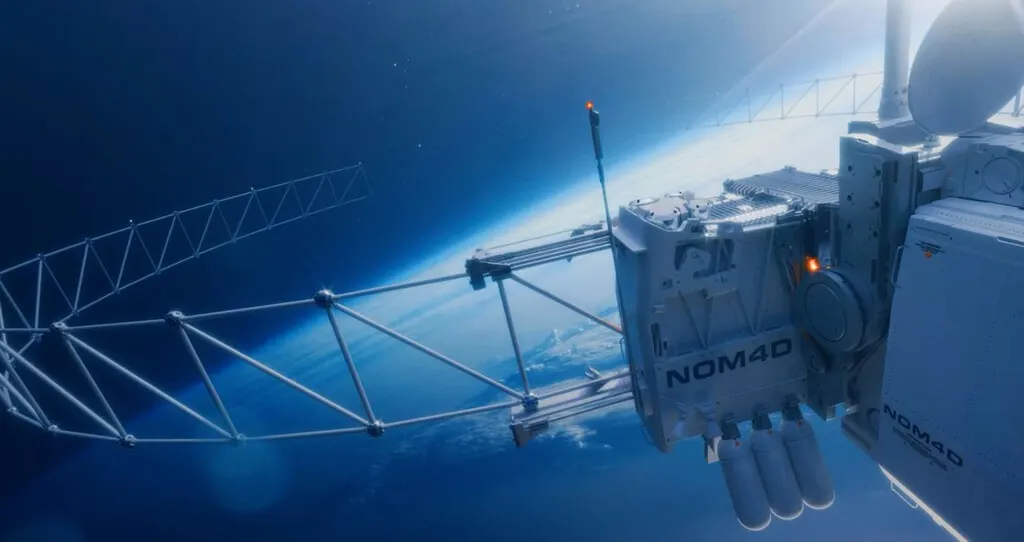
ASTRA is a gantry robot that moves in straight lines along three perpendicular axes. It occupies one cubic metre and carries a robotic arm and a motorised dispenser of building materials. It launched on 30 March 2026 aboard Momentus' Vigoride 7 vehicle, on a SpaceX rocket. After commissioning, it began assembling structural tubes and joints into repeating units called bays, which form the truss that becomes the final device.
What it built
The antenna is a test article, not a functional one. ASTRA flew with two modules already assembled and only had to build the third. The result uses composite-fibre tubes, aluminium connectors and a reflective Kapton film, a durable material common on spacecraft.
A minor incident delayed the work, so the antenna will not be fully completed before the mission ends in December. Even so, the team considers the approach proven, as more time would allow it to finish.
Caltech scientists controlled the robot from Earth with minimal intervention, using seven or eight communication windows a day of about 15 minutes each. A twin unit in the laboratory helped them troubleshoot problems.
Part of a DARPA programme
ASTRA belongs to DARPA's Novel Orbital and Moon Manufacturing, Materials, and Mass-efficient Design (NOM4D) programme. It also includes a laser metal-bending project from the University of Florida and a University of Illinois Urbana-Champaign experiment, planned on a module attached to the International Space Station, on hardening carbon tubes in space. Neither has launched yet, so how well they would complement ASTRA remains to be seen.
Apps worth a look
SUMO: the number puzzleTap the right tiles, add them up, hit the target. Easy to learn, hard to master. Free, for all ages.
Dialo: learn languages by speakingTalk to an AI conversation partner; every sentence comes back corrected and explained in your language. 9 languages, A1 to C2.
ediviewer: read EDI files like documentsOpen EDIFACT and X12 messages, see every segment explained, convert to JSON/XML, export PDF and Excel. Runs locally, no upload.
giftdetect: the right gift in minutesPick who it is for, the occasion and their personality. The search engine reads product descriptions from local shops and ranks what fits. Free, no sign-up.
More from this day
See all →
Anthropic Earned Up to $2.3B From Claude Users Later Banned

Yandex Cloud Recovers 97% of Customer Data After Attacks

Rutube Launches Rutube Ads, Its Own Video Ad Platform

EU Digital Fairness Act Targets Dark Patterns and AI Shopping Agents
More in: Space
See all →
NASA's PROMISE Rover Will Run on Nuclear Power at Moon's South Pole

Starlink Mini 2 Adds Swappable Battery for 4.5 Hours Off-Grid

Bureau 1440 Tests Satellite Terminal on Nuclear Icebreaker Ural