Brainbot nanorobot uses infrared light to carry cancer drugs to the brain
A tadpole-shaped nanorobot called Brainbot pops its cork under infrared light and pushes itself through blood vessel walls. In mice, 5.2 times more cancer drug reached the brain.
 SUMO· the number puzzle
 Dialo· learn languages by speaking
 ediviewer· read EDI files like documents
 giftdetect· the right gift in minutes
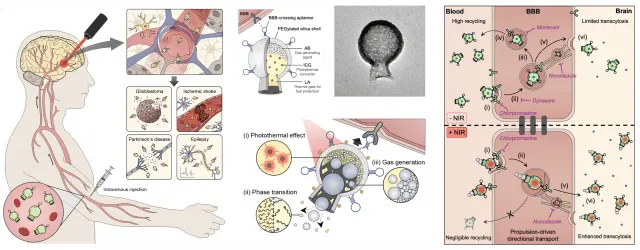
Brainbot is a nanorobot shaped like a tadpole, and it moves by letting off gas when light hits it. In mouse tests it delivered 5.2 times more cancer drug to brain tissue than the same robots left in the dark.
Researchers at UNIST in South Korea, led by Professor Joo Jin-myung of the Department of Biomedical Engineering, built it together with a team under Professor Wei Gao at Caltech in the US. UNIST announced the work on the 29th.
How does the Brainbot nanorobot work?
Each Brainbot is 250 nanometres long. Inside, it carries a fuel and a material that absorbs light. The opening is sealed with a plug that melts when heated.
When near-infrared light is shone on it from outside, the light-absorbing material heats up and the plug melts. The fuel breaks down and releases gas, which propels the robot. On its surface sit the cancer drug and an aptamer, a molecule that sticks to the cells lining blood vessels. That helps the robot get through the vessel wall and on towards the tumour.
What did the mouse experiments show?
The team attached the cancer drug doxorubicin to Brainbots and injected them into the veins of mice. After near-infrared light was applied from outside, the amount of drug in brain tissue was 5.2 times higher than in mice given Brainbots without light.
Survival also improved in mice with brain tumours. At day 50, every animal in the control group and in the drug-only group had died. In the group given drug-loaded Brainbots plus infrared light, 3 of 6 mice were still alive.
Will it work in people?
Not yet known. Professor Joo says clinical use needs more checking. A mouse skull is thin, so near-infrared light passes through fairly easily, while conditions in humans differ. Long-term safety after repeated doses also still has to be tested.
If it holds up, he expects the approach could carry other things that struggle to reach the brain, such as protein and gene therapies. It could then be applied to Alzheimer's disease, Parkinson's disease and epilepsy.
Apps worth a look
SUMO: the number puzzleTap the right tiles, add them up, hit the target. Easy to learn, hard to master. Free, for all ages.
Dialo: learn languages by speakingTalk to an AI conversation partner; every sentence comes back corrected and explained in your language. 9 languages, A1 to C2.
ediviewer: read EDI files like documentsOpen EDIFACT and X12 messages, see every segment explained, convert to JSON/XML, export PDF and Excel. Runs locally, no upload.
giftdetect: the right gift in minutesPick who it is for, the occasion and their personality. The search engine reads product descriptions from local shops and ranks what fits. Free, no sign-up.
More from this day
See all →
Meta smart glasses ban: pools, schools and venues push back
Will AI replace lawyers and accountants? Korean firms say no

NASA's green laser under the aurora in Svalbard, explained