AT2025abao: astronomers watched a giant star swallow its companion
Astronomers caught a star in Andromeda eating its smaller partner, and because they were already watching, they saw the build-up as well as the flash.
 SUMO· the number puzzle
 Dialo· learn languages by speaking
 ediviewer· read EDI files like documents
 giftdetect· the right gift in minutes
Stars merging is usually something astronomers reconstruct after the fact. This time they had pictures from before the crash. The object is called AT2025abao, it sits in the Andromeda Galaxy, and it appears to be a giant star that swallowed its smaller companion.
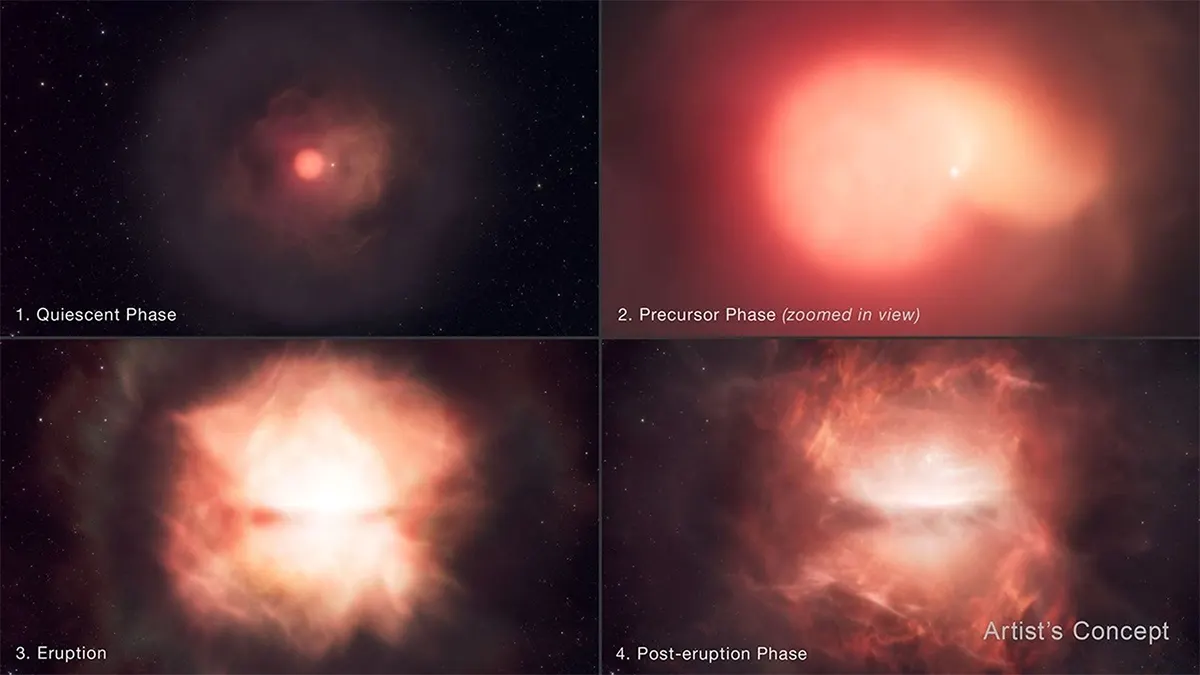
The story started in 2023, when Viraj Karambelkar and Kishalay De independently noticed a source in Andromeda that kept getting brighter. Old digitised photos from the Palomar Observatory Sky Survey showed it had been fairly stable for about 30 years, then began brightening around 2019. The star weighed roughly seven Suns. In 2025, before the finale, the team suggested it was a red giant with an unseen companion.
On 17 October 2025, Japanese amateur astronomer Koichi Itagaki spotted a bright flare in Andromeda. Follow-up observations with several telescopes, including the Zwicky Transient Facility, Palomar and Keck, pointed to a luminous red nova. That is not an ordinary nova and not a supernova. It is what happens when two stars merge.
What is a common envelope, and what happened to Small Bao?
Many stars live in pairs. When one swells into a giant, its partner can end up inside its thin outer layers. This is called a common envelope. It is not like a whale swallowing a stone: the gas is extremely diffuse, so the smaller star keeps orbiting, but it loses orbital energy and spirals inward.
The researchers nicknamed the pair Big Bao and Small Bao. Big Bao had about seven solar masses and was around 18,000 times brighter than its partner. Small Bao weighed about 0.7 solar masses. In July 2025 the SPHEREx space telescope happened to observe the object. It showed Big Bao still bright in infrared while fading in visible light, a sign of cooling and of more gas and dust being thrown out.
Small Bao is thought to have covered the last stretch of its spiral in fewer than 10 orbits, then hit Big Bao's core. Ejected material initially travelled at about 800 km/s, roughly 2.9 million km/h, then slowed to about 150 km/s when it ploughed into the surrounding gas. That collision powered the flare. About 10 percent of the red giant's envelope was blown away.
Astrophysicists use common envelopes to explain very tight pairs of stars, but the process is hard to catch in the act. Because AT2025abao was monitored before the outburst, it gives a rare observational look at it.
Apps worth a look
SUMO: the number puzzleTap the right tiles, add them up, hit the target. Easy to learn, hard to master. Free, for all ages.
Dialo: learn languages by speakingTalk to an AI conversation partner; every sentence comes back corrected and explained in your language. 9 languages, A1 to C2.
ediviewer: read EDI files like documentsOpen EDIFACT and X12 messages, see every segment explained, convert to JSON/XML, export PDF and Excel. Runs locally, no upload.
giftdetect: the right gift in minutesPick who it is for, the occasion and their personality. The search engine reads product descriptions from local shops and ranks what fits. Free, no sign-up.
More from this day
See all →
Unknown device in your Google account? 5 steps to lock it down

X scheduled posts now work on Android, up to 18 months ahead

Do game streams on YouTube and Twitch hurt sales? Japan weighs in
XL Office: a full office suite for the 8-bit Atari, in 64 KB
More in: Science
See all →
Cerdolí: the Vietnamese pig hybrid now roaming Spain's countryside

Rice University heat Q-switching gives 5x thermal power burst

Fugaku supercomputer stays 9th as China's LineShine takes No. 1