Xreal Aura Launches as First Android XR Glasses, Not in Europe Yet
Xreal Aura, the first Android XR smart glasses, are on sale in the US, Canada and South Korea from $1,279. Europe, Poland included, has to wait.
Xreal has started selling the Aura, the first augmented reality glasses running Android XR. Availability is limited for now to the United States, Canada and South Korea, so European buyers will have to wait.
The glasses come in two versions: 12 GB RAM with 256 GB storage for $1,279, and 16 GB with 512 GB for $1,499. Both prices exclude tax. In June, Xreal said the glasses would reach Europe "soon" after the first markets, and Poland was on the list of countries it revealed at the time.
A headset-class device in a glasses frame
Until now, the flagship Android XR product was the large, heavy Galaxy XR headset. A year later, Xreal and Google have fitted comparable capabilities into glasses with an external compute module. Unlike Apple Vision Pro or Galaxy XR, the Aura does not rely on camera passthrough. It uses transparent lenses, so users see their surroundings directly while digital windows and 3D elements are overlaid on their view.
The glasses weigh only 95 grams because the hardware is split. A cable connects the frames to a smartphone-like module weighing 265 grams, which houses the Snapdragon Reality Elite chip, a 4455 mAh battery and a touchpad. The frames hold two Sony Micro-OLED displays at 1920 × 1200 pixels per eye with a 70-degree field of view, and electrochromic lenses with adjustable tinting. An Xreal X1S spatial co-processor handles sensor data, hand tracking and six-degrees-of-freedom positioning with latency of about 3 ms.
Gemini and productivity
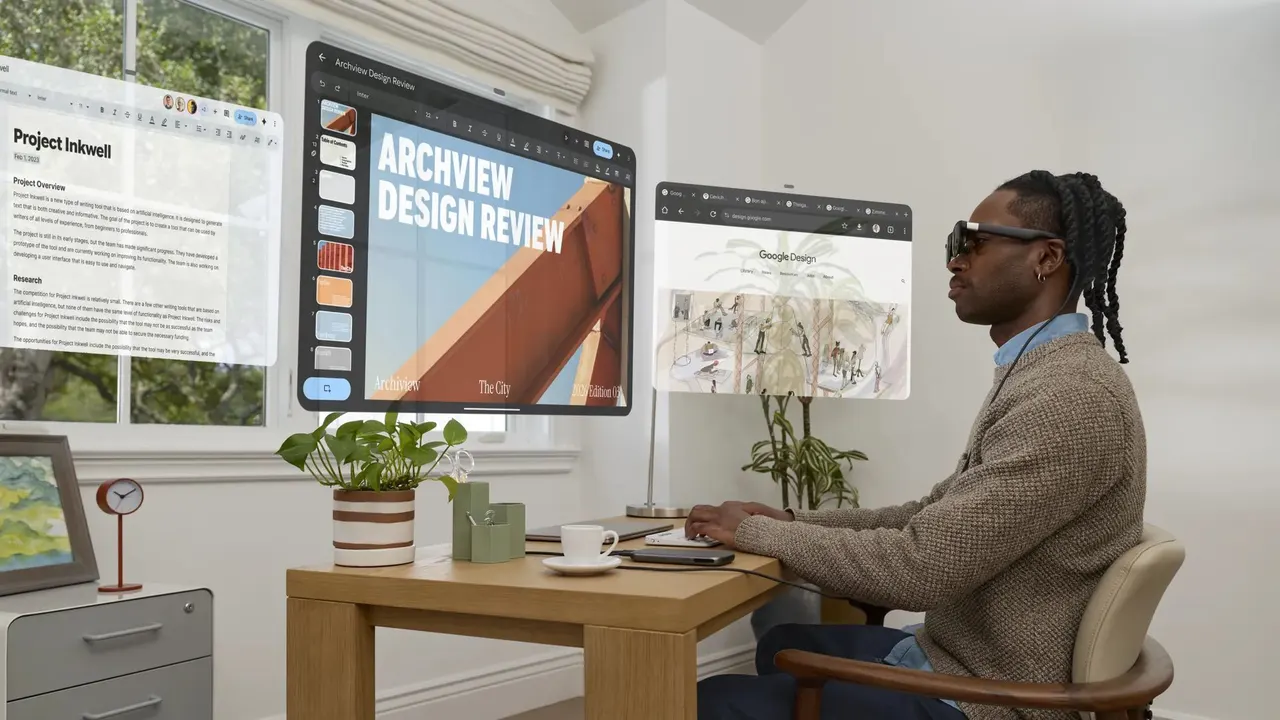
Android XR gives access to Google Play, including ordinary 2D apps and more than 150 titles built for 3D space. The Gemini assistant uses the external cameras to analyze both virtual desktops and the real environment, identifying objects in a room, helping organize open windows and answering questions about what the user sees.
Productivity is the main pitch: users can place several virtual monitors around their head and control them with hand gestures, voice, the touchpad with fingerprint reader, or a Bluetooth keyboard and mouse. A DisplayPort-in connection also lets the glasses link to a laptop over USB-C to show a private virtual screen.
More from this day
See all →
GEX Pure Pet Fur Sweeper Collects Cat Hair Around the Clock
Arrowspace S1 Smart Screwdriver Uses AI to Pick the Right Bit

Voyager 1 Gets Years More Science After Risky Big Bang Fix