Xiaomi humanoid robots work an eight-hour shift in its EV factory
Two Xiaomi humanoid robots sorted car parts for a full eight-hour shift, says the company. The video leaves out how often a human stepped in.
 SUMO· the number puzzle
 Dialo· learn languages by speaking
 ediviewer· read EDI files like documents
 giftdetect· the right gift in minutes
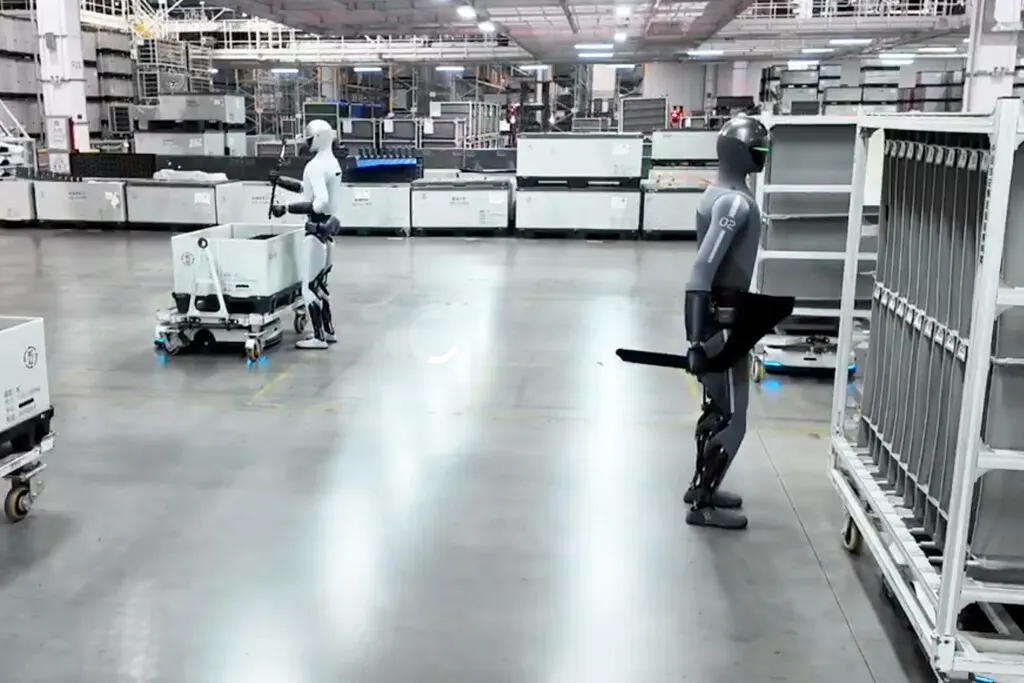
Two Xiaomi humanoid robots worked a full eight-hour shift on the line of the company's electric car factory, sorting trim pieces for the center console. At least, that's what Xiaomi says in a video it posted on X on 3 November 2026, the same day it collected two awards at the World Internet Conference in Wuzhen.
The footage shows the robots lifting parts out of bins and placing them into slots on shelves. A running timer sits on screen, along with labels marking the clip as autonomous and sped up 100 times. According to Xiaomi, the robots covered the station's whole daily output, talked to the line's control system, and spotted and fixed their own mistakes.
How autonomous were the Xiaomi humanoid robots?
That's the open question. Xiaomi hasn't said how many parts were sorted, what the success rate was over the eight hours, or how many times a person had to step in. It also didn't explain the battery situation. The video offers a clue: according to Chinese outlet CLS, the robots stopped to charge twice, at 3 hours 2 minutes and 6 hours 3 minutes, and one label reads "charging".
A moment around 1:37 stands out. A humanoid torso on a wheeled base comes over to help the two legged robots and, per CLS, picks up a part one of them dropped. Autonomous mobile robots, the wheeled carriers that have long hauled material around car plants, also move the bins.
Why the word "autonomous" deserves scrutiny
In robot videos it can mean almost anything. Tesla's Optimus robots at the 2024 We, Robot event were partly remote-controlled by people, which Tesla admitted only afterwards. In early December 2025, an Optimus fell during a demo in Miami, with its hands going to its head like a teleoperator pulling off a VR headset.
In fairness, Xiaomi has published success rates and cycle times before. In March its humanoids worked as "interns" at the Beijing factory, fitting self-tapping nuts with a 90.2% success rate over three hours, enough for that station's 76-second cycle. In July it claimed 98% and added two harder stations, including this part sorting. Lei Jun, Xiaomi's CEO, said in late 2025 that humanoids would be deployed at scale in its factories within five years.
If the eight hours were truly autonomous, it's one of the most impressive humanoid demos so far. Tesla, for its part, doesn't expect to deliver Optimus to outside customers until around the end of 2027.
Apps worth a look
SUMO: the number puzzleTap the right tiles, add them up, hit the target. Easy to learn, hard to master. Free, for all ages.
Dialo: learn languages by speakingTalk to an AI conversation partner; every sentence comes back corrected and explained in your language. 9 languages, A1 to C2.
ediviewer: read EDI files like documentsOpen EDIFACT and X12 messages, see every segment explained, convert to JSON/XML, export PDF and Excel. Runs locally, no upload.
giftdetect: the right gift in minutesPick who it is for, the occasion and their personality. The search engine reads product descriptions from local shops and ranks what fits. Free, no sign-up.
More from this day
See all →
Steam FPS data: Valve starts collecting frame rates from games

HMD 235 4G (2nd edition): a 75 euro phone with Snake and USB-C
Tiny 2.1: an AI language model that runs on a 486 from a floppy