Welopō‘ai: a triple star system 27.6 light-years away that shouldn't exist
Astronomers found a triple system with a red dwarf and two white dwarfs just 27.6 light-years away. One of the researchers says it shouldn't exist.
 SUMO· the number puzzle
 Dialo· learn languages by speaking
 ediviewer· read EDI files like documents
 giftdetect· the right gift in minutes
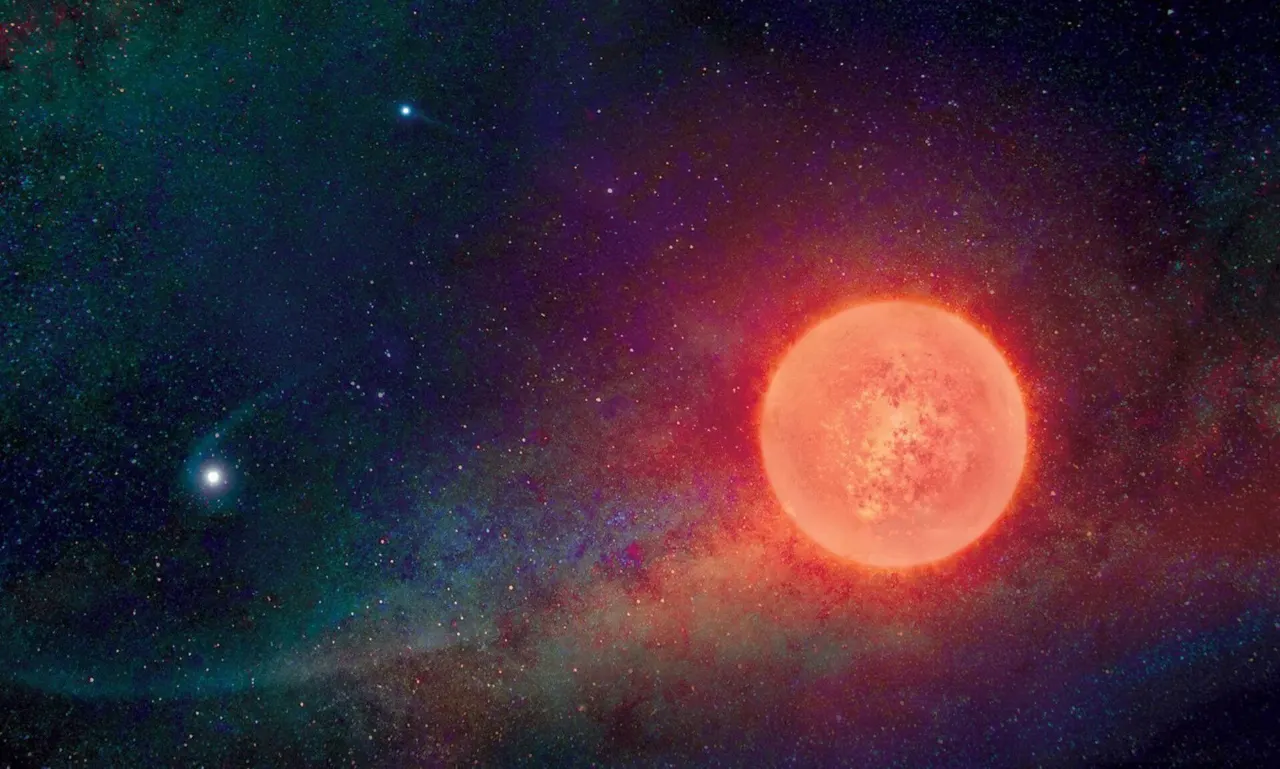
Welopō‘ai is a triple star system only 27.6 light-years from Earth, and the astronomer who helped find it says flatly that it "should not exist". It pairs a red dwarf with two white dwarfs, a combination with no known twin within 100 light-years of the Sun.
A team at the Université de Montréal stumbled on it while hunting for exoplanets. They were using the SPIRou spectrograph on the Canada-France-Hawai'i Telescope to track the red dwarf TYC 3980-1081-1. Its velocity kept wobbling in a way that didn't match the signature of a planet.
Further analysis revealed a very faint white dwarf sitting about 0.6 arcseconds from the red dwarf on the sky, and much dimmer than it. Follow-up observations with the Gemini North telescope confirmed it belongs to the system. This white dwarf has about 0.618 times the mass of the Sun, which makes it one of the most precisely "weighed" white dwarfs within 65 light-years. The red dwarf comes in at 0.419 solar masses, and the inner pair orbit each other every 9.8 years. The third member is a second white dwarf, already known to astronomers, which circles roughly 124 astronomical units away from the inner pair.
Why shouldn't Welopō‘ai exist?
A white dwarf is the dense, fading core of a star that has run out of fuel. The inner one must once have swollen into a giant, yet the red dwarf next to it survived. Professor Patrick Dufour of the Université de Montréal put it bluntly: "We have no clear explanation of how it formed. That is a question we will want to answer in further studies."
What happens next
The team also noticed a possible excess of infrared light around the inner white dwarf. That could point to a dust disc, but more measurements are needed. The James Webb Space Telescope and data from the Gaia satellite could help check it.
Dr. Étienne Artigau said finds like this show that complex and unexpected star systems exist close to the Sun. The results were published in Astronomy & Astrophysics.
Apps worth a look
SUMO: the number puzzleTap the right tiles, add them up, hit the target. Easy to learn, hard to master. Free, for all ages.
Dialo: learn languages by speakingTalk to an AI conversation partner; every sentence comes back corrected and explained in your language. 9 languages, A1 to C2.
ediviewer: read EDI files like documentsOpen EDIFACT and X12 messages, see every segment explained, convert to JSON/XML, export PDF and Excel. Runs locally, no upload.
giftdetect: the right gift in minutesPick who it is for, the occasion and their personality. The search engine reads product descriptions from local shops and ranks what fits. Free, no sign-up.
More from this day
See all →
Google's Mirror Dimension: a fake internet built for AI agents

mObywatel down this Saturday night: 3-hour maintenance window

Samsung Auto Blocker can't be switched off during a call

Polemos Industries: a 16-year-old's AI missile startup joins Y Combinator
More in: Science
See all →
Dark periodic table: a new idea for what dark matter is made of

Prickly pear cacti produce electric voltage, like living solar panels

Diamond hit at Mach 8 turns to graphite in microseconds