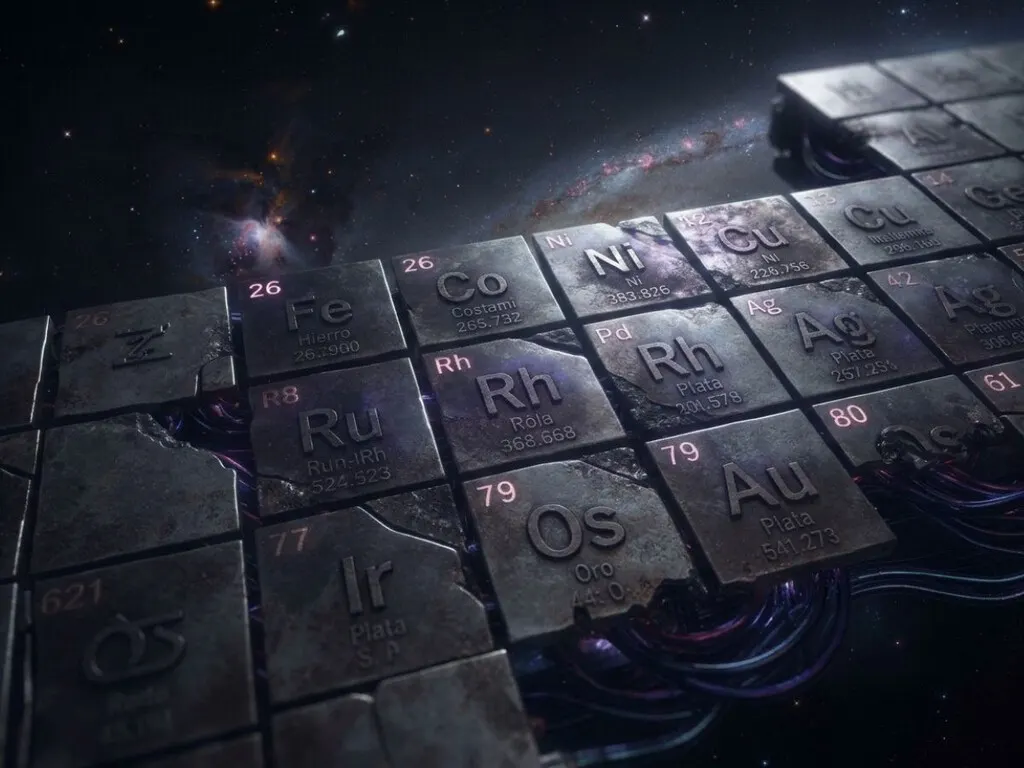
Dark periodic table: a new idea for what dark matter is made of
Dark matter outweighs normal matter about five to one. A team in the US and Canada says that ratio hints at a whole dark periodic table, with dark stars.
 SUMO· the number puzzle
 Dialo· learn languages by speaking
 ediviewer· read EDI files like documents
 giftdetect· the right gift in minutes
Why is there roughly five times more dark matter than ordinary matter? A team of scientists in the United States and Canada thinks the answer is a dark periodic table: a set of dark elements built from particles much like our own.
Dark matter is the invisible stuff whose gravity makes galaxies spin faster than visible matter can explain and bends light more than expected. Nobody has identified it. Most hypotheses point to one unknown particle, such as WIMPs or axions. This team argues that makes little sense. If dark matter were a single, completely different kind of particle, you would not expect its amount to land so close to that of normal matter. Five to one is a small gap. The researchers compare it to rolling a die with a million faces and getting a number from 1 to 6.
Their study has not yet been peer reviewed.
What is the dark periodic table?
The idea is that dark matter has its own versions of protons, neutrons and electrons, slightly different from ours. In normal matter, the neutron can decay outside a nucleus. In the dark version, the neutron would be very stable, and it would be about five times heavier than a normal proton. If dark neutrons and normal protons are about equally numerous, the dark side weighs five times more.
These particles could build atoms and molecules. Dark hydrogen would be unstable, because the proton would capture the electron and turn into a neutron. Dark deuterium would be stable. By the team's calculations, dark helium, lithium, beryllium, boron and even carbon could form. Dark stars would exist too, but our telescopes could not see their light.
Can the dark matter idea be tested?
The researchers say yes, by hunting for dark acoustic oscillations (DAO). These would be the counterpart of baryon acoustic oscillations (BAO), frozen imprints of waves that crossed the dense plasma of matter and light in the early universe. If dark matter behaved like this, it would carry its own imprints, visible as patterns in how it is distributed. Gravitational lensing and other mapping techniques could look for them.
For now it is a peculiar hypothesis. But the dark matter puzzle is unlikely to crack without leaving the usual path, and the DAO give the idea something concrete to check.
Apps worth a look
SUMO: the number puzzleTap the right tiles, add them up, hit the target. Easy to learn, hard to master. Free, for all ages.
Dialo: learn languages by speakingTalk to an AI conversation partner; every sentence comes back corrected and explained in your language. 9 languages, A1 to C2.
ediviewer: read EDI files like documentsOpen EDIFACT and X12 messages, see every segment explained, convert to JSON/XML, export PDF and Excel. Runs locally, no upload.
giftdetect: the right gift in minutesPick who it is for, the occasion and their personality. The search engine reads product descriptions from local shops and ranks what fits. Free, no sign-up.
More from this day
See all →
Welopō‘ai: a triple star system 27.6 light-years away that shouldn't exist

Google's Mirror Dimension: a fake internet built for AI agents

mObywatel down this Saturday night: 3-hour maintenance window