Webb's Little Red Dots may hide primordial black holes
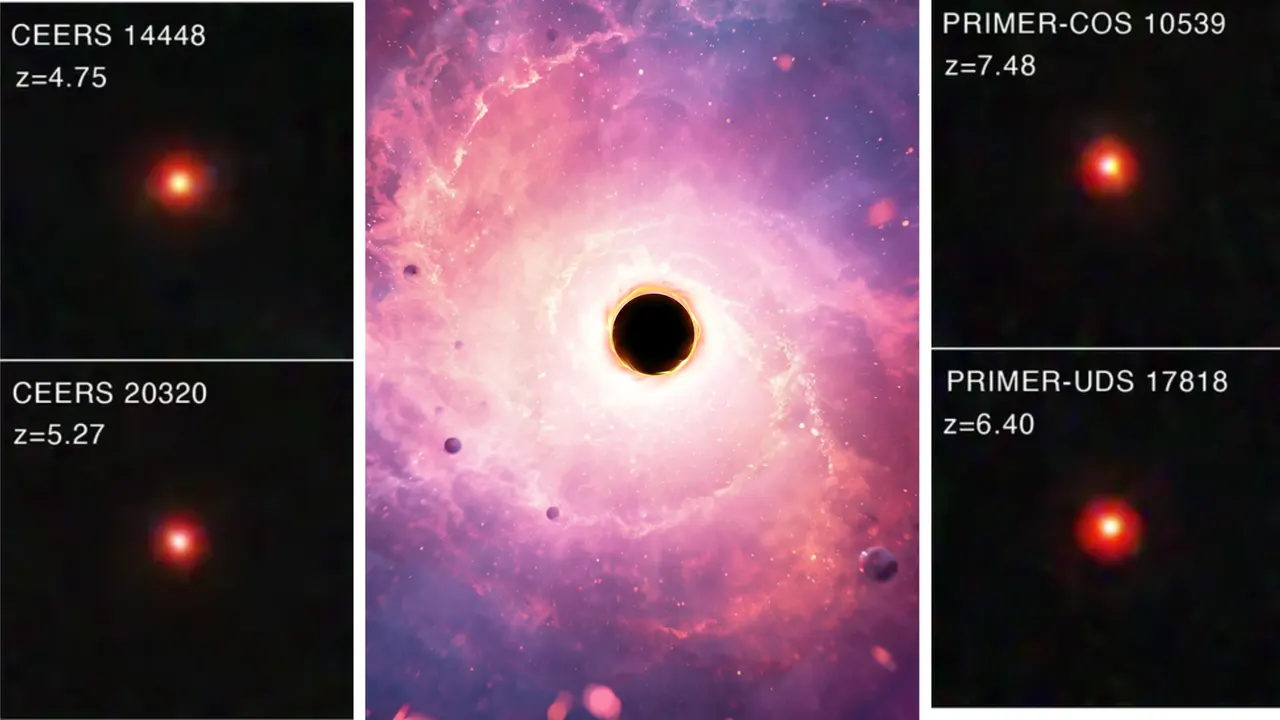
New modeling of a James Webb Space Telescope target, QSO1, suggests Little Red Dots could host primordial black holes born just after the Big Bang.
 SUMO· the number puzzle
 Dialo· learn languages by speaking
 ediviewer· read EDI files like documents
 giftdetect· the right gift in minutes
Astronomers at Johns Hopkins University say the James Webb Space Telescope's enigmatic Little Red Dots could include primordial black holes, objects born in the first moments after the Big Bang rather than from collapsing stars. The study was published in June in the journal Physical Review Letters.
Little Red Dots are compact cosmic objects that JWST has found in the early universe and that seemingly vanish before the cosmos is two billion years old. The team tested whether one of them, Abell 2744-QSO1 (QSO1), could host a primordial black hole.
Why QSO1
QSO1 lies about 13.1 billion light-years away and is seen as it was just 700 million years after the Big Bang. It is almost entirely made of hydrogen and helium, the universe's first elements, which makes it potentially more pristine than other Little Red Dots.
Primordial black holes were first proposed by Stephen Hawking in the 1970s, but no hard evidence has emerged. A key problem is telling them apart from astrophysical black holes formed when massive stars collapse. "Little Red Dots could surround astrophysical black holes, and most probably many of them do, but they could also be primordial black holes, if primordial black holes exist," said Valerio De Luca.
What the models show
The researchers modeled how a Little Red Dot like QSO1 could arise from a primordial black hole, while respecting cosmological limits on how many such black holes can exist overall and within a given cluster. Of three scenarios considered, the most likely was a smaller primordial black hole that fed on surrounding gas and energy until it reached QSO1's size.
"The door was open on this theory," said Loris Del Grosso. "We've now cracked it open a little farther by showing some scenarios are more likely than others."
The team plans to examine the roughly 100 other Little Red Dots seen by JWST to estimate how many might have begun as primordial black holes. If they do exist, De Luca said, something must have created them in the early universe, which "would be a groundbreaking discovery in physics."
Apps worth a look
SUMO: the number puzzleTap the right tiles, add them up, hit the target. Easy to learn, hard to master. Free, for all ages.
Dialo: learn languages by speakingTalk to an AI conversation partner; every sentence comes back corrected and explained in your language. 9 languages, A1 to C2.
ediviewer: read EDI files like documentsOpen EDIFACT and X12 messages, see every segment explained, convert to JSON/XML, export PDF and Excel. Runs locally, no upload.
giftdetect: the right gift in minutesPick who it is for, the occasion and their personality. The search engine reads product descriptions from local shops and ranks what fits. Free, no sign-up.
More from this day
See all →
OpenAI tests ChatGPT analytics hub for businesses in beta
Espressif ESP32-S31 now runs regular Linux natively
NHTSA Probes Whether Waymo's School Bus Recall Actually Worked

Cisco adds Anthropic's Claude Mythos to AI Defense for red teaming
More in: Space
See all →
Marble Imaging raises €6M to build German VHR satellite fleet
Russia's Rassvet Starlink Rival Targets Full Launch in 2027

SWISSto12 and UNIVITY pass design review for 5G satellite antennas