SWE-CoWork: AI agents fully finish under 8% of office coding tasks
In a simulated 26-person software company, the best AI agent fully completed just 7.92% of tasks. It passed about 63% of individual tests, though.
 SUMO· the number puzzle
 Dialo· learn languages by speaking
 ediviewer· read EDI files like documents
 giftdetect· the right gift in minutes
Put an AI agent in a virtual software company and ask it to do a programmer's job, and it mostly fails. That is the finding of SWE-CoWork, a new benchmark from researchers at TokenWave AI. The best model fully completed 7.92% of the tasks.
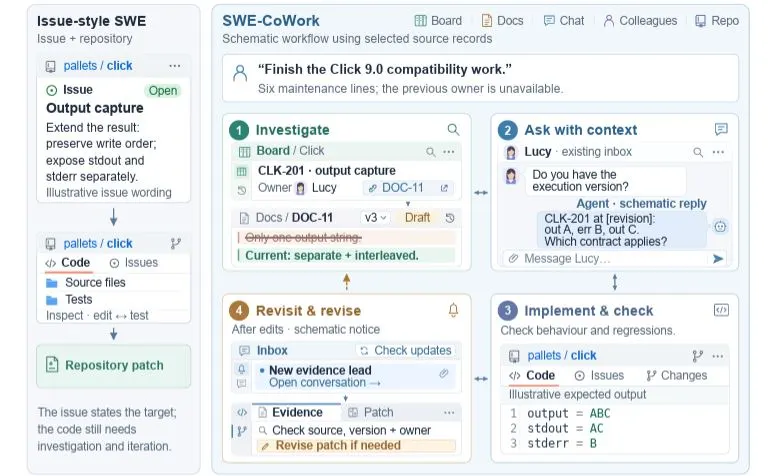
The benchmark tests more than coding. It also tests whether an agent can work with colleagues. The team built 101 tasks from real software projects, covering 11 programming languages and 12 areas of development. Each task came with its own virtual company of 26 employees, who had different roles and knew different amounts about the project.
The agent got only a short task description. From there it had to read documentation, chat history, change history and task boards, find the right colleagues, clarify requirements, write the code and check the result.
How did the AI agents score on SWE-CoWork?
Eleven models took part. OpenAI's GPT-6 Astra led with 7.92% of tasks fully completed, followed by Anthropic's Claude Opus 5.5 at 6.93%. The other nine managed 0.99% or less.
Partial credit looks much better. Claude Opus 5.5 passed 63.84% of the tests for new requirements and GPT-6 Astra passed 62.91%. But a task counted as done only if every requirement was met and nothing that already worked broke.
Where do the agents go wrong?
Not only in the code. Claude Opus 5.5 picked the right person to ask in 93% of first questions, yet ended up with only 64% of the requirements those colleagues held. In 153 of 450 cases it never went back to an open question, even though a median of 7.1 hours of its time budget remained.
Full instructions did not fix it. When GPT-6 Astra and Seed Evolving got everything up front, their pass rates on new requirements rose from 62.91% to 78.84% and from 39.09% to 55.76%. The number of fully finished tasks stayed the same.
Agents also overrated their own work. In Claude Opus 5.5's case, 31% of the requirements it marked as done failed their tests. Sometimes it declared a job finished while its own notes still listed open items.
The authors conclude that reliable autonomous development needs agents that track each requirement from the first question through implementation, testing and hand-off.
Separately, OpenAI is testing an "always on" mode for its Codex agent, which would keep working until it is explicitly put to sleep and plan follow-up tasks across sessions.
Apps worth a look
SUMO: the number puzzleTap the right tiles, add them up, hit the target. Easy to learn, hard to master. Free, for all ages.
Dialo: learn languages by speakingTalk to an AI conversation partner; every sentence comes back corrected and explained in your language. 9 languages, A1 to C2.
ediviewer: read EDI files like documentsOpen EDIFACT and X12 messages, see every segment explained, convert to JSON/XML, export PDF and Excel. Runs locally, no upload.
giftdetect: the right gift in minutesPick who it is for, the occasion and their personality. The search engine reads product descriptions from local shops and ranks what fits. Free, no sign-up.
More from this day
See all →
NASA's Swift Observatory burns up after 22 years of science
Anthropic's Siren test baits AI agents into escaping sandboxes

Russia's electronics tech fee: 746 rubles per laptop from December