Spain's Income Map: INE Atlas Shows Wealth Gaps Street by Street
An interactive map built on the INE's household income atlas covers 33,600 census sections and shows how sharply incomes differ between neighbouring streets in Spain.
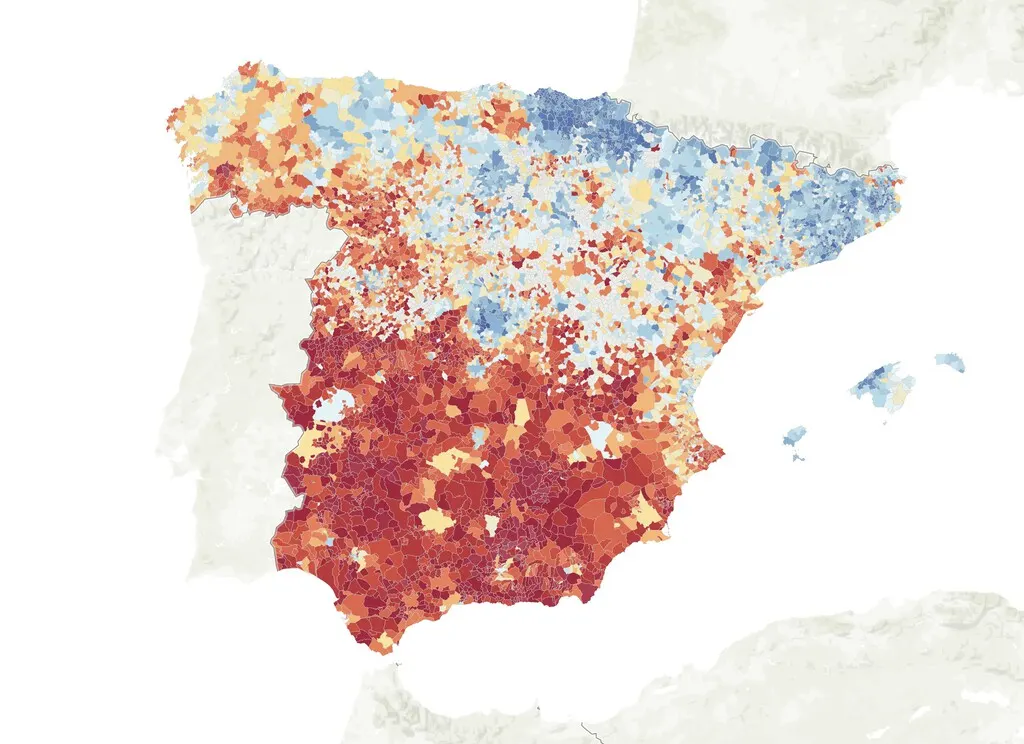
Type in your address and within seconds you can see whether the street next door earns twice as much as yours. Spanish media have turned the latest Household Income Distribution Atlas from the national statistics institute (INE) into a map of more than 33,600 census sections, each home to around 1,500 people.
The average net income per person rose 6.1% in 2024, to 15,948 euros. Behind that figure lies a wide gap. Among municipalities with more than 2,000 inhabitants, Pozuelo de Alarcón tops the table at 32,612 euros per resident, while Iznalloz (Granada) closes it at 9,153, a ratio of 3.56 to one. The three poorest municipalities, Iznalloz, El Palmar de Troya (Seville) and Albuñol (Granada), are all in Andalusia.
Cities split in different ways
Madrid divides into a wealthy north and a poorer south, and Seville into east and west, while in Valencia and Zaragoza the centre out-earns the periphery. According to one analysis, 36% of Madrid's sections sit in the richest national decile and only 7% in the poorest. Seville is more polarised, with 19% in the poorest decile and 16% in the richest. In Ceuta, 30.4% of sections are in the bottom 10%, yet more than one in five rank among the highest.
At postcode level, tax agency data again puts La Moraleja (Alcobendas) first, with an average of 235,556 euros gross per filer. At the other end, Torreblanca in Seville records 11,560 euros, roughly twenty times less.
What the map leaves out
The atlas relies only on income tax returns, so it excludes the informal economy, undeclared income and earnings channelled through shell companies. The INE also caps household figures between 20,000 and 167,076 euros. Between 2019 and 2024, income grew in nearly every section, but in one in five it failed to offset cumulative inflation of 18.8%.
Income is also not wealth. Tax agency figures show taxpayers with more than 30 million euros in assets rose from 471 in 2013 to 1,023. Meanwhile, 34.7% of Andalusia's population, about three million people, is at risk of poverty or exclusion, although that rate fell 0.9 points from 2024. The data cannot say how many poor people there are per rich one, but they point to an economy whose gains are shared unevenly.
Apps worth a look
 SUMO: the number puzzle
Tap the right tiles, add them up, hit the target. Easy to learn, hard to master. Free, for all ages.
 Dialo: learn languages by speaking
Talk to an AI conversation partner; every sentence comes back corrected and explained in your language. 9 languages, A1 to C2.
 ediviewer: read EDI files like documents
Open EDIFACT and X12 messages, see every segment explained, convert to JSON/XML, export PDF and Excel. Runs locally, no upload.
More from this day
See all →
HYBE Confirms Data Breach Hitting Former Staff and Partners

Ex-Korea Startup Forum chief Choi Sung-jin joins Cols Dynamics

Patternn Launches AI Agent for Law-Based Risk Assessment Review
Rakuten Securities: 362 Customer Records Possibly Leaked via NTT Data
More in: Business
See all →
T2 Turns MVNO Launches Into a Business Serving 25 Partners

SUSE to Cut One in Ten Jobs, Citing Automation and AI

Anthropic Targets $3.5 Billion From Japanese Investors in IPO