South Korea Eases Rules for Privately Funded Public Software
South Korea's science ministry will simplify eligibility reviews for privately funded software projects under 2 billion won and offer pre-screening of business plans.
South Korea's Ministry of Science and ICT is lowering the barrier to privately funded public software projects, aiming to keep pace with fast-moving technology such as artificial intelligence. Projects with construction costs under 2 billion won (about 20억 원) will get a simplified eligibility review, and applicants can have their business plans checked against requirements before formally applying.
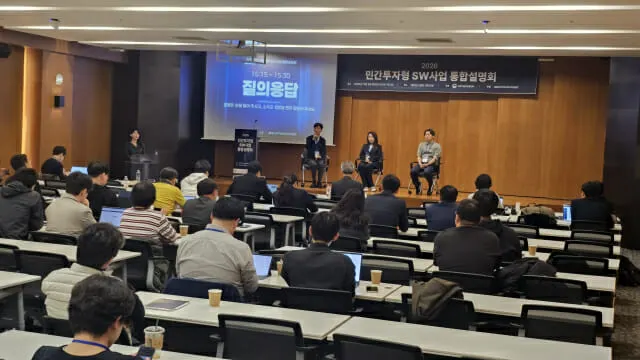
The ministry presented the main revisions to its "Private Investment Software Project Guide 3.0" on November 3 at the 2026 integrated briefing in Seoul's Jung District. It plans to collect feedback from the field and distribute the final guide next month.
How the model works
In these projects, a private company invests its own funds and technology up front to build a public information system, then recovers the investment during operation. The arrangement can extend from development through operation, maintenance and service upgrades.
There are two types. In the lease type, public agencies pay rent or similar fees. In the revenue type, costs are covered by user fees, advertising or other business income. Projects can start from a private proposal or be planned directly by the government.
Guide 3.0 spells out practical procedures for lease-type projects, including how agencies request funding, how performance evaluation committees operate, evaluation criteria, and how government payments vary with results. Standard implementation agreements and guidance on cost adjustments will also be updated.
Flexibility and examples
Lee Seok-jun, a senior official at the National Information Society Agency, said agreements and business plans can be changed after signing, for example because of technology upgrades. Changes go through consultation with the competent authority or ministry review to assess risk-sharing between public and private parties. Payback periods and returns are set in individual agreements, and feasibility reviews check how realistic the revenue forecasts are.
Two candidate projects were presented. Jeonnam-Gwangju's AI administration office outlined a unified public facility booking service funded by advertising, rewards and local product sales, with roughly 5 billion won in in-kind private investment and a pilot targeted for 2027. The Gwangju lifelong education agency proposed a lease-type platform that links learning records from universities and training bodies and certifies them with digital badges. Feasibility and profitability of both remain under review.
Apps worth a look
 SUMO: the number puzzle
Tap the right tiles, add them up, hit the target. Easy to learn, hard to master. Free, for all ages.
 Dialo: learn languages by speaking
Talk to an AI conversation partner; every sentence comes back corrected and explained in your language. 9 languages, A1 to C2.
 ediviewer: read EDI files like documents
Open EDIFACT and X12 messages, see every segment explained, convert to JSON/XML, export PDF and Excel. Runs locally, no upload.
More from this day
See all →Solgram raises over $1 million pre-seed for premium grocery
OpenAI Raises Bug Bounty Rewards to $172,000 in Security Push

Google: Videostrong Pre-Installed Malware on 1.3M Android Devices
Egypt Drafts Dedicated AI Law to Govern Use of the Technology
More in: Software
See all →
Google switches off Search in schools that reject its AI
Flangguage Launches CHATTER, an AI Tool for Speaking English

Nextcloud and Ionos launch open-source school platform