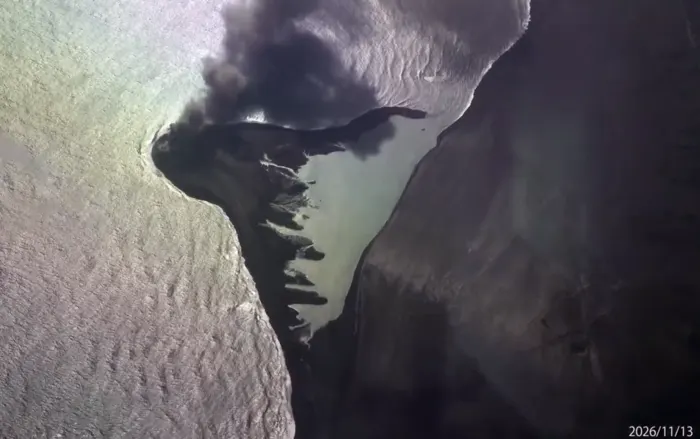
RV Falkor (too) finds a seamount roughly twice Burj Khalifa's height
A research ship stumbled on an undersea mountain that wasn't on any seabed map. Its estimated height is 1,591 to 2,681 metres, against the Burj Khalifa's 828.
 SUMO· the number puzzle
 Dialo· learn languages by speaking
 ediviewer· read EDI files like documents
 giftdetect· the right gift in minutes
The tallest building on Earth just got outclassed by something nobody had on a map. The research ship RV Falkor (too) has found a seamount, an underwater mountain, estimated at between 1,591 and 2,681 metres (5,220 to 8,796 feet). Dubai's Burj Khalifa is 828 metres (2,717 feet).
The peak was not in any seabed topography database. The crew came across it more or less by accident while studying gravity anomalies on the ocean floor. That work is basically a hunt for bumps on a map, and it paid off during the ship's first science expedition of the year in Chile. Jon Fulmer, a marine technician at the Schmidt Ocean Institute, said in a press release that the team found the big seamount while carrying on with the planned trip.\n\nSince 2012 the ship has turned up nine seamounts, hills and trenches in total.
Why does mapping the seafloor matter?
About 75 percent of the seabed is still unmapped, according to Jamie McMichael-Phillips, project director of Seabed 2030, an effort to map the whole seafloor by 2030. He says ocean maps are central to understanding the planet and to protecting it and managing it sustainably. By 2024, Falkor and Falkor (too) had mapped 580,000 square miles (about 1.5 million square kilometres) of seabed.
Seamounts and trenches are also homes for deep-sea life such as corals, sponges and anemones. Falkor (too) has filmed hydrothermal vents on underwater mountain ranges and some decidedly odd deep-sea animals.
Seabed surveys can also tell human history. In 2019 another research team published a stark map of craters left on the Pacific floor by nuclear tests at Bikini Atoll. Surveys off Peru have shown that the seabed needs roughly 50 years to recover from deep-sea mining carried out in the mid-20th century.
Apps worth a look
SUMO: the number puzzleTap the right tiles, add them up, hit the target. Easy to learn, hard to master. Free, for all ages.
Dialo: learn languages by speakingTalk to an AI conversation partner; every sentence comes back corrected and explained in your language. 9 languages, A1 to C2.
ediviewer: read EDI files like documentsOpen EDIFACT and X12 messages, see every segment explained, convert to JSON/XML, export PDF and Excel. Runs locally, no upload.
giftdetect: the right gift in minutesPick who it is for, the occasion and their personality. The search engine reads product descriptions from local shops and ranks what fits. Free, no sign-up.
More from this day
See all →Hugendubel, Tolino Cloud and eBook.de offline after cyberattack

YouTube app icons: 7 new designs, some retro, are in the works

PC repair job interview: the voltage switch trap he suggested

Google's new 3D emoji need 6GB RAM and 10GB storage, now explained
More in: Science
See all →
Superhabitable planets: why scientists want a better Earth

Brain implant users write first guidelines for BCI trials

Teen screen time and the brain: what a Finnish MRI study found