Riemann hypothesis proof claims: Claude vs a Stanford human
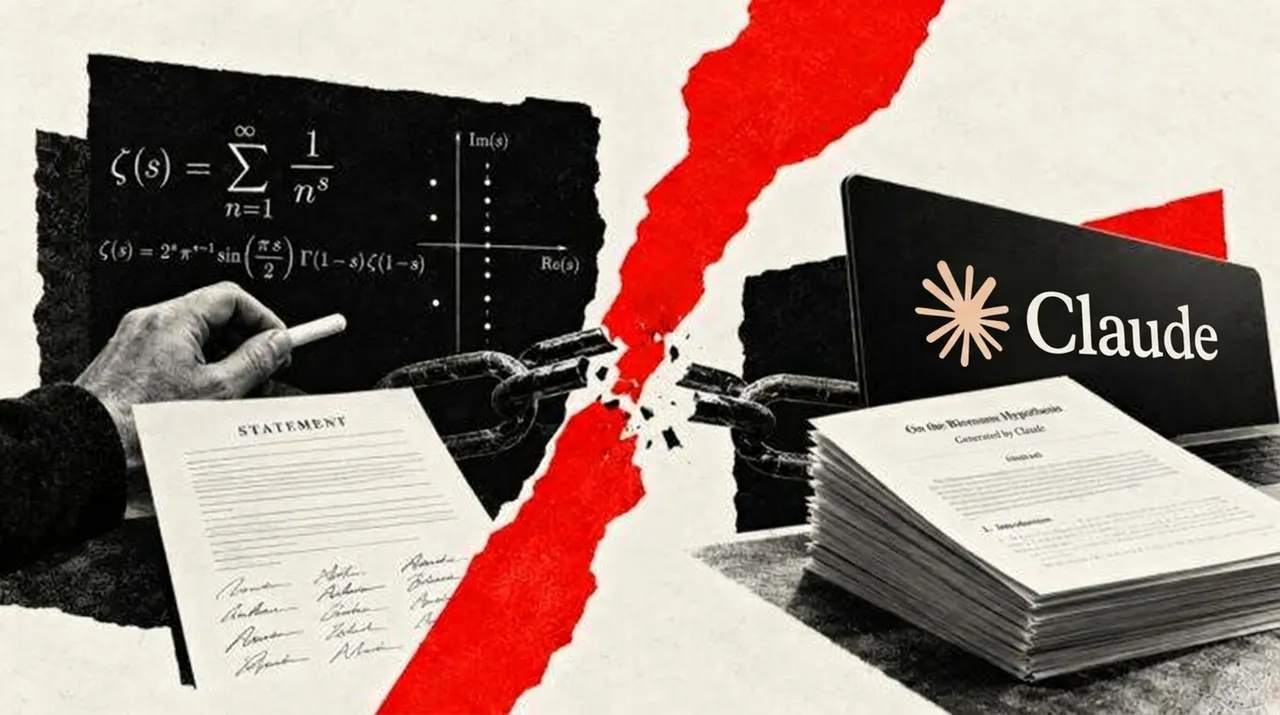
Two rival proofs of the Riemann hypothesis appeared on the same day. One was found with Anthropic's Claude, the other written by a Stanford researcher without any AI.
 SUMO· the number puzzle
 Dialo· learn languages by speaking
 ediviewer· read EDI files like documents
 giftdetect· the right gift in minutes
The Riemann hypothesis, one of the most famous unsolved problems in mathematics, suddenly has two claimed solutions. Both appeared on Friday 20 November, and one of them says loudly that no AI was involved.
Levent Alpöge, a mathematician at Anthropic, posted a four-page note on his personal website. He says that, "working with Claude", he proved the Riemann hypothesis and its generalised version. Hours later, Ravi Vakil, president of the American Mathematical Society and a Stanford professor, published on his blog the draft of a rival proof. He describes it as "entirely human, no AI".
Its author is Alessandro Masullo, a young Stanford mathematician. His text targets the generalised Riemann hypothesis and was reportedly written several months ago. Brian Conrad, a Stanford specialist who has been reading and commenting on Masullo's work for months, confirmed the details of Vakil's post to Scientific American. Conrad said the choice was between "two unappealing options": announce now, or stay quiet and publish later. Vakil writes that the original plan was to polish the text with Masullo before announcing it.
What is the Riemann hypothesis?
Bernhard Riemann posed it in 1859. It concerns how prime numbers are spread out, and it has resisted the best mathematicians for 167 years. It is one of the seven Millennium Problems of the Clay Mathematics Institute, which attaches a prize of one million dollars (about 860,000 euros) to it.
Has anyone proved it yet?
Not yet. Neither proof has been validated. If one survives scrutiny from specialists, it would be one of the biggest mathematical advances in decades. It would also vindicate the many papers that already assume the hypothesis is true.
For now, this is a race between a note and a draft, and the people who will decide are the experts who now have to read them line by line.
Apps worth a look
SUMO: the number puzzleTap the right tiles, add them up, hit the target. Easy to learn, hard to master. Free, for all ages.
Dialo: learn languages by speakingTalk to an AI conversation partner; every sentence comes back corrected and explained in your language. 9 languages, A1 to C2.
ediviewer: read EDI files like documentsOpen EDIFACT and X12 messages, see every segment explained, convert to JSON/XML, export PDF and Excel. Runs locally, no upload.
giftdetect: the right gift in minutesPick who it is for, the occasion and their personality. The search engine reads product descriptions from local shops and ranks what fits. Free, no sign-up.
More from this day
See all →Hugendubel, Tolino Cloud and eBook.de offline after cyberattack

YouTube app icons: 7 new designs, some retro, are in the works

PC repair job interview: the voltage switch trap he suggested

Google's new 3D emoji need 6GB RAM and 10GB storage, now explained
More in: Science
See all →
Superhabitable planets: why scientists want a better Earth
Brain implant users write first guidelines for BCI trials
Teen screen time and the brain: what a Finnish MRI study found