Quasar pair J1602+4228AB: two huge black holes, 900M years after Big Bang
Two black holes, one about 1.5 billion times the Sun's mass, seem to have grown huge when the universe was only 900 million years old. Nobody can yet say how.
 SUMO· the number puzzle
 Dialo· learn languages by speaking
 ediviewer· read EDI files like documents
 giftdetect· the right gift in minutes
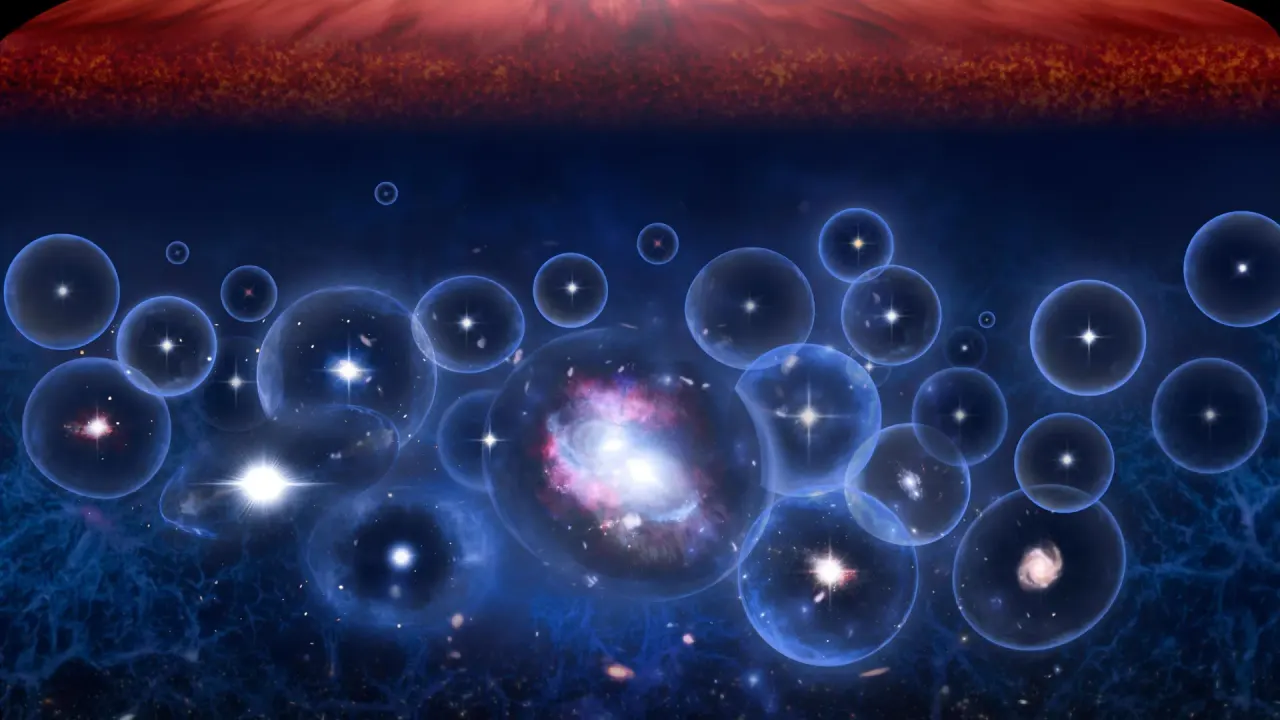
Astronomers have found what looks like a pair of quasars from just 900 million years after the Big Bang. Each one is powered by a black hole that is far bigger than it should be for such a young universe. Nobody has a settled explanation for how they grew so fast.
The system is called J1602+4228AB. It also has a Hawaiian name, Nāpōwawāʻenakaulua. It is only the third known quasar pair from the era of cosmic dawn, and the closest of them. The two black holes sit about 18,100 light-years apart, roughly a fifth of the width of the Milky Way. One is estimated at 1.5 billion solar masses, the other at about 400 million.
What is a quasar?
When galaxies collide or merge, huge amounts of gas and stars end up near their central black holes. Material falling in, a process called accretion, releases enormous energy. The glow can outshine every star in the host galaxy. Astronomers call these extremely bright objects quasars.
Is it really two quasars?
Not certain yet, which is why the authors call it a candidate. The other possibility is a single quasar seen twice, because gravity from a galaxy in front bends its light (gravitational lensing). A likely foreground galaxy does sit near one of the objects. But the two spectra differ, including the shape of their emission lines, which points to two separate light sources. The team currently favours a real physical pair and says more modelling is needed to rule out lensing.
How it was found
The discovery combined the James Webb Space Telescope with the Gemini North telescope on Mauna Kea in Hawaii. Webb's Aether survey, which targets the early universe, gathered near-infrared data on 200 quasars. While looking through it, astronomers noticed that the known quasar J1602+4228A seemed to have a companion. Follow-up with Gemini North's GNIRS spectrograph separated the two. The work was led by Silvia Onorato of NSF NOIRLab and appears in The Astrophysical Journal Letters.
How the system formed is unknown. The researchers suggest its odd properties could point to an exceptionally dense clump of matter in the early universe.
Apps worth a look
SUMO: the number puzzleTap the right tiles, add them up, hit the target. Easy to learn, hard to master. Free, for all ages.
Dialo: learn languages by speakingTalk to an AI conversation partner; every sentence comes back corrected and explained in your language. 9 languages, A1 to C2.
ediviewer: read EDI files like documentsOpen EDIFACT and X12 messages, see every segment explained, convert to JSON/XML, export PDF and Excel. Runs locally, no upload.
giftdetect: the right gift in minutesPick who it is for, the occasion and their personality. The search engine reads product descriptions from local shops and ranks what fits. Free, no sign-up.
More from this day
See all →
MacBook trackpad talks: NO SPEAKER turns a haptic motor into a voice

Keio ransomware attack may have exposed 10.6 million people's data

Nvidia driver 621.40 again claims to fix the SSD wear bug