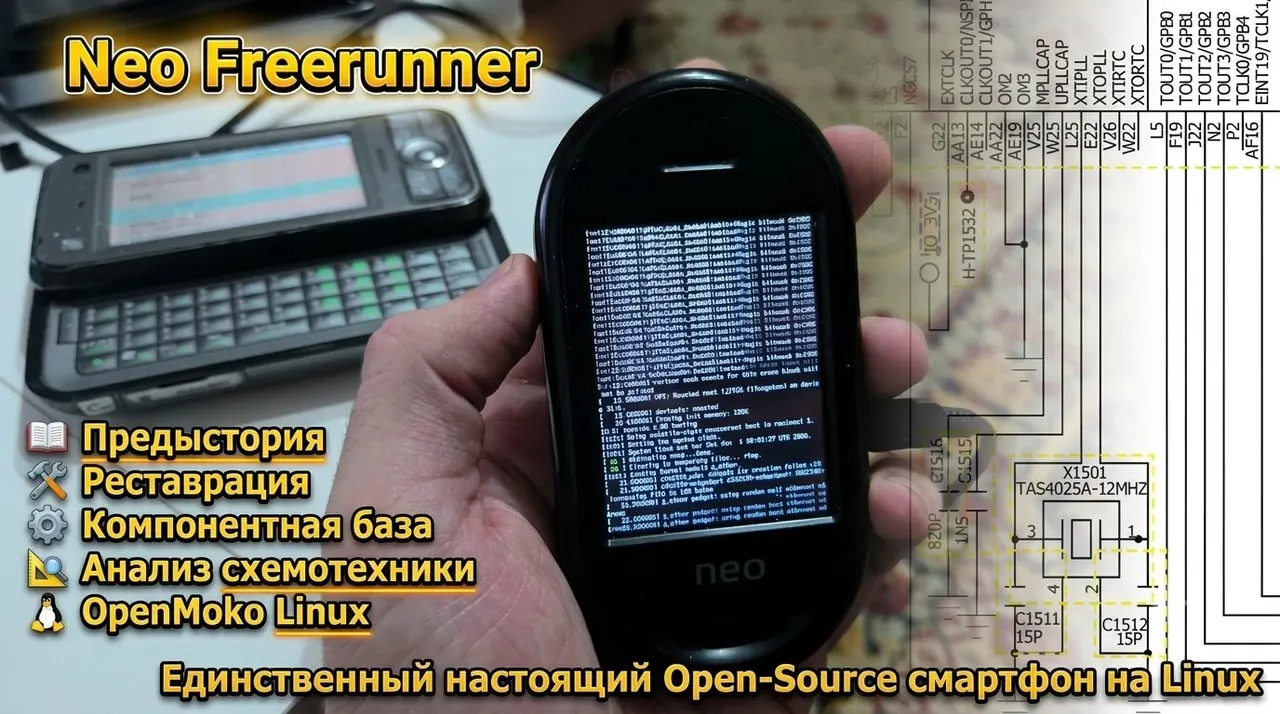
Neo FreeRunner: the open-hardware Linux phone, taken apart
The Neo FreeRunner was built so anyone could repair it at home, down to a Nokia battery from a corner shop. One owner revived a dead unit and mapped its hardware.
 SUMO· the number puzzle
 Dialo· learn languages by speaking
 ediviewer· read EDI files like documents
 giftdetect· the right gift in minutes
The Neo FreeRunner is a phone you can take apart with two screws and a fingernail, and its battery was the kind you could once buy at a grocery store. One enthusiast has now restored a dead unit and written up what is inside.
In 2006 a small R&D team at the Taiwanese company FIC started OpenMoko, a mobile platform meant to be open from top to bottom. It had a fully free Linux distribution based on Ångström, and hardware that any manufacturer could build and modify without licence fees. The first reference phone, the Neo 1973, came out in a run of about 3,000 and cost around $300. A year later, in 2008, came the FreeRunner, with an upgraded spec. Only about 10,000 were made, because the global financial crisis of 2008 wrecked FIC's plans.
What is inside the Neo 1973 and FreeRunner?
The Neo 1973 used a Samsung S3C2410 with one ARM920T core at up to 266 MHz, the same chip found in the Acer N35 and iPaq h1940 PDAs. It had 128 MB of SDRAM and 64 MB of NAND. For comparison, the $1,200 HTC Universal had just 64 MB of RAM. The screen was a 2.8-inch 640×480 resistive touch display, and a TI Calypso 2G modem, Bluetooth and GPS handled connectivity.
The FreeRunner is easy to open. Remove the back cover, undo two screws at the bottom, unclip the top panel. Above the display sits a full debug connector exposing I2C, UART, SPI and JTAG. There are also two LIS302DL accelerometers, one on each side of the board. The display, a Toppoly TD028TTEC11, is held by double-sided tape, and the author notes that a screen from the Glofiish X650 fits.
Why restore it now?
The author received the phone in 2022. The soft-touch coating had turned sticky and the resistive touchscreen had stopped working, a common fault with that panel type. He had wanted a real Linux phone since his school days around 2013, so he decided to repair it fully and document the circuitry.
He contrasts it with Nokia's N900, which ran open Maemo but relied on binary driver blobs and a closed PowerVR GPU. The FreeRunner, he argues, came much closer to being open hardware, and is far simpler to repair than a modern glued-together phone.
Apps worth a look
SUMO: the number puzzleTap the right tiles, add them up, hit the target. Easy to learn, hard to master. Free, for all ages.
Dialo: learn languages by speakingTalk to an AI conversation partner; every sentence comes back corrected and explained in your language. 9 languages, A1 to C2.
ediviewer: read EDI files like documentsOpen EDIFACT and X12 messages, see every segment explained, convert to JSON/XML, export PDF and Excel. Runs locally, no upload.
giftdetect: the right gift in minutesPick who it is for, the occasion and their personality. The search engine reads product descriptions from local shops and ranks what fits. Free, no sign-up.
More from this day
See all →
Quick Commander 4.00 for ZX Spectrum ships 20 years after its announcement

OpenAI countersues Apple over its unreleased AI device
Cockroach resistance: some roaches now refuse the bait
Why plane turbulence is getting more common, and why it hurts
More in: Hardware
See all →
Why your AirTag keeps beeping: the common reasons
Old console browsers: why none can run a modern Chrome
Home battery without solar panels: buy power at 3 cents, use it at 20