MIT insect robot weighs 1.29 grams and lands on a sunflower
A four-winged robot from MIT and Cornell carries its own sensors and chip at just 1.29 grams, lighter than a big paper clip. It still needs a cable and a joystick.
 SUMO· the number puzzle
 Dialo· learn languages by speaking
 ediviewer· read EDI files like documents
 giftdetect· the right gift in minutes
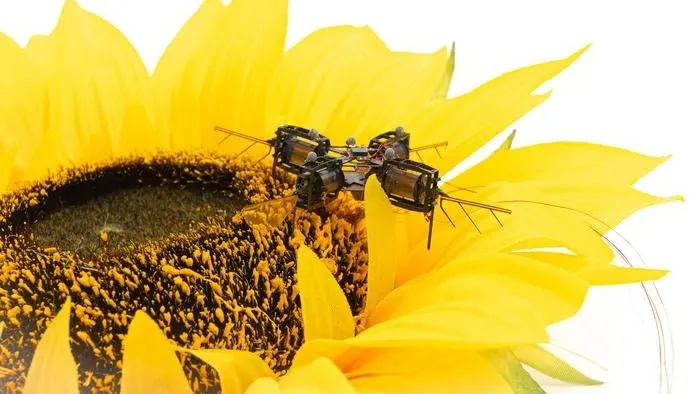
A flying robot lighter than a large paper clip has landed on a sunflower. The MIT insect robot weighs 1.29 grams including its electronics, and it is the first of its size to carry its own sensors and computing instead of relying on cameras around the room.
Researchers at MIT and Cornell University describe it in the journal Science Robotics. The four-winged machine is about the size of a small dictation tape. Until now, flapping-wing robots in this weight class only flew in tight lab spaces, where external cameras tracked their position and outside computers worked out every correction. The previous lightest craft with onboard navigation was an 18-gram propeller minidrone, more than ten times heavier.
How does the robot carry its own electronics?
The 1.05-gram body has to lift a 244-milligram electronics package. Team leader Kevin Chen, an MIT electrical engineering professor, and colleagues reworked the artificial muscles, soft plastic tubes that deform under voltage and beat the wings 330 times a second. Making them 50 percent longer and wider raised usable lift by 46 percent. The wings now produce 1.9 times the robot's weight in lift.
On board are three sensors: an orientation sensor like the one in a smartphone, a light sensor that measures distance to the ground, and an optical sensor like a computer mouse that reads sideways speed. A 7-milligram chip with two cores runs simplified maths, since many quick corrections keep it steadier than slow, detailed ones. In tests it hovered for ten seconds and flew short back-and-forth paths, straying about two centimetres from its route on average.
Why is it still tethered?
It is not flying alone. A person steered it around plants with a joystick through an external computer, and it touched down on a sunflower after 30 seconds. There is no camera to spot flowers, and in the lab video a black-and-white patterned mat helps the ground sensor.
The muscles also need up to 1,900 volts, so thin wires still supply power. Batteries plus electronics to step up the voltage would add 1 to 1.5 grams, meaning the robot would need to grow 15 to 35 percent. Pollination is one proposed use. The work was funded by the National Science Foundation and by US Navy and Air Force research offices, which suggests interest in reconnaissance in tight spaces too.
Apps worth a look
SUMO: the number puzzleTap the right tiles, add them up, hit the target. Easy to learn, hard to master. Free, for all ages.
Dialo: learn languages by speakingTalk to an AI conversation partner; every sentence comes back corrected and explained in your language. 9 languages, A1 to C2.
ediviewer: read EDI files like documentsOpen EDIFACT and X12 messages, see every segment explained, convert to JSON/XML, export PDF and Excel. Runs locally, no upload.
giftdetect: the right gift in minutesPick who it is for, the occasion and their personality. The search engine reads product descriptions from local shops and ranks what fits. Free, no sign-up.
More from this day
See all →
Jia Mingxuan, 14, pulls water from desert air with a tube and bottles

AI gift ideas: Germans get the cheapest suggestions
Flipper One Kickstarter hits 46x its goal in two days