Lute, the Polish startup teaching robots to feel what they grip
Robots can see, but they still crush soft packaging. Warsaw startup Lute built AI that learns from touch sensors, and it has raised $20 million.
 SUMO· the number puzzle
 Dialo· learn languages by speaking
 ediviewer· read EDI files like documents
 giftdetect· the right gift in minutes
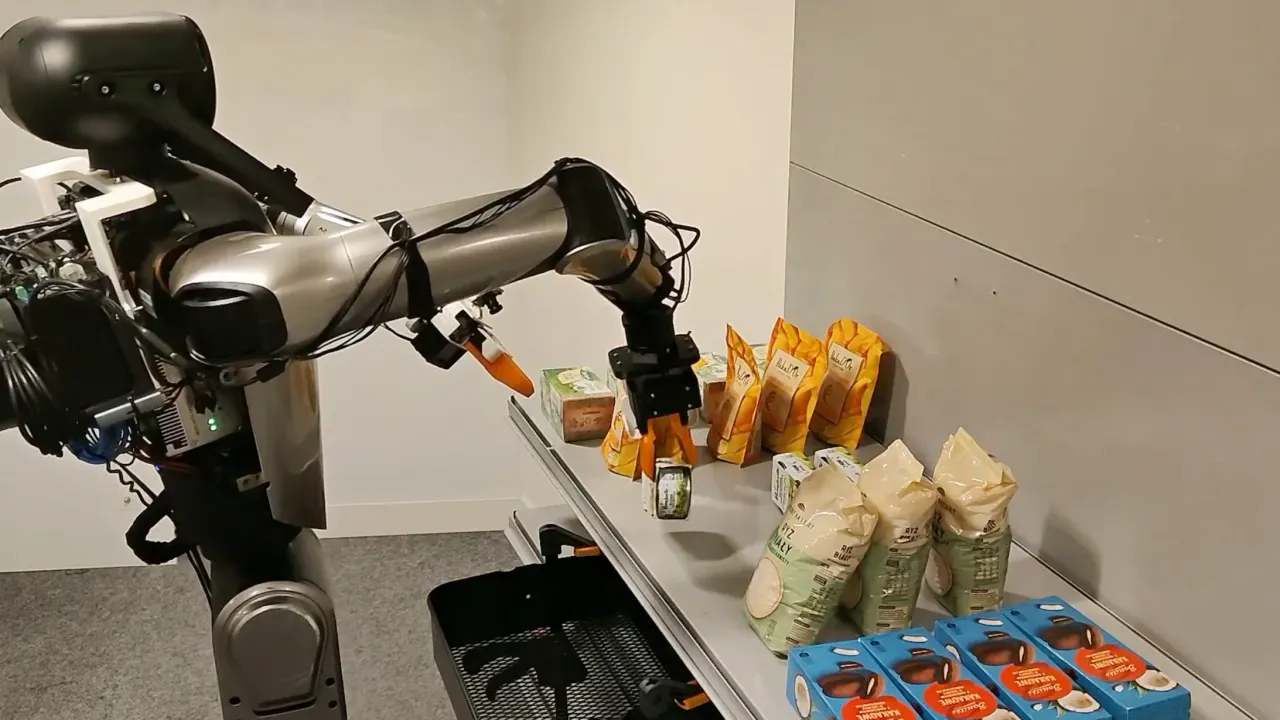
Robots are good at spotting objects. They are much worse at holding them. A flimsy package, a slippery item, the moment something starts sliding out of the gripper: people handle these by reflex, machines mostly don't. Lute, a Warsaw startup, wants to give robots a sense of touch.
The company builds AI models for robots that use touch data as well as camera images. Together with partners it developed small, flexible sensors made of elastomer, a rubbery material, that work a bit like artificial skin. They report how hard something is being pressed, how contact changes and when an object begins to slip. Lute also made a portable kit for recording touch data in different environments, which is then used to train its models.
What is Lute-0?
Lute-0 is the first of a planned family of foundation models, meaning large pre-trained systems that can be adapted to specific jobs, much like the language models behind chatbots. It is a video-action model: it uses visual input to predict and generate robot actions, including where to place the gripper and how much force to use.
According to the company, Lute-0 matches or beats the open robotics model π0.5 while needing much less training data and less training time. It also claims twice the latency performance, meaning a shorter delay between input and response.
Who is using it?
Lute started in January 2026 and says it has now raised $20 million in total. Ten months in, its models already run at Europe's largest distributor of car parts, and it works with large international retail chains. It also partners with system integrators, firms that install automation for other companies, so its software can go into existing robot setups without replacing the hardware. Healthcare and industry are the next areas.
The timing matters. Japan, Taiwan and China are all pushing physical AI, which is AI that acts in the real world rather than on a screen. Japan's Noetra consortium, with Sony, SoftBank, NEC and Honda, is working on a national foundation model for robots. Lute's founders point to sectors covering about 1.4 billion jobs and roughly 40 percent of global GDP, which is why even small efficiency gains could matter.
Apps worth a look
SUMO: the number puzzleTap the right tiles, add them up, hit the target. Easy to learn, hard to master. Free, for all ages.
Dialo: learn languages by speakingTalk to an AI conversation partner; every sentence comes back corrected and explained in your language. 9 languages, A1 to C2.
ediviewer: read EDI files like documentsOpen EDIFACT and X12 messages, see every segment explained, convert to JSON/XML, export PDF and Excel. Runs locally, no upload.
giftdetect: the right gift in minutesPick who it is for, the occasion and their personality. The search engine reads product descriptions from local shops and ranks what fits. Free, no sign-up.
More from this day
See all →
WhatsApp eSIM feature spotted: buy travel data inside the app
Caltech nanobots cross the blood-brain barrier to carry cancer drug
R3NEGADE: US Army robot drives out of a container, launches 18 drones
Coin on a Wi-Fi router: the viral trick to boost your signal
More in: AI
See all →
Xpeng IRON humanoid robot to cost about as much as a car

Voiceloo's AI dubbing tool Polita cuts costs by up to two thirds

Amateur astronomer uses Codex to spot an exoplanet candidate in NASA data