Little Red Dots: could Webb's mystery objects be Big Bang black holes?
Hundreds of tiny red lights in James Webb images have puzzled astronomers. A new study asks if some are black holes born before the first star.
 SUMO· the number puzzle
 Dialo· learn languages by speaking
 ediviewer· read EDI files like documents
 giftdetect· the right gift in minutes
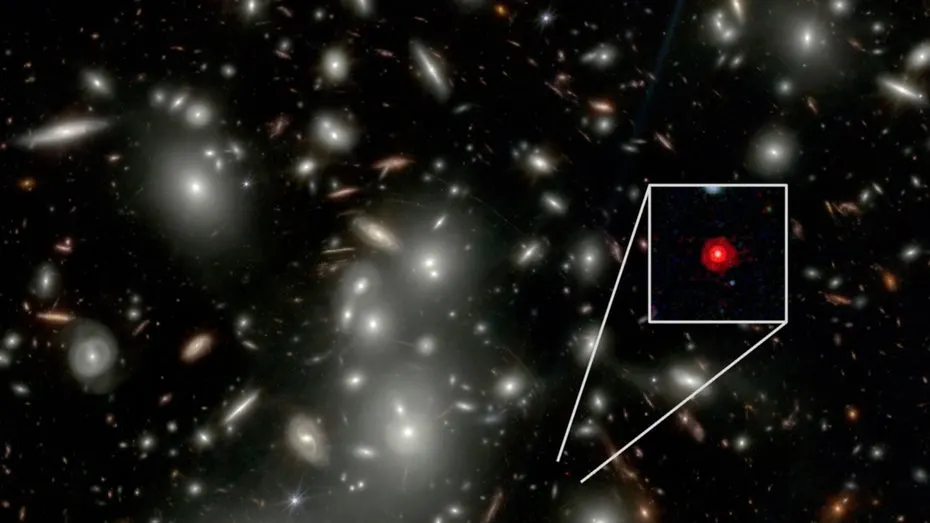
The James Webb Space Telescope keeps finding tiny red lights in the young universe, the so-called Little Red Dots, and nobody agrees on what they are. A new study says some could be black holes that formed in the first fractions of a second after the Big Bang.
The work, published in Physical Review Letters, comes from researchers at Johns Hopkins University, the Space Telescope Science Institute in Baltimore and the University of Padua. Ordinary black holes are the leftovers of burned-out stars. Primordial black holes, a idea Stephen Hawking floated in the 1970s, would have collapsed directly from dense clumps of matter before any star existed.
What is Abell 2744-QSO1?
The test case is Abell 2744-QSO1, about 13.1 billion light-years away, seen as it was roughly 700 million years after the Big Bang. A galaxy cluster in front of it acts like a magnifying glass and shows it three times. At its centre, gas circles a black hole of around 50 million solar masses, at least twice as heavy as all the surrounding stars combined. Today a central black hole is typically about a thousandth of its galaxy's stellar mass. The surroundings are almost pure hydrogen and helium, so few stars can have lived there.
How could a Big Bang black hole get that big?
The team ruled out two routes. Black holes born with millions of solar masses would have left marks in the cosmic microwave background, the radiation echo of the early universe, and satellite data show none, so the starting weight was at most about 1,000 suns. Thousands of small ones merging also fails in nearly all models, because the collisions kick the merged object away.
One path survived: a roughly 1,000-solar-mass black hole feeding on hydrogen and helium for hundreds of millions of years, with almost no new stars forming in its gas disk. That fast feeding would also puff up the inner disk and trap X-rays, which fits why Little Red Dots give off so few.
Is it proven?
No. The study offers no observational proof, and many of the roughly 100 catalogued Little Red Dots probably hold ordinary black holes. Rivals include young black holes wrapped in dense gas, called black hole stars, and direct collapse of huge gas clouds. Co-author Loris Del Grosso says the study only opened a door that was already ajar a bit wider. Proof would need an object that clearly formed before the first stars, or one lighter than any collapsed star could be.
Apps worth a look
SUMO: the number puzzleTap the right tiles, add them up, hit the target. Easy to learn, hard to master. Free, for all ages.
Dialo: learn languages by speakingTalk to an AI conversation partner; every sentence comes back corrected and explained in your language. 9 languages, A1 to C2.
ediviewer: read EDI files like documentsOpen EDIFACT and X12 messages, see every segment explained, convert to JSON/XML, export PDF and Excel. Runs locally, no upload.
giftdetect: the right gift in minutesPick who it is for, the occasion and their personality. The search engine reads product descriptions from local shops and ranks what fits. Free, no sign-up.
More from this day
See all →
Comet 220P/McNaught suddenly got 1,000 times brighter. Here's why

Coral Hart used AI to write 370 books in 20 months

WhatsApp Zaps: self-deleting photos and videos for any chat

Green SM taxis: Karnataka halts new registrations, eyes mandatory meters
More in: Science
See all →
Coriscada wind farm: 4 turbines replace 40 and make 78% more power

Wind turbine blade recycling: a French startup makes ping-pong tables
Drones that carry objects by weaving rope around them midair