Korean Appliance Suppliers Bring AI to Press, Assembly and Logistics
Samsung supplier DK and AI firm UBC are building autonomous manufacturing systems, taking AI from big-brand factories to smaller parts makers.
 SUMO· the number puzzle
 Dialo· learn languages by speaking
 ediviewer· read EDI files like documents
 giftdetect· the right gift in minutes
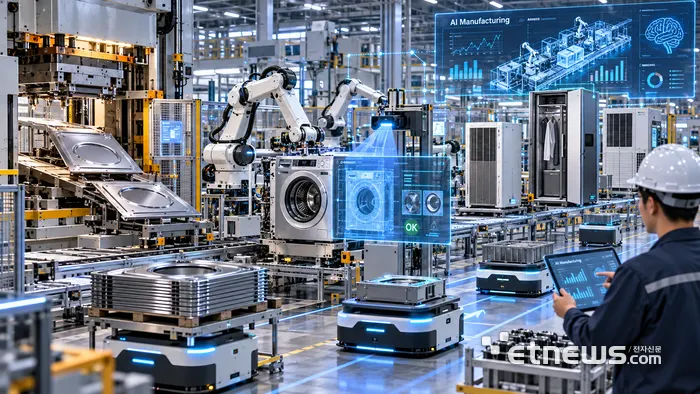
South Korean home appliance makers and their suppliers have begun rolling out artificial intelligence on the factory floor in earnest. AI-driven autonomous manufacturing, long focused on large companies' finished-product lines, is now spreading to component machining, assembly, quality inspection and logistics at mid-sized and small firms.
DK targets press-line changeovers
DK, a first-tier supplier of Samsung Electronics' home appliance business, will invest about 6.9 billion won through the end of 2028 to develop an AI autonomous manufacturing system for press processes that must cope with appliance model changes. Each time the product changes, dies and equipment settings have to be reconfigured, which can halt machines and cause early defects.
DK will combine product, die, equipment and quality data so AI can predict the best production conditions for each product. Automatic die replacement, press settings, robot tool changing and AI vision inspection will be linked. The AI recommends process conditions, a worker reviews and applies them, and production and inspection results feed back into the model. The aim is to replace settings that relied on operator experience with data-based ones.
DK expects to cut changeover time by more than 30% and raise productivity by over 12%. It also wants to bring the defect rate down from 11.5% to 9.5% or less.
UBC links large makers and suppliers
Manufacturing AI company UBC will work with LG Electronics' Production Engineering Research Institute, the Korea Institute of Industrial Technology and others through the end of 2029 on an integrated autonomous manufacturing solution for high-mix, variable appliance supply chains. Trials will cover Styler clothing care units and industrial air conditioners.
The core idea is to connect manufacturing data from large companies and smaller suppliers to manage assembly, inspection, welding and logistics together. Assembly robots handle parts, humanoid robots inspect products using multiple sensors and AI, and welding robots adjust position and speed to the work状態. Autonomous mobile robots move parts to match production pace and inventory. AI analyzes the data to predict defects and propose process corrections, with the goal of optimizing quality and logistics across the whole line.
Industry observers expect the work to lower the barrier to AI adoption for mid-sized and small manufacturers and to tighten quality control between brands and suppliers. One industry official said the push is about connecting manufacturing data rather than simply installing robots.
Apps worth a look
SUMO: the number puzzleTap the right tiles, add them up, hit the target. Easy to learn, hard to master. Free, for all ages.
Dialo: learn languages by speakingTalk to an AI conversation partner; every sentence comes back corrected and explained in your language. 9 languages, A1 to C2.
ediviewer: read EDI files like documentsOpen EDIFACT and X12 messages, see every segment explained, convert to JSON/XML, export PDF and Excel. Runs locally, no upload.
giftdetect: the right gift in minutesPick who it is for, the occasion and their personality. The search engine reads product descriptions from local shops and ranks what fits. Free, no sign-up.
More from this day
See all →
Orange launches Orange France super-app with AI aggregator
Dongwon F&B's AI Shopping Assistant Lifts Conversion 10.8x
South Korea Has Just 796 Chargers of 350 kW or More for 800V EVs

SoftBank, Grab and PETROS Commit $1 Billion to Sarawak AI Hub
More in: AI
See all →
Anthropic Turns Claude Into an Office Suite With Meetings, Sheets
Anthropic Buys Its Own Gas Turbines in a $3.4 Billion Deal

Australia Plans AI Incident Reporting Rules After OpenAI Agent Breach