Korean Telemedicine Industry Council Opposes Prescription Day Caps
Korea's Telemedicine Industry Council filed a formal opinion on the health ministry's draft medical law rule, urging it to drop uniform limits on prescription days and consultation counts.
 SUMO· the number puzzle
 Dialo· learn languages by speaking
 ediviewer· read EDI files like documents
 giftdetect· the right gift in minutes
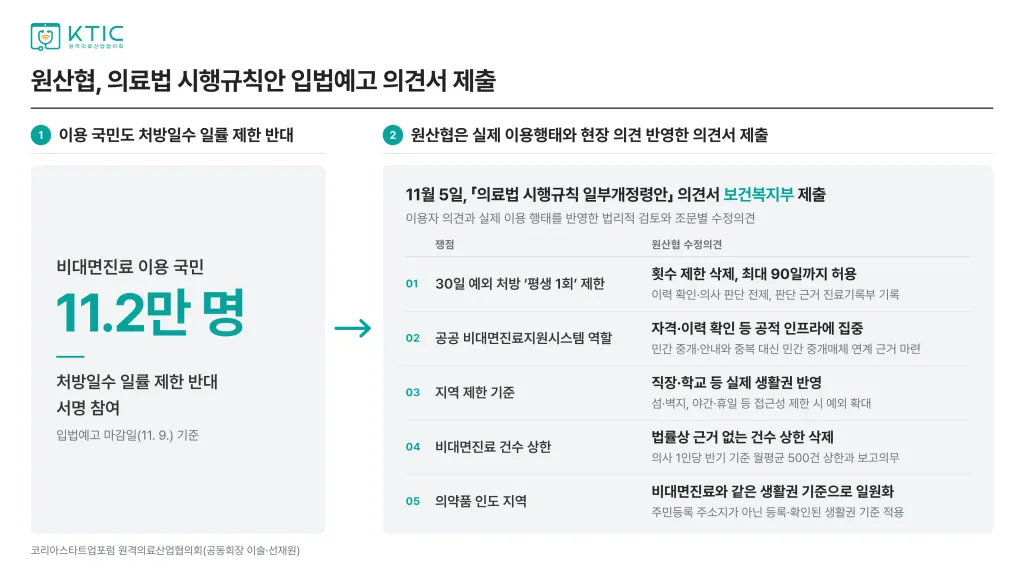
The Telemedicine Industry Council (Wonsanhyeop), led by co-chairs Lee Seul and Sun Jae-won, formally submitted its opinion on November 5 on the Ministry of Health and Welfare's pre-announced partial amendment to the Enforcement Rules of the Medical Service Act. The document, prepared after legal review by a law firm, calls for withdrawing uniform limits on prescription days and consultation volumes.
It proposes article-by-article revisions on four core issues: unclear criteria for limiting 30-day exceptional prescriptions, a new cap and reporting duty on consultations per medical professional that lacks a statutory basis, overlap between a public telemedicine support system and private platforms, and regional restrictions and medication delivery rules that ignore where patients actually live.
What the council wants changed
The council called the rule limiting a 30-day exceptional prescription to once per lifetime unrealistic. Without public infrastructure to check a patient's exceptional prescription history across institutions, it argues, the limit would force manual checks by clinics, proof documents from patients and separate systems at platforms. Instead, it proposes dropping the count limit, allowing up to 90 days based on a review of treatment and prescription history and the doctor's professional judgment, and requiring the reasoning for continued treatment to be recorded in the medical chart.
It also urged scrapping the cap of 500 telemedicine consultations per month on average per doctor, measured half-yearly, saying the parent law gives no authority for it. On the public support system, the council said the government should focus on public infrastructure such as eligibility and prescription history checks, rather than duplicating brokerage functions private platforms already perform, and should give private intermediaries a legal basis to query that data.
On regional limits, it wants rules to reflect workplaces and schools rather than only registered residence, broader exceptions for islands, remote areas, nights and holidays, and medication delivery areas aligned with the same living-area standard.
Public opposition
Patients also weighed in. By the November 9 deadline of the comment period, 110,000 telemedicine users had signed a petition against the uniform prescription-day limit. The council plans to compile the signatures, deliver them to the ministry and keep urging a system design that reflects real demand.
The co-chairs said safety depends on systematic checks of consultation and prescription history and on records of medical judgment, not on mechanically blocking prescription days and regions. They added that the public system should support the reliability of private infrastructure rather than compete with it.
Apps worth a look
SUMO: the number puzzleTap the right tiles, add them up, hit the target. Easy to learn, hard to master. Free, for all ages.
Dialo: learn languages by speakingTalk to an AI conversation partner; every sentence comes back corrected and explained in your language. 9 languages, A1 to C2.
ediviewer: read EDI files like documentsOpen EDIFACT and X12 messages, see every segment explained, convert to JSON/XML, export PDF and Excel. Runs locally, no upload.
giftdetect: the right gift in minutesPick who it is for, the occasion and their personality. The search engine reads product descriptions from local shops and ranks what fits. Free, no sign-up.
More from this day
See all →
Google Wallet Adds Digital Home Keys for NFC and UWB Smart Locks

TSMC plans up to $1 billion investment in Anthropic and OpenAI

Acecore, Supplya and Navidyn Take Top Spots at TC Battlefield

Airwallex to invest more than $1.6 billion in Singapore over five years
More in: Business
See all →
MAX Messenger Ad Spend Hits 3.5 Billion Rubles, Up 30-Fold

PayPal Fees Ban on Surcharges Draws Germany's Cartel Office

India Bans Export of Lithium-Ion Battery Black Mass