Korea's exam emergency alert didn't reach some phones. Why?
South Korea sent a nationwide emergency alert on exam day to catch phone cheating, but some people say their phones stayed silent. The government points to device and signal issues.
 SUMO· the number puzzle
 Dialo· learn languages by speaking
 ediviewer· read EDI files like documents
 giftdetect· the right gift in minutes
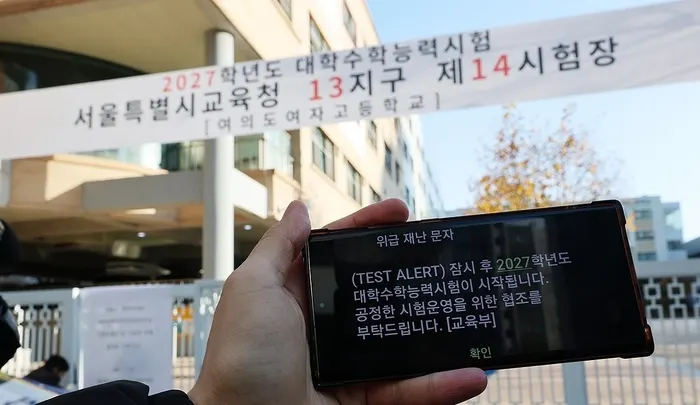
South Korea sent a nationwide emergency alert on the morning of its college entrance exam, the Suneung, to deter cheating with phones. Then the complaints started: some people said the emergency alert never reached their phones.
According to the Ministry of the Interior and Safety, the alert went out at 8:30 a.m. on 19 November. The idea was to check whether students had brought phones into the exam and to head off cheating. Soon after, posts appeared in online communities and on social media. Some described families in the same room where only some phones received it. One iPhone user said nothing came through with Do Not Disturb on. Galaxy Z Fold7 users said the text arrived but the alarm didn't sound. Another claim: no alert in airplane mode while on Wi-Fi.
Other users said the alarm rang loudly even in silent or Do Not Disturb mode, so results clearly differed by device. Some also asked how the government can catch phone cheating if alerts don't reliably arrive.
Why did some phones not receive the emergency alert?
The ministry says these alerts don't work like ordinary texts. They use cell broadcast, which sends one message to every phone connected to a cell tower at once, rather than to individual numbers. In principle, any phone built to international and domestic standards should receive it.
Exceptions exist, the ministry says. Old 3G phones and illegally modified devices may miss it. So may phones in weak-signal areas, or phones with software errors. Problems after a software update, or a conflict when installing or deleting an app, were also named as possible causes.
This category of alert can't be turned off by the user. On a powered-on phone, it is set to sound at 40 decibels or more for 10.5 seconds.
What happens next
The government first planned a single alert just before the exam. After concerns that someone could cheat by switching a phone on after the message, it added a second. Around 2:21 p.m. on the same day, a second alert goes out. The plan is to catch students who carried a phone into the exam without turning it on.
Apps worth a look
SUMO: the number puzzleTap the right tiles, add them up, hit the target. Easy to learn, hard to master. Free, for all ages.
Dialo: learn languages by speakingTalk to an AI conversation partner; every sentence comes back corrected and explained in your language. 9 languages, A1 to C2.
ediviewer: read EDI files like documentsOpen EDIFACT and X12 messages, see every segment explained, convert to JSON/XML, export PDF and Excel. Runs locally, no upload.
giftdetect: the right gift in minutesPick who it is for, the occasion and their personality. The search engine reads product descriptions from local shops and ranks what fits. Free, no sign-up.
More from this day
See all →
Anthropic cuts its 90-day bug disclosure window to 30 days

Tesla FSD in Europe: France accused of urging a no vote

Kona Card platinum card costs 20 million won in Seoul pop-up

Nuclear blast in low Earth orbit could kill 98% of satellites in a week
More in: Mobile
See all →
Samsung One UI 9.5 may show your phone's IMEI on the lock screen
WhatsApp backup without Google Drive: 2GB free on its own cloud

Meta Direct: a standalone messaging app that works without Instagram