Kakao Open-Sources Kanana-2-v-decide, a Decision Model for AI Agents
Kakao released Kanana-2-v-decide on Hugging Face, a multimodal model that returns probabilities, choices and scores instead of sentences, aimed at AI agents.
 SUMO· the number puzzle
 Dialo· learn languages by speaking
 ediviewer· read EDI files like documents
 giftdetect· the right gift in minutes
Kakao has released Kanana-2-v-decide, a multimodal decision model, as open source on Hugging Face. The company announced the release on the 6th. It is covered by the Kanana Open License, which allows commercial use as well as research.
Instead of writing a long answer, a decision model returns a result in a fixed format: a probability, a choice or a score. A general large language model produces sentences, so a service must extract the conclusion from the text afterwards. A decision model skips that step and can pass the result straight to the next action. Similar models are appearing elsewhere: US startup TypeSafe AI launched one called Jev in September.
Built for agent workflows
AI agents handle multi-step tasks and must keep deciding which tool to use, which information to consult and what to do next. A decision model supplies the conclusion for each step quickly so the agent can move on.
Kanana-2-v-decide is based on Kakao's multimodal model Kanana-2-v-3b. A probability shows how likely a condition is to hold. A choice gives the probability of each option and the best fit. A score gives a finer rating that reflects probabilities at each evaluation stage. In one example, a customer uploads a photo of a broken product and asks for an exchange. The model weighs the photo and the message to judge whether the item is really damaged, what type of inquiry it is and how dissatisfied the customer is. The service then routes the case to an agent or starts the exchange process. Other uses include sorting inquiries, picking tools for agents and judging product images.
The design is embedding-based: questions and options are converted into vectors and compared for similarity. This works even with many categories, and frequently used options can be stored as vectors and reused, which cuts computation and response time for repeated requests.
Speed and benchmarks
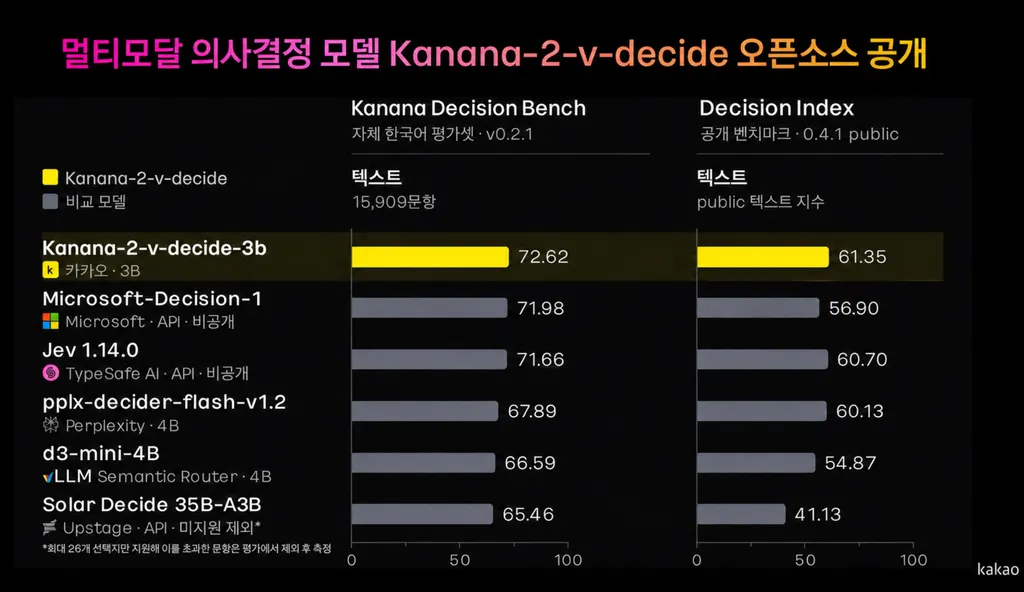
According to Kakao, the model responds in 0.04 seconds on average on a single H200 GPU, about 43 times faster than OpenAI's GPT-6 Luna. Accuracy was measured on Kakao's own Korean benchmark, Kanana Decision Bench, with 15,909 questions, and on the public Decision Index. Kakao says it scored highest on both against Microsoft's Decision-1, TypeSafe AI's Jev, Perplexity's pplx-decider-v1.1-27B and Upstage's Solar Decide.
Kakao plans to apply the model first to internal projects such as web search and automatic product categorization, refining it in live services. Longer term, it aims to merge search and decision-making into a single model.
Apps worth a look
SUMO: the number puzzleTap the right tiles, add them up, hit the target. Easy to learn, hard to master. Free, for all ages.
Dialo: learn languages by speakingTalk to an AI conversation partner; every sentence comes back corrected and explained in your language. 9 languages, A1 to C2.
ediviewer: read EDI files like documentsOpen EDIFACT and X12 messages, see every segment explained, convert to JSON/XML, export PDF and Excel. Runs locally, no upload.
giftdetect: the right gift in minutesPick who it is for, the occasion and their personality. The search engine reads product descriptions from local shops and ranks what fits. Free, no sign-up.
More from this day
See all →
GOG GALAXY Is Coming Natively to Linux After 18 Years
Claude Code accused of leaking users' email addresses to websites

Alta Ares wins six NATO counter-drone lots in first big deal