Hyundai to Launch South Korea's First 13m Hydrogen Coach in 2027
Hyundai has cleared emissions certification for the Elec City hydrogen intercity bus, a 13-metre low-floor model due next year as Chinese battery buses gain ground.
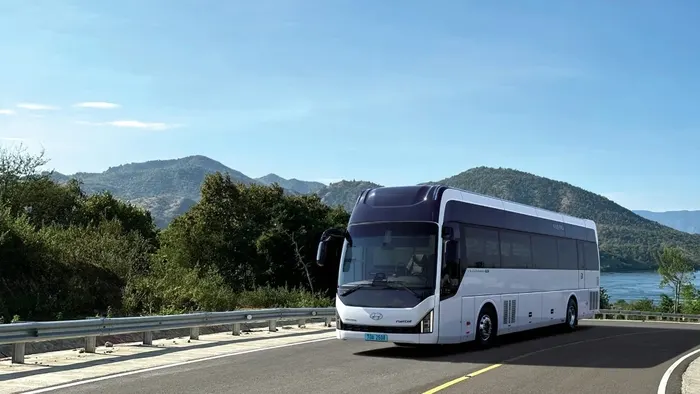
Hyundai Motor will launch South Korea's largest hydrogen fuel-cell intercity bus next year, a low-floor model close to the 13-metre legal limit for a single vehicle. Industry sources said the company has recently completed final emissions certification for the Elec City Hydrogen Electric Intercity Bus (type name CYEX401-A27FCEV6T-C) with the National Institute of Environmental Research's transport environment lab, KENCIS.
It is the first time Hyundai has put a 13-metre-class low-floor hydrogen bus into its production lineup. The company is still expected to go through vehicle specification registration with the transport ministry and safety testing, then build and deliver the bus at its Jeonju plant next year.
Powertrain and seating
The bus is built for long highway runs. It pairs a 475 hp (350 kW) drive motor with Hyundai's in-house PEMFC hydrogen fuel-cell system and a 48.3 kWh (630 V, 76.6 Ah) lithium-ion battery pack. Kerb weight is 13.6 tonnes and gross vehicle weight is 16.2 tonnes.
The length also resolves a policy conflict. Revised accessibility rules require low-floor buses with wheelchair space when route buses are replaced. Intercity buses on urban expressways cannot legally carry standing passengers, so operators need roughly 40 seats to make routes pay. Standard 11-metre low-floor bodies drop to 20 to 30 seats once a wheelchair area is added, which drew objections from operators. Hyundai's longer body keeps wheelchair facilities and still seats 41, including the driver.
Market context
The Environment Ministry plans to expand hydrogen buses from about 3,000 today to more than 20,000 cumulatively by 2030. The new model is expected to absorb replacement demand for ageing diesel buses on major routes around the Seoul area.
Hydrogen is also pitched as an answer to the limits of battery buses on this kind of route. Running heating and cooling on a large body over round trips of more than 100 km would need batteries weighing several tonnes, and charging takes one to two hours. A hydrogen bus can refuel in 15 to 20 minutes. Meanwhile, Chinese makers such as BYD have taken around 40% of the domestic 11-metre city battery bus market with cheaper LFP batteries, but large-body control and fuel-cell durability under harsh conditions are areas where they are unlikely to catch up quickly.
Apps worth a look
 SUMO: the number puzzle
Tap the right tiles, add them up, hit the target. Easy to learn, hard to master. Free, for all ages.
 Dialo: learn languages by speaking
Talk to an AI conversation partner; every sentence comes back corrected and explained in your language. 9 languages, A1 to C2.
 ediviewer: read EDI files like documents
Open EDIFACT and X12 messages, see every segment explained, convert to JSON/XML, export PDF and Excel. Runs locally, no upload.
More from this day
See all →Solgram raises over $1 million pre-seed for premium grocery
OpenAI Raises Bug Bounty Rewards to $172,000 in Security Push

Google: Videostrong Pre-Installed Malware on 1.3M Android Devices
Egypt Drafts Dedicated AI Law to Govern Use of the Technology
More in: Automotive
See all →
Hyundai Motor Group Suspends External AI Tools in Core R&D
BMW to Launch City Driving Assistance in 2027, Starting in Germany
Mercedes-Benz Sells Its European Charging Network to Electra