How DPI detects a VPN: four home-built servers, blocked in days
A hobbyist ran four self-built VPN servers and watched deep packet inspection shut them down. Two lasted months. Two were gone in 3 and 8 days.
 SUMO· the number puzzle
 Dialo· learn languages by speaking
 ediviewer· read EDI files like documents
 giftdetect· the right gift in minutes
Hosting providers say one thing about how DPI detects a VPN, and one experimenter's logs say the opposite. He ran four home-built servers, and the ones his host told him to abandon were the ones that survived.
DPI, deep packet inspection, is the filtering gear that examines network traffic and restricts tunnels, whether personal or corporate. The author of the experiment says he did it to understand how current filters work, not to dodge blocks. He also notes that talk is growing of a machine-learning model inside DPI that can spot even VLESS, a popular tunnelling protocol, in encrypted traffic. Some people claim servers now live only about 3 days.
His hosting provider blames REALITY, a method that hides tunnel traffic among connections to a big popular website. The provider claims it lets DPI flag bad users, for example through active probing, and urged customers to switch to Self-SNI, where the server poses as its own site or API.
Does REALITY or Self-SNI survive longer?
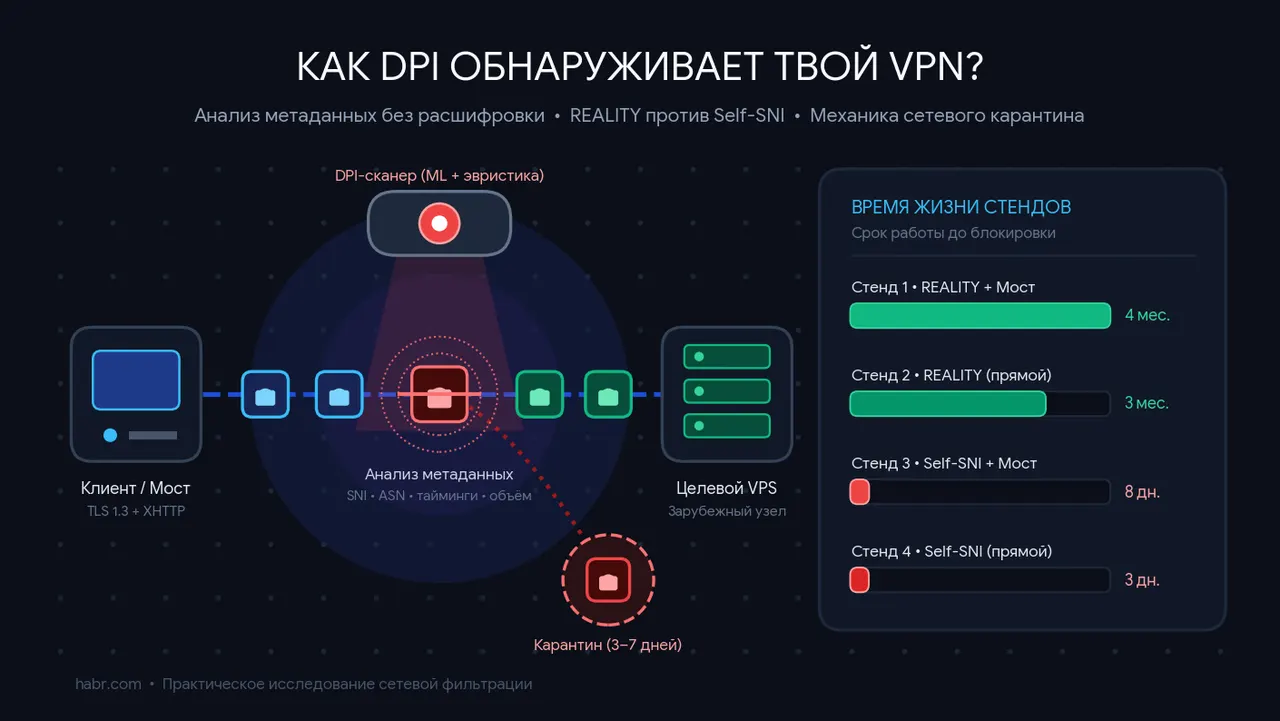
In his tests, the provider's advice failed. The REALITY setups lived for 3 to 4 months. The Self-SNI ones were blocked after 3 and 8 days. Hiding among a large, popular resource looked far safer than passing a lone VPS off as a private API.
The four setups all ran VLESS over XHTTP. He changed only two things: direct connection versus going through an intermediate server in Russia, and REALITY versus Self-SNI. Servers with the intermediate hop lived much longer, though he cautions that other factors may play a part, since setup number 2 also lasted a long time.
Is a DPI block permanent?
Not always. After one server was blocked, pings to its subnet neighbours stopped, came back a day later, then vanished again. In another case he found a neighbour's IP on public blocklists a couple of days later, and his own address was fully unblocked a week on. That points to subnet-wide blocking with accidental victims released later.
His advice: if pings fail, wait 5 to 7 days before changing IP or buying a new server. Addresses seem to go into a quarantine of 3 to 7 days and are freed if no anomalies appear. A repeat offence looks permanent. That happened to his setup number 3 after he sent VLESS packets once it came back. If the VPS matters to you, he says, switch off the VPN server software after a block.
These are the results of one person's small sample, and he says yours may differ.
Apps worth a look
SUMO: the number puzzleTap the right tiles, add them up, hit the target. Easy to learn, hard to master. Free, for all ages.
Dialo: learn languages by speakingTalk to an AI conversation partner; every sentence comes back corrected and explained in your language. 9 languages, A1 to C2.
ediviewer: read EDI files like documentsOpen EDIFACT and X12 messages, see every segment explained, convert to JSON/XML, export PDF and Excel. Runs locally, no upload.
giftdetect: the right gift in minutesPick who it is for, the occasion and their personality. The search engine reads product descriptions from local shops and ranks what fits. Free, no sign-up.
More from this day
See all →
.zr domain: who owns a dead country code, and why .su survives

Windows 11 Emerging Risks will warn you about risky apps and drivers
Optimizely hack: malicious script hit BBC, Ikea and Zoom sites