Hera probe reaches Didymos, where NASA's DART hit an asteroid moon
NASA slammed a probe into the asteroid moon Dimorphos four years ago. Now ESA's Hera has arrived to inspect the crash site and the damage up close.
 SUMO· the number puzzle
 Dialo· learn languages by speaking
 ediviewer· read EDI files like documents
 giftdetect· the right gift in minutes
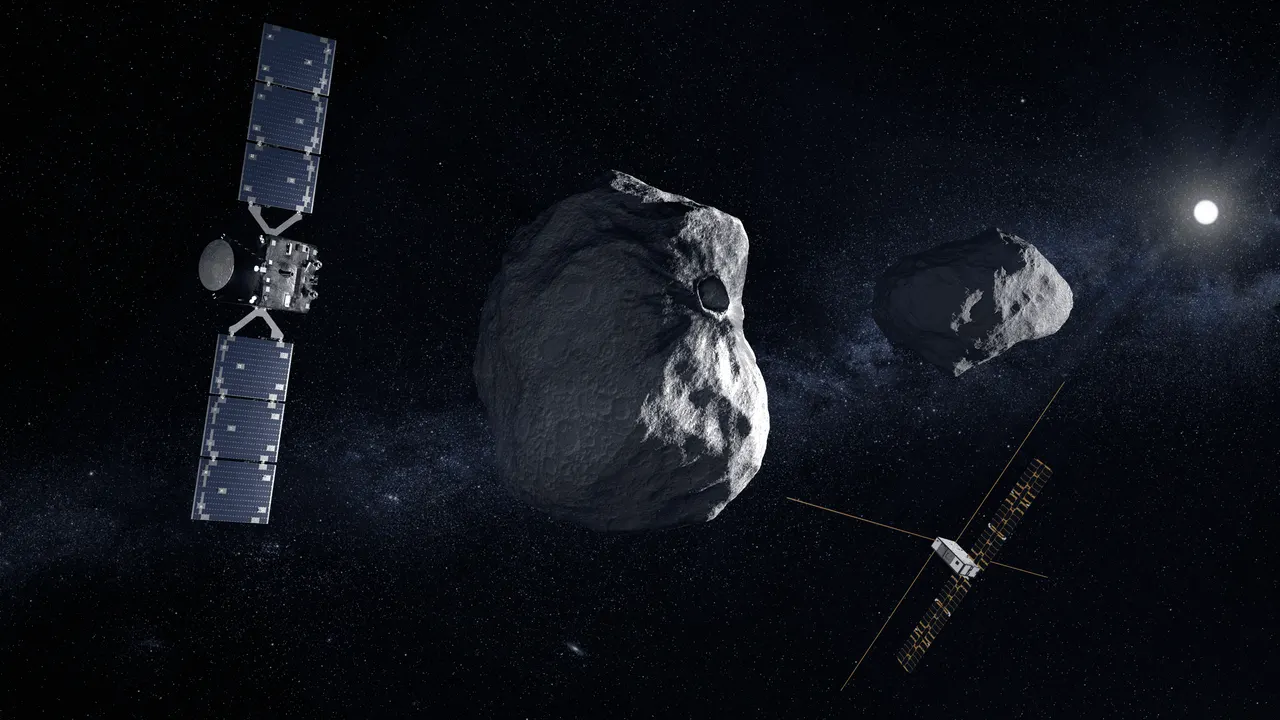
Four years after NASA deliberately crashed a spacecraft into an asteroid moon, the European Space Agency's Hera probe has turned up to see what happened. It began its arrival phase in October and is now close to the asteroid Didymos and its small companion Dimorphos.
The original experiment was DART, launched in late 2021. It hit Dimorphos nearly a year later at over 13,000 miles per hour. Scientists hoped to shorten the moon's orbit around Didymos by a minute or more. The orbit got 33 minutes shorter. Debris thrown out by the impact gave the moon a much bigger push than the crash alone. Both asteroids also slowed slightly in their orbit around the sun, and for a while Dimorphos had a long, comet-like tail.
What is the Hera probe supposed to find?
ESA launched Hera in October 2024. After a flyby of Mars, it took its first image from about 800 miles away, and the first detailed picture of Didymos came out in early November. Didymos is 780 meters across and Dimorphos about 151 meters. It is the first time a binary asteroid system will be explored in detail.
Hera will measure the exact mass of Dimorphos, which is needed to judge how well DART really worked. It will study the impact crater, map the surface with lidar and analyze its chemistry, with images at 1 meter per pixel. Didymos spins once every 2.3 hours, right at the edge of stability, so it is interesting in its own right.
What are Juventas and Milani?
They are two cube-shaped mini satellites, CubeSats, that Hera will release in January 2027 and try to land on the surface. Juventas has a radar that can probe up to 100 meters deep, plus a gravimeter to track how gravity on Dimorphos shifts as it circles Didymos. Milani will examine surface composition and look for dust and volatile substances.
Why does it matter for Earth?
The asteroid Apophis, 450 meters wide, will pass Earth in mid-April 2029 at about 19,000 miles, visible to the naked eye. Spotting threats is getting easier: in 2000 we knew of 300 near-Earth asteroids, today over 43,000. Deflecting one is the missing piece, and the plan is to nudge its orbit rather than blow it up. Hera's main phase is expected to run until next summer.
Apps worth a look
SUMO: the number puzzleTap the right tiles, add them up, hit the target. Easy to learn, hard to master. Free, for all ages.
Dialo: learn languages by speakingTalk to an AI conversation partner; every sentence comes back corrected and explained in your language. 9 languages, A1 to C2.
ediviewer: read EDI files like documentsOpen EDIFACT and X12 messages, see every segment explained, convert to JSON/XML, export PDF and Excel. Runs locally, no upload.
giftdetect: the right gift in minutesPick who it is for, the occasion and their personality. The search engine reads product descriptions from local shops and ranks what fits. Free, no sign-up.
More from this day
See all →Hugendubel, Tolino Cloud and eBook.de offline after cyberattack

YouTube app icons: 7 new designs, some retro, are in the works

PC repair job interview: the voltage switch trap he suggested

Google's new 3D emoji need 6GB RAM and 10GB storage, now explained
More in: Space
See all →BepiColombo reaches Mercury orbit after 8 years and a solar panel snag
Ariane 6 launch live: 36 Amazon Leo satellites on one rocket
Perseverance and Odyssey both fail on Mars within a week