Gribshunden wreck: chain mail found on Danish king's warship
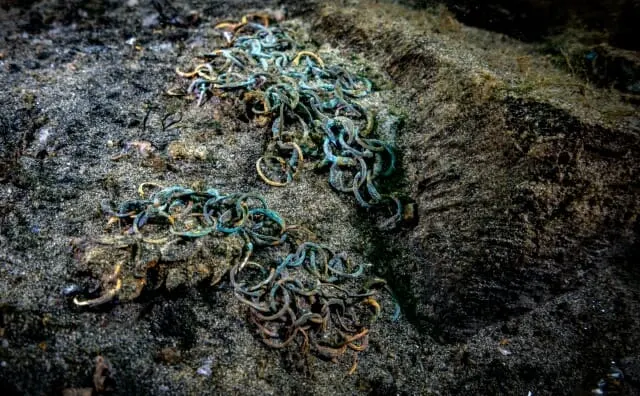
Archaeologists exploring the Gribshunden, a Danish royal warship that blew up in 1495, found well-preserved chain mail in a storage space under the forecastle.
 SUMO· the number puzzle
 Dialo· learn languages by speaking
 ediviewer· read EDI files like documents
 giftdetect· the right gift in minutes
Nearly 530 years after it caught fire and sank, the Danish royal warship Gribshunden has given up a piece of its crew's gear: well-preserved chain mail, found in a compartment under the bow.
A joint team from the University of Southampton, Sweden's Södertörn University and Stockholm University made the find while exploring the wreck, one of the Baltic Sea's major shipwrecks. The mail is made of a copper alloy. Divers came across it while checking a storage space for ammunition and tools, below the forecastle, the raised fighting platform at the front of the ship.
What is the Gribshunden?
The Gribshunden, also known as the Griffin, belonged to King Hans of Denmark in the 15th century. In 1493 it carried the king's envoys to England, so it served diplomacy as well as war. In 1495 it was anchored north of the island of Stora Ekön, off Sweden, when an explosion and fire sank it. The wreck was found in the 1970s, and Södertörn University's maritime archaeology research has been studying it since 2013.
Whose armour was it?
That is still open. Rodrigo Pacheco-Ruiz, a visiting researcher at Southampton's Centre for Maritime Archaeology and co-investigator of the Griffin Project, said the remains lay right under the forecastle in a space likely used to store military equipment. "It was a really amazing find," he said. Historical sources say German mercenaries were aboard when the ship sank, so the space may have held soldiers' gear, though its exact use is unknown.
The team says the quality of the mail alone cannot reveal who owned it. Armour like this lasted a long time and was often repaired or reused, so the pieces could be older equipment still in service in 1495.
The researchers are now running chemical analysis to trace where the mail came from, and expect expert study of how it was made to help. They also hope that surveying the forecastle and nearby structures will show how weapons, equipment and soldiers were arranged on board, adding to what is known about medieval military organisation.
Apps worth a look
SUMO: the number puzzleTap the right tiles, add them up, hit the target. Easy to learn, hard to master. Free, for all ages.
Dialo: learn languages by speakingTalk to an AI conversation partner; every sentence comes back corrected and explained in your language. 9 languages, A1 to C2.
ediviewer: read EDI files like documentsOpen EDIFACT and X12 messages, see every segment explained, convert to JSON/XML, export PDF and Excel. Runs locally, no upload.
giftdetect: the right gift in minutesPick who it is for, the occasion and their personality. The search engine reads product descriptions from local shops and ranks what fits. Free, no sign-up.
More from this day
See all →
Oracle bone script reward: China pays up to 100,000 yuan per character

League of Legends Esports Manager shuts down after 4.5 years
JAXA astronaut recruitment 2027: Japan will hire again after five years