Gallium Defense raises €7.1M seed for low-cost drone radar
French startup Gallium Defense has emerged from stealth with a €7.1 million seed round to build the GDS-10, a software-defined radar aimed at detecting FPV drones at 10 km.
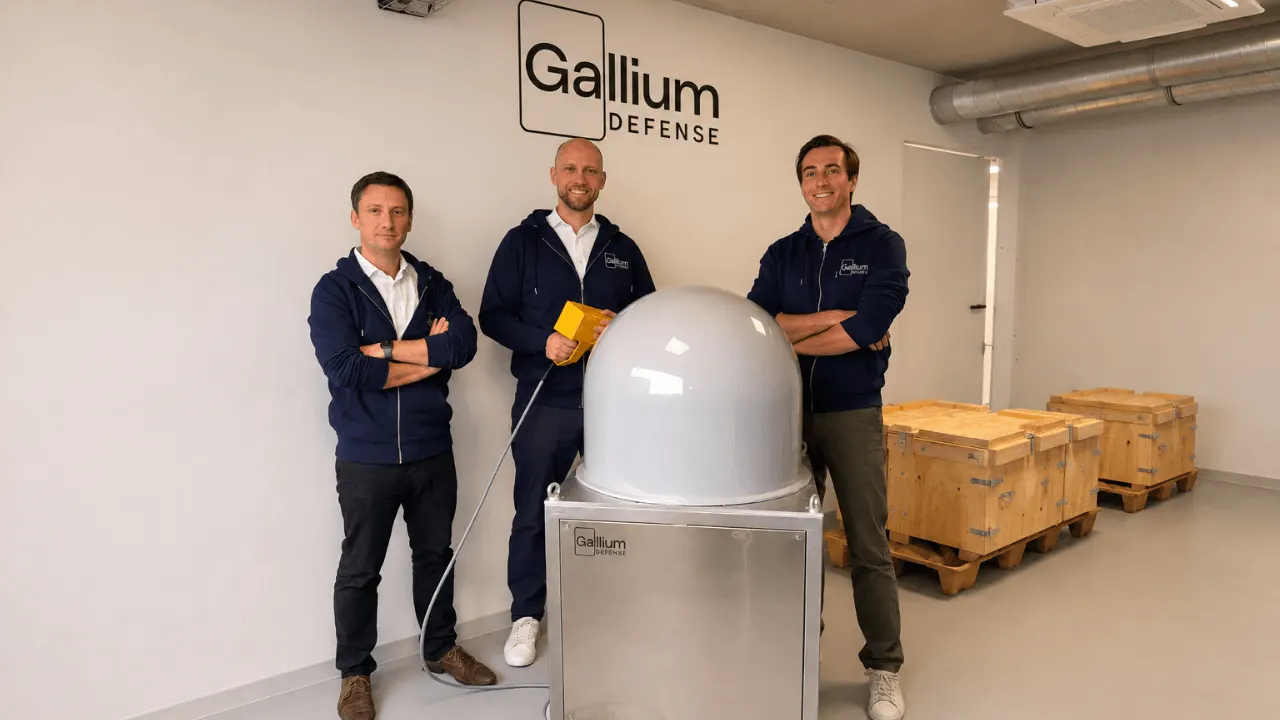
Gallium Defense has emerged from stealth with a €7.1 million seed round led by Keen Venture Partners and 360 Capital, with Omnes Capital and Polytechnique Ventures also participating. The Paris-based startup is building the GDS-10, a software-defined X-band active electronically scanned array (AESA) radar meant to detect first-person-view (FPV) drones up to 10 kilometres away at a fraction of the cost of conventional systems.
Target specifications include 360-degree horizontal and 90-degree vertical coverage, drone swarm tracking, jamming resistance and all-weather, day-and-night operation. Two versions are planned: one for critical infrastructure and one for military use.
A supplier, not a defence prime
The company was founded in April 2026 by three former Boston Consulting Group colleagues: CEO Eric Fournier, CTO Florian Lemoine and COO Robin Mandel. Rather than become a systems integrator, they chose to be a specialist radar supplier, partnering with French radio-frequency firm Inoveos. Fournier admitted the pitch was "not a super sexy story" at first, but Dutch investor Keen Venture Partners backed the model and other investors followed quickly.
Telecoms parts to cut cost
The design leans on commercially available technology. The antenna uses gallium-based amplification components common in 5G, and the company claims it has cut antenna unit costs by more than tenfold. With about 512 antenna elements in the GDS-10, each saving is multiplied accordingly. Processing runs on NVIDIA hardware, which Fournier says offers more than 100 times the capacity of some conventional approaches, while high-speed optical links from telecoms carry data between antenna and processor. The architecture is designed to take on more advanced signal processing and object classification through software updates.
Fournier summed up the goal as meeting 80 per cent of the need at 20 per cent of the price.
Where it stands
Two operational antennas exist, and the first two GDS-10 prototypes entered development in June. The company has demonstrated detection of Class 1 drones at 10 kilometres, but only under controlled conditions, with favourable weather and known target locations. Real-world performance remains to be proven as the startup moves from demonstrations toward commercial deployment.
Apps worth a look
 SUMO: the number puzzle
Tap the right tiles, add them up, hit the target. Easy to learn, hard to master. Free, for all ages.
 Dialo: learn languages by speaking
Talk to an AI conversation partner; every sentence comes back corrected and explained in your language. 9 languages, A1 to C2.
 ediviewer: read EDI files like documents
Open EDIFACT and X12 messages, see every segment explained, convert to JSON/XML, export PDF and Excel. Runs locally, no upload.
More from this day
See all →
Sam Altman: Patching Every Bug Is No Longer a Workable Plan
US Military Freezers Hacked to Heat Up, Ruining Commissary Food

Moscow Court Fines Google and Telegram 18.4 Million Rubles
Russia Weighs Giving Digital Ministry Lead Role in AI Rollout
More in: Startups
See all →
Andreessen Horowitz scouts: Two Germans on investing for US VCs
fal Raises $1.3 Billion at $16 Billion Valuation