Euclid finds the most distant quasar yet, 630 million years after the Big Bang
A faint red dot in Euclid's images turns out to be a quasar whose light left 13 billion years ago, powered by a black hole 90 times heavier than the Milky Way's.
 SUMO· the number puzzle
 Dialo· learn languages by speaking
 ediviewer· read EDI files like documents
 giftdetect· the right gift in minutes
For more than 13 billion years, a faint infrared signal travelled across space before it reached the European Euclid telescope. Astronomers now say it comes from the most distant quasar ever found, nicknamed Dún Aonghasa, which was already shining 630 million years after the Big Bang.
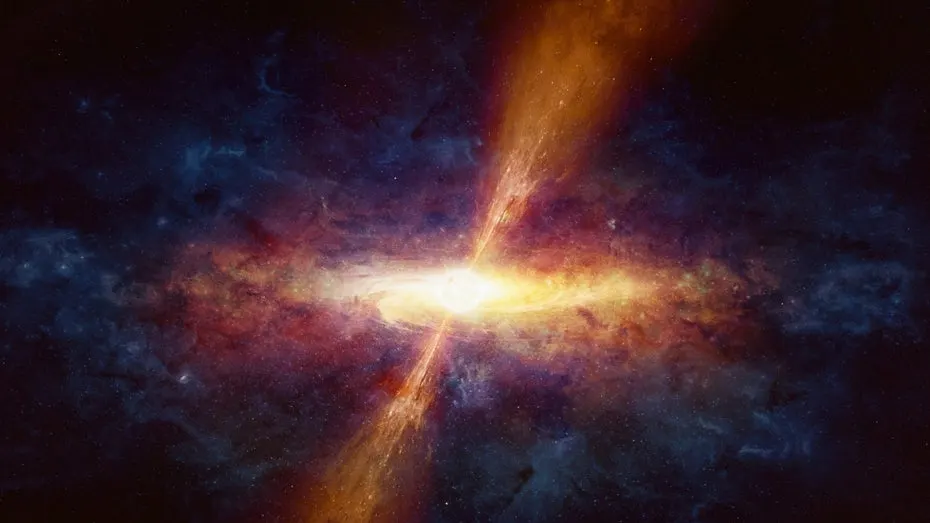
A quasar is the bright core of a galaxy, where a supermassive black hole pulls in gas and dust. The material heats up in a swirling disc before it vanishes and glows hundreds to thousands of times brighter than the rest of the galaxy. The black hole in this one weighs about 360 million Suns, roughly 90 times the black hole at the centre of the Milky Way. The universe was then less than five percent of its present age. The study appears in Astronomy & Astrophysics.
The record beats the previous one from July 2026 by about 39 million years. The team nicknamed the object after a prehistoric stone fort on an Irish sea cliff, as a symbol of an outpost at the edge of what we can observe. The work was led at the Max Planck Institute for Astronomy in Heidelberg. First author Julien Wolf has since moved to the European Southern Observatory near Munich.
How was the most distant quasar confirmed?
Euclid has been scanning large patches of sky for ESA since February 2024. The expansion of the universe stretched the quasar's light to more than nine times its original wavelength, and hydrogen clouds along the way absorbed the rest of the short-wavelength light. In visible light the source is invisible. Three machine-learning selection methods picked out the infrared dot anyway.
Euclid's own spectrograph was too weak for the job, so four other observatories stepped in: Keck in Hawaii, Hubble, and the Large Binocular Telescope in Arizona. A 36-minute James Webb observation in late June 2026 settled distance and mass.
Why the black hole puzzles researchers
The black hole is currently feeding at only about 26 percent of its theoretical limit, the Eddington limit, where radiation pressure pushes incoming gas away. Its main growth spurt must therefore have happened earlier. If it never exceeded that limit, its seed needed roughly 100,000 Sun masses, which could form when a huge gas cloud collapses directly into one body. Remnants of first stars, about 100 Sun masses, would need long phases above the limit. Primordial black holes of about 5,000 Sun masses are a third option. Mergers alone hardly suffice.
The study stays cautious. One object rules out none of the three paths, and the mass estimates range from 214 to 776 million Suns. Euclid has covered only a quarter of its target area, and the team expects 8 to 23 similarly distant quasars over its six-year mission. Co-author Silvia Belladitta told Reuters this is the most distant quasar seen, "but maybe not the most distant there is to find".
Apps worth a look
SUMO: the number puzzleTap the right tiles, add them up, hit the target. Easy to learn, hard to master. Free, for all ages.
Dialo: learn languages by speakingTalk to an AI conversation partner; every sentence comes back corrected and explained in your language. 9 languages, A1 to C2.
ediviewer: read EDI files like documentsOpen EDIFACT and X12 messages, see every segment explained, convert to JSON/XML, export PDF and Excel. Runs locally, no upload.
giftdetect: the right gift in minutesPick who it is for, the occasion and their personality. The search engine reads product descriptions from local shops and ranks what fits. Free, no sign-up.
More from this day
See all →
Flooded Los Santos: GTA V's city under rising seas by 2300

FaceStealer: North Korean hackers use fake video calls to steal $400M

No Speaker: a MacBook trackpad that sings through its motor