ETRI tests 5 autonomous search drones for missing persons
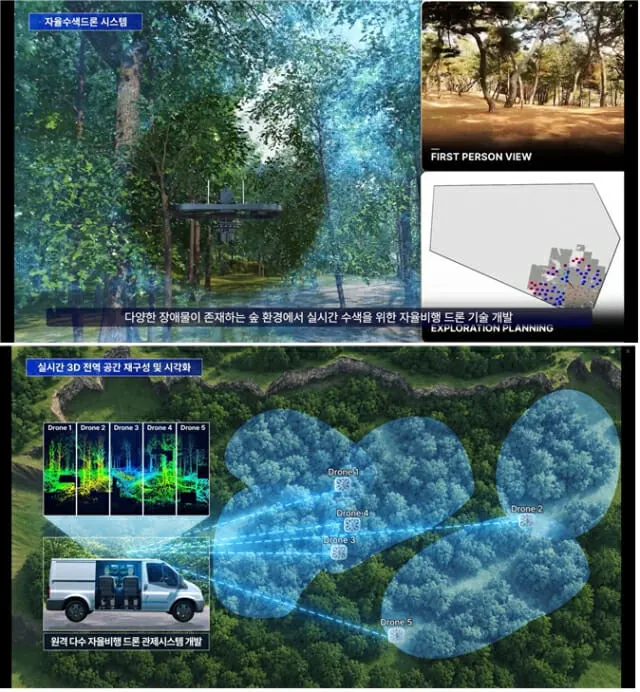
Five drones flew through a Daejeon arboretum without GPS help, mapping the trees in 3D and looking for a simulated missing person.
 SUMO· the number puzzle
 Dialo· learn languages by speaking
 ediviewer· read EDI files like documents
 giftdetect· the right gift in minutes
Finding a missing person in a forest is hard enough on foot. South Korea's ETRI has now shown five autonomous drones doing the searching together, in a place where GPS barely works.
The Electronics and Telecommunications Research Institute announced on 24 November that it ran a demonstration of its multi-drone missing-person search system on 3 November at Hanbat Arboretum in Daejeon. Police and experts from the defence and drone fields attended. The test simulated a real search in a wooded area, with all five drones sent out at once.
How do the autonomous search drones work?
Under tree cover, GPS is limited, so the drones rely on SLAM, short for simultaneous localization and mapping. In plain terms, each drone works out where it is while building a 3D picture of its surroundings, which lets it steer around obstacles on its own.
While flying, the drones collect point cloud data (a 3D scan made of many measured points) plus electro-optical and infrared video. All of it goes live to a mobile control system. That system rebuilds the search area in 3D and uses AI detection to spot missing people and their belongings in the footage. The goal is to help search crews on the ground make quick decisions.
What else did the team build?
The researchers improved the SLAM flight, real-time 3D reconstruction, and the AI detection. They also added automatic mission reports that include where a person was detected and a photo. For AI training, they built and released day and night datasets of missing persons and personal items.
This was the final field demonstration of a five-year project that began in 2022. A first flight trial with three drones took place in November 2024 at Solbat Park in Jaundae, again with police present.
ETRI senior researcher Cha Ji-hun said the team wants to keep improving how well the technology fits real search sites, so police can use it and help secure the critical early hours of a search.
Apps worth a look
SUMO: the number puzzleTap the right tiles, add them up, hit the target. Easy to learn, hard to master. Free, for all ages.
Dialo: learn languages by speakingTalk to an AI conversation partner; every sentence comes back corrected and explained in your language. 9 languages, A1 to C2.
ediviewer: read EDI files like documentsOpen EDIFACT and X12 messages, see every segment explained, convert to JSON/XML, export PDF and Excel. Runs locally, no upload.
giftdetect: the right gift in minutesPick who it is for, the occasion and their personality. The search engine reads product descriptions from local shops and ranks what fits. Free, no sign-up.
More from this day
See all →


More in: Science
See all →
Ancient Amazon city found under jungle with LiDAR, 6,000 platforms

Welopōʻai: a nearby triple star system that shouldn't exist

Welopō’ai: the triple star system 28 light-years away that shouldn’t exist