ESA's Hera Probe Splits Didymos and Dimorphos in First Image
ESA's Hera spacecraft has photographed Didymos and its moonlet Dimorphos as separate objects for the first time. Dimorphos is the asteroid NASA's DART probe hit in 2022.
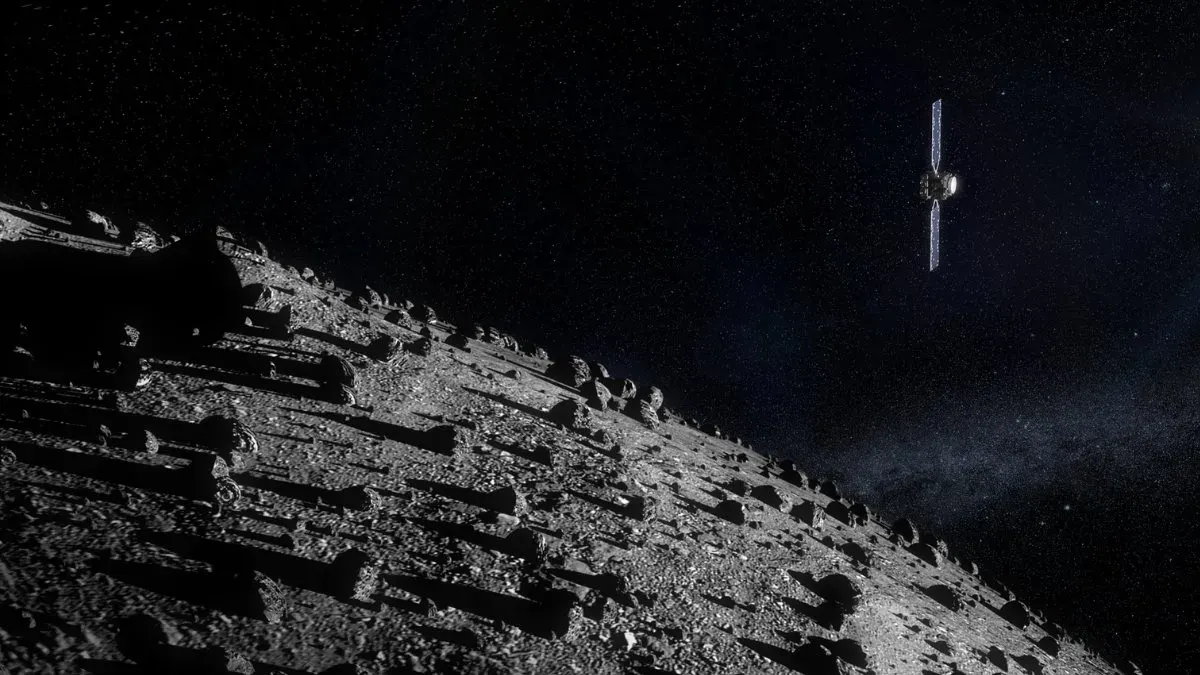
The European Space Agency's Hera spacecraft has captured the asteroids Didymos and Dimorphos as two separate objects for the first time. Until recently, its camera recorded the pair as a single bright point. The agency says the image was taken by the monochrome Asteroid Framing Camera from a distance of about 1,280 km.
The milestone matters because Dimorphos is the moonlet that NASA's DART probe deliberately struck in 2022. Hera is now closing in to examine what that collision actually did.
Still just one pixel
The new picture does not yet show the surface of Dimorphos. The smaller body fills only about one pixel, so no boulders, hollows or traces of the DART impact can be made out. What the image does confirm is that Hera is close enough to begin proper observations of its target.
Didymos measures roughly 780 m across, while Dimorphos is about 151 m wide. The smaller body orbits at an average distance of around 1.15 km, moving at about 18 cm/s. The system is currently some 197 million km from Earth.
What Hera is meant to find out
DART hit Dimorphos on 26 September 2022 at about 6.1 km/s and shortened its orbit around Didymos by roughly 33 minutes. Later measurements showed the impact also changed the motion of the whole system around the Sun.
Researchers still do not know the current state of Dimorphos' surface, its internal structure or how much material was displaced. It is also unclear whether the impact left a classic crater or reshaped the entire object. A loosely bound rubble pile may react differently from a solid body, and ejected material adds to the change in momentum.
ESA says Hera has finished its braking manoeuvres, cutting its speed relative to both asteroids to about 20 m/s. The first detailed images of Dimorphos are due on 25 November. Two small CubeSat satellites will later observe from even closer, and the mission plan includes an attempt to reach the asteroid's surface.
The results should show how much momentum must be transferred to a space rock to alter its orbit predictably. The agency is also considering a small rapid-response probe that could study a potentially hazardous object on short notice.
More from this day
See all →
Digital euro: Deutsche Telekom and Telefónica join consortia

Kippo: Dümmel Deal Collapses After Die Höhle der Löwen Pitch

Lena Gercke Invests in Joy_ and Fronts Zugutschein TV Campaign
OpenAI GPT-6.1 Terra and Google Gemini 4 Carbon Launch
More in: Space
See all →
Callisto Replica Rises at Kourou's Historic Diamant Launch Pad

Seraphim Academy to Invest $150,000 in Early-Stage SpaceTech
Multimillion Loans for Space Firms in Germany and the EU