EIGHT fold: AlphaFold's 'glitch' turned out to be a real protein knot
AlphaFold predicted a protein shape so tangled it looked like an AI hallucination. Polish researchers checked, and gut bacteria really make it.
 SUMO· the number puzzle
 Dialo· learn languages by speaking
 ediviewer· read EDI files like documents
 giftdetect· the right gift in minutes
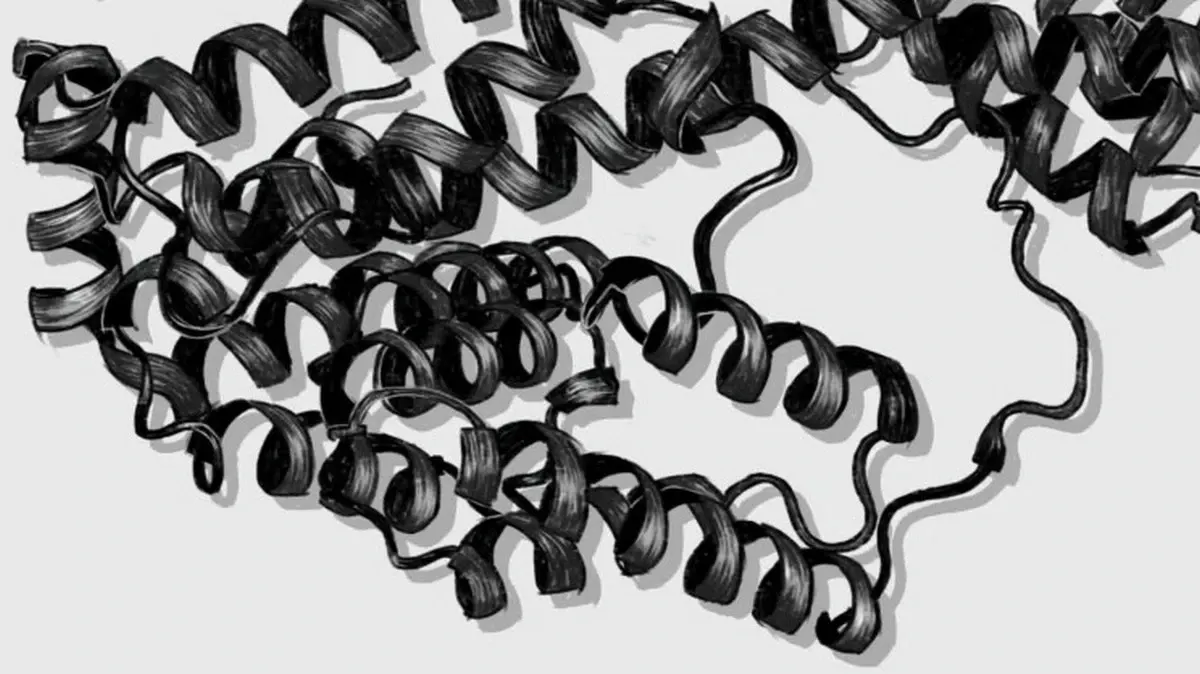
The shape looked so odd that many would have written it off as a bug. AlphaFold, Google DeepMind's protein-prediction AI, proposed a structure with an extremely intricate knot. A team in Warsaw decided to test it anyway, and it turned out to be real.
The team is led by Prof. Joanna Sułkowska of the University of Warsaw's Centre of New Technologies, working with biochemist Prof. Sophie Jackson. Their findings, published in PNAS, describe the first crystal structures of proteins with a knot called 8₃. They named the new family EIGHT fold, short for Extraordinarily Intricate Globular Helical Tangled fold.
What is a protein knot, and why is 8₃ special?
A protein starts as a long chain of amino acids, which folds into a 3D shape that decides what the protein does. Sometimes the chain threads through itself and forms a knot. Mathematicians classify knots by their crossings: the simple trefoil (3₁) has three, the figure-eight knot (4₁) has four. The 8₃ knot has eight.
Until now, researchers assumed proteins mostly form knots made by a single threading of the chain. Making 8₃ means pushing the chain's end through the structure twice. Earlier theoretical models treated that as practically incompatible with how proteins form naturally.
How did they prove it was real?
The team picked this motif out of more than 600,000 knotted proteins. Because it appears in organisms separated by millions of years of evolution, they reasoned it was more than an AI hallucination. Early analysis pointed to anaerobic gut bacteria from the classes Clostridia and Tissierellia, which live without oxygen.
The researchers identified the bacteria, grew them, isolated the protein and determined its structure experimentally. It contained the 8₃ knot, exactly as AlphaFold had predicted. The result also suggests the AI can predict very complex structures without having been trained on anything like them.
The biggest open question is how a protein ties such a knot by itself.
Apps worth a look
SUMO: the number puzzleTap the right tiles, add them up, hit the target. Easy to learn, hard to master. Free, for all ages.
Dialo: learn languages by speakingTalk to an AI conversation partner; every sentence comes back corrected and explained in your language. 9 languages, A1 to C2.
ediviewer: read EDI files like documentsOpen EDIFACT and X12 messages, see every segment explained, convert to JSON/XML, export PDF and Excel. Runs locally, no upload.
giftdetect: the right gift in minutesPick who it is for, the occasion and their personality. The search engine reads product descriptions from local shops and ranks what fits. Free, no sign-up.
More from this day
See all →
Comet 220P/McNaught suddenly got 1,000 times brighter. Here's why
Coral Hart used AI to write 370 books in 20 months

WhatsApp Zaps: self-deleting photos and videos for any chat
Green SM taxis: Karnataka halts new registrations, eyes mandatory meters
More in: Science
See all →
Coriscada wind farm: 4 turbines replace 40 and make 78% more power
Wind turbine blade recycling: a French startup makes ping-pong tables
Drones that carry objects by weaving rope around them midair