Autonomous a2z Completes 1.3-Tonne Driverless Skateboard Platform
Korean physical AI firm Autonomous a2z has finished a prototype skateboard-style driverless logistics platform that can carry up to 1.3 tonnes, with field trials planned for 2027.
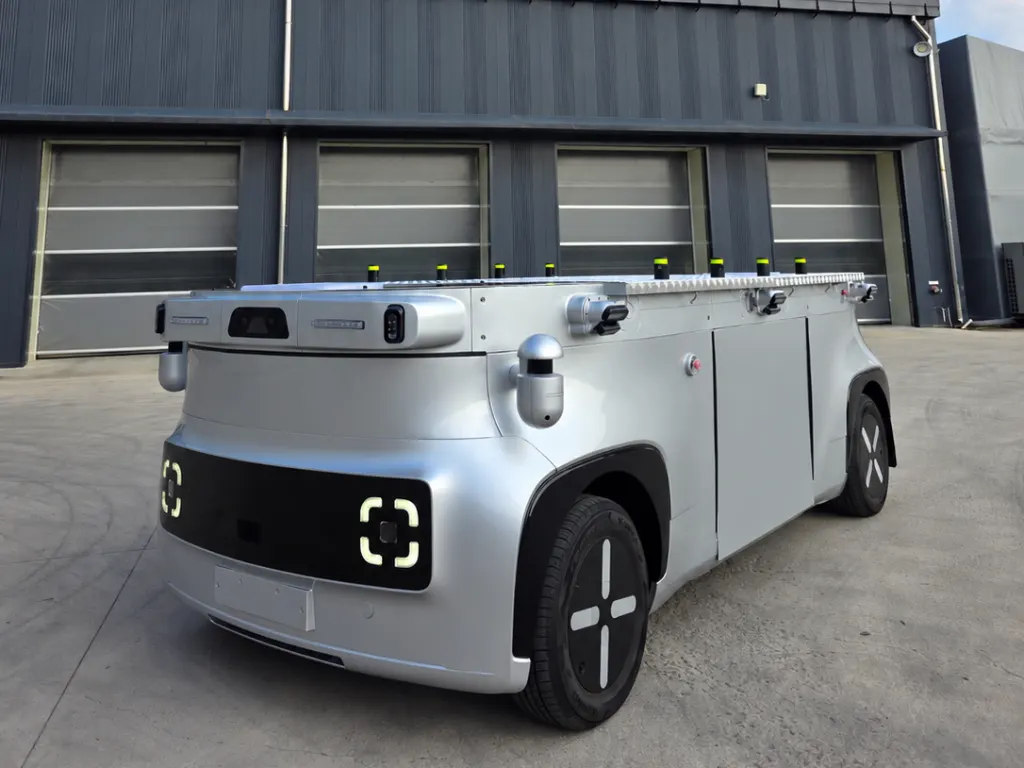
Autonomous a2z, a South Korean physical AI company led by CEO Han Ji-hyung, has completed a prototype of a skateboard-style driverless logistics platform able to carry up to 1.3 tonnes of cargo.
The vehicle is an industrial autonomous mobile robot (AMR) adapted from the sensor system of the company's Level 4 self-driving vehicle, ROii. It drops the roof and cargo box in favor of a flat deck, so parts of many shapes and sizes can be loaded efficiently. The frame has been reinforced for the 1.3-tonne load and fitted with tie-down hooks and protective guards. For safety and ease of use on site, it also carries combined safety lamps for night and low-light work, an external emergency-stop controller and a rain cover.
Government-backed project
The prototype comes from a project titled commercialization technology development for a multipurpose mid-size (over 1 tonne to under 5 tonnes) driverless vehicle platform. It is supported by South Korea's industry ministry and run by the Korea Evaluation Institute of Industrial Technology (KEIT), with a2z as lead developer. Work began in July 2025 and is scheduled to finish in 2027. KC Motors, Prosco, Metec, Ulsan Technopark and Chungbuk National University are co-developers.
Software work is moving in parallel. A2z is building a scene understanding model, based on its own AI algorithms, to recognize irregular exceptions inside factories. Chungbuk National University is developing an HD map inference model that adapts to indoor and outdoor settings. Together, the aim is to let vehicles drive autonomously at manufacturing sites where no high-definition map has been built in advance.
Trials at Gwangju Global Motors
In 2027 the prototype will be deployed at Gwangju Global Motors (GGM) for field validation. It will run a real logistics line that carries parts autonomously from outside suppliers to the vehicle assembly plant, collecting operating data. Factory requirements will then shape the final production model.
Han said the prototype is a practical bridge connecting the company's Level 4 passenger-transport experience with automation demand in industrial logistics. He said a2z will pursue full commercialization after completing the GGM trials, focusing on settings with frequent repeat transport such as factories and industrial complexes.
More from this day
See all →
YouTube Shopping Affiliate Programme Launches in KSA, UAE, Egypt

NoorNation Raises $1.05M Seed Round Led by Customer Linah Farms

Saudi proptech Ghanem adds $1.5M to pre-seed, total hits $8.6M

Masters & Robots 2026: Europe's First Humanoid Robot Fashion Show
More in: Automotive
See all →
Autonomous a2z Unveils Driverless Factory Cargo Prototype

Hyundai Motor Group Advances $9 Trillion Won Saemangeum AI Valley

Tesla Cybercab Battery Pack Aims to Fix Model Y Repair Woes