AT 2016blu: the star that flares every 113 days has a hidden partner
A star 30 million light-years away has mimicked a supernova 27 times without dying. New Chandra X-ray data point to a hidden neutron star or black hole.
 SUMO· the number puzzle
 Dialo· learn languages by speaking
 ediviewer· read EDI files like documents
 giftdetect· the right gift in minutes
For nearly fifteen years, astronomers have watched a star blow up like a supernova, again and again, and survive every time. The star is called AT 2016blu, and a new study finally offers an explanation: it is not alone.
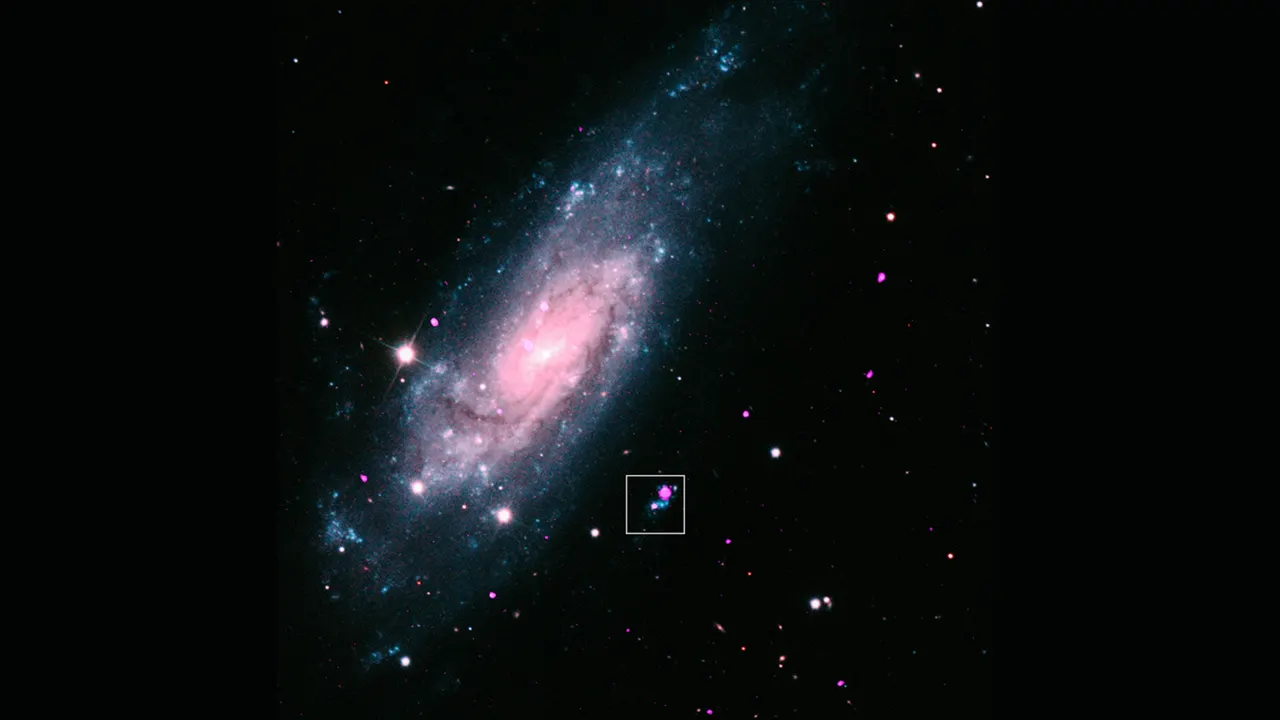
The story began on 12 January 2012, when the Lick Observatory supernova search in California spotted what looked like a stellar explosion. Telescopes around the world turned toward it. But the signal did not quite match a supernova, and the star was still there once the glow faded. Since then it has brightened roughly every 113 days, about three times a year. Ground-based telescopes logged 27 of these flares between 2012 and June 2026.
The study, published on 9 November in The Astrophysical Journal, comes mostly from a team at the University of Virginia. They turned to NASA's Chandra space telescope, which has been working since 1999 and sees in X-rays. It is also the only X-ray telescope sharp enough to separate AT 2016blu from another very bright source right next to it.
What is causing the flares on AT 2016blu?
The team's best explanation is a compact companion, either a neutron star or a black hole. The two objects orbit each other on an oval path. Each time the companion swings close, it captures some of the material thrown off by the big star. That gas whirls around it at close to the speed of light and heats up until it glows fiercely in X-rays.
Chandra looked at the star only twice: in 2001 and 2002, before the flares began, and during the March 2026 eruption. In March 2026 the system was at least 100 times brighter in X-rays than in the earlier images.
Neutron star or black hole?
Nobody can say yet. Both are tiny and give off little light of their own, so the data cannot tell them apart. The companion remains the best explanation, though.
The star sits in the galaxy NGC 4559, 30 million light-years away, and weighs at least 33 times as much as the Sun. It is bright enough in X-rays to be a candidate for an ultraluminous X-ray source, a rare class of objects astronomers still understand poorly. They also suspect that many sudden brightness changes seen in stars before a supernova come from similar pairs: a massive star orbiting a compact object, or another massive star.
Apps worth a look
SUMO: the number puzzleTap the right tiles, add them up, hit the target. Easy to learn, hard to master. Free, for all ages.
Dialo: learn languages by speakingTalk to an AI conversation partner; every sentence comes back corrected and explained in your language. 9 languages, A1 to C2.
ediviewer: read EDI files like documentsOpen EDIFACT and X12 messages, see every segment explained, convert to JSON/XML, export PDF and Excel. Runs locally, no upload.
giftdetect: the right gift in minutesPick who it is for, the occasion and their personality. The search engine reads product descriptions from local shops and ranks what fits. Free, no sign-up.
More from this day
See all →
Comet 220P/McNaught suddenly got 1,000 times brighter. Here's why

Coral Hart used AI to write 370 books in 20 months

WhatsApp Zaps: self-deleting photos and videos for any chat

Green SM taxis: Karnataka halts new registrations, eyes mandatory meters
More in: Science
See all →
Coriscada wind farm: 4 turbines replace 40 and make 78% more power

Wind turbine blade recycling: a French startup makes ping-pong tables

Drones that carry objects by weaving rope around them midair