AT 2016blu: the fake supernova that flares every 113 days
A star in NGC 4559 has faked a supernova 27 times. Chandra X-rays now point to a hidden black hole or neutron star feeding on it.
 SUMO· the number puzzle
 Dialo· learn languages by speaking
 ediviewer· read EDI files like documents
 giftdetect· the right gift in minutes
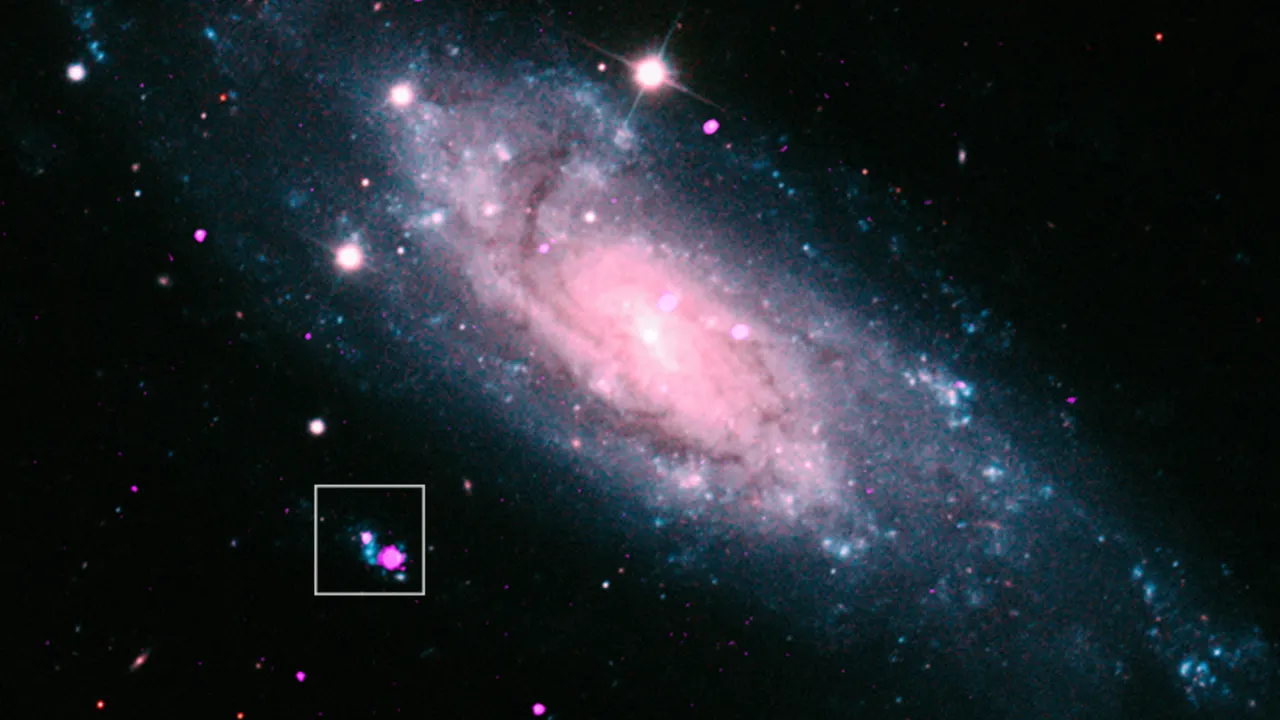
For 15 years, a star in a galaxy 25 million light-years away has kept pretending to blow up. Now astronomers think they know why: AT 2016blu, the fake supernova, has a hidden black hole or neutron star taking bites out of it.
The story began on 11 January 2012, when astronomers saw what looked like a supernova on the edge of the spiral galaxy NGC 4559, in the constellation Coma Berenices. A real supernova destroys a star. This one faded, and the star was still there. Then it flared again, and has done so every 113 days, 27 times so far.
What is AT 2016blu?
It is a luminous blue variable, one of the most massive and brightest kinds of star known. They are unstable and regularly throw off layers of gas. This one is at least 33 times the mass of the sun. Throwing off gas is normal for the type. Mimicking a supernova on a schedule is not.
How does a hidden black hole fake a supernova?
A team led by Mojgan Aghakhanloo of the University of Virginia needed X-ray data taken during an outburst. They got time on NASA's Chandra X-ray Observatory in March 2026, and Chandra caught a strong burst of X-rays just as the star flared again. Earlier Chandra looks at the galaxy, in 2001 and 2002, had shown nothing odd.
The X-rays point to an unseen companion, either a neutron star or a stellar-mass black hole, on an elliptical 113-day orbit. Both are leftovers of massive stars that really did explode, so this was once a pair of stars. Each time the companion swings closest, its gravity drags gas off the blue star. That gas forms a hot, fast-spinning disk that gives off X-rays.
Those X-rays heat the dense cloud the blue star had earlier shed, and the cloud glows in visible light. "The dense gas surrounding the system is heated by the X-rays and then glows in the optical," said Nathan Smith of the University of Arizona. The team calculates the gas is pulled in faster than a neutron star can safely take, known as the Eddington limit.
AT 2016blu is also bright enough to count as an ultra-luminous X-ray source, a rare class whose power source is still unclear. Whether impostors and these sources are linked is too early to say. Only one other impostor, SN 2010da, shows similar X-rays, and its companion is a red supergiant. The work was published on 9 November in The Astrophysical Journal.
Apps worth a look
SUMO: the number puzzleTap the right tiles, add them up, hit the target. Easy to learn, hard to master. Free, for all ages.
Dialo: learn languages by speakingTalk to an AI conversation partner; every sentence comes back corrected and explained in your language. 9 languages, A1 to C2.
ediviewer: read EDI files like documentsOpen EDIFACT and X12 messages, see every segment explained, convert to JSON/XML, export PDF and Excel. Runs locally, no upload.
giftdetect: the right gift in minutesPick who it is for, the occasion and their personality. The search engine reads product descriptions from local shops and ranks what fits. Free, no sign-up.
More from this day
See all →
Figeac fibre optic delay: a pole too tall, a street too narrow

Samsung One UI 9.5 Blocked Calls Dashboard Tracks Spam for 30 Days

WHOOP Humans: a social feed built on sleep and recovery data
Louisiana sues Kalshi, Robinhood and other prediction markets
More in: Space
See all →
ICEYE satellite spots Krasukha-2 jammer in Kaliningrad at night

Nuclear bomb in space could knock out Starlink in 15 days
Nāpōwawāʻenakaulua: Webb Finds Earliest Quasar Pair Ever