ANYmal D robot dog hikes 10 km of Swiss Alps with AI navigation
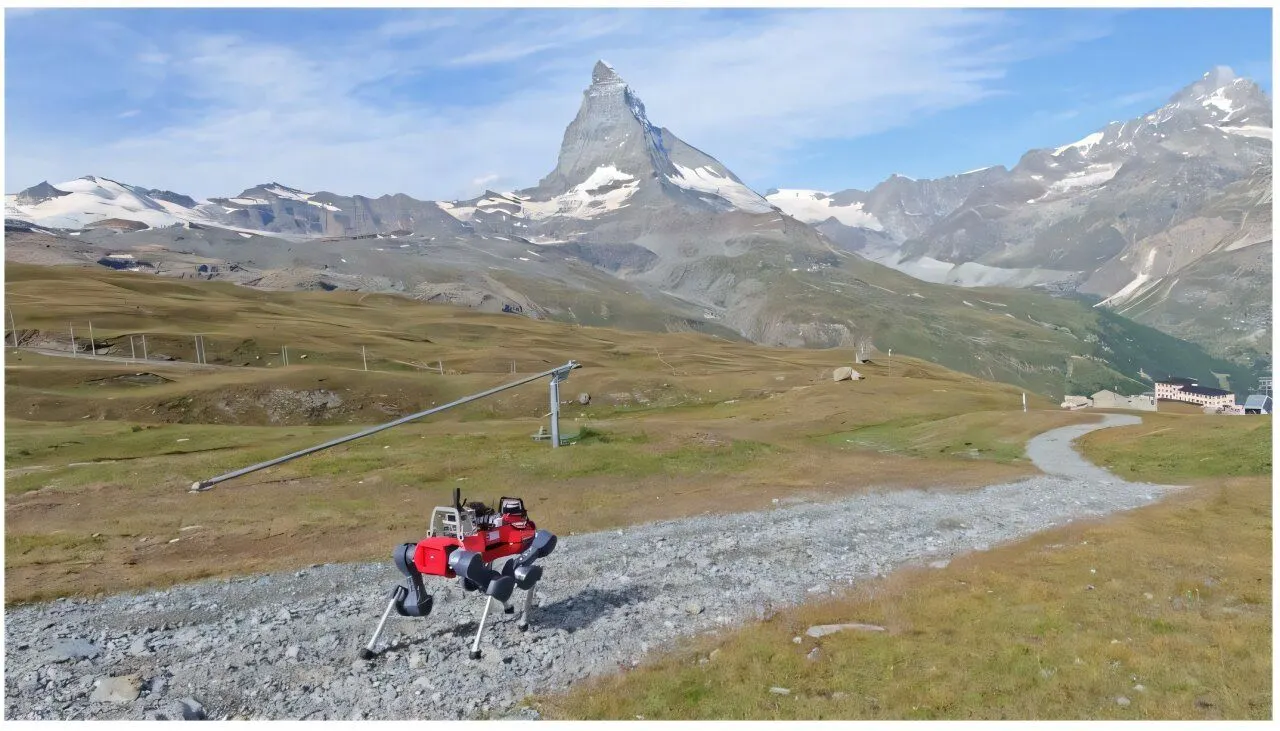
A four-legged robot called ANYmal D walked a 10.1 km Alpine trail near Zermatt, choosing its own route and needing human help only a handful of times.
 SUMO· the number puzzle
 Dialo· learn languages by speaking
 ediviewer· read EDI files like documents
 giftdetect· the right gift in minutes
A robot dog has hiked a mountain trail in the Swiss Alps, and it mostly decided where to go by itself. The four-legged ANYmal D covered 10.1 kilometres near Zermatt with very little help from people.
The machine was running ROAM, short for Robust Open-world Autonomous Mobility, a new AI system from researchers at ETH Zurich and Apple. ANYmal D carries cameras, lidar and satellite navigation. Keeping its balance on rocks and steep slopes is hard enough, but the researchers say the real barrier for robots outside the lab is choosing the route.
How does ROAM navigate?
ROAM pairs a vision-language model with two control systems. One picks the route, the other handles the actual leg movement. Both were trained in computer simulations using reinforcement learning.
The model looks at camera images and spots things like gravel paths, grass or water. It scores each for risk, how safe it is to step on and how useful it is as a path. The system combines that with a terrain map to choose a direction and where to place its feet.
What happened on the trail
The first hike started at more than 3,000 metres above sea level. The robot crossed rocky ground, steep slopes and a stretch along a lake. It ran autonomously 96.7 per cent of the time, though two serious human interventions were needed to keep it safe.
The second test was a 2.38 km loop around Seealpsee lake, with 97.5 per cent autonomy. The robot worked out that it should avoid private pastures. Operators stepped in a few times, for instance when it got too close to the lake edge and when it met a turnstile it could not get through.
In other trials, ANYmal D read roadworks signs correctly and recognised a mannequin lying on a path as a person, then went around it.
Full independence is still far off, the researchers say. This version of ROAM needs an internet connection for its more complex reasoning, and on longer routes it relies on a path planned in advance. The results were published in Science Robotics.
Apps worth a look
SUMO: the number puzzleTap the right tiles, add them up, hit the target. Easy to learn, hard to master. Free, for all ages.
Dialo: learn languages by speakingTalk to an AI conversation partner; every sentence comes back corrected and explained in your language. 9 languages, A1 to C2.
ediviewer: read EDI files like documentsOpen EDIFACT and X12 messages, see every segment explained, convert to JSON/XML, export PDF and Excel. Runs locally, no upload.
giftdetect: the right gift in minutesPick who it is for, the occasion and their personality. The search engine reads product descriptions from local shops and ranks what fits. Free, no sign-up.
More from this day
See all →
Jason's house from GTA 6 has a real twin in Florida for $739,000

Gigabyte RTX stutter traced to RGB software, team reportedly cut

Polly Pet is a Tamagotchi that clips onto your phone with MagSafe