Anthropic Claude AI Agent Performs Brain Surgery on a Live Mouse
Biotech startup Exin Therapeutics says an AI agent built on Anthropic's Sonnet chose a gene therapy, dose and brain target, then directed robots to inject a live mouse.
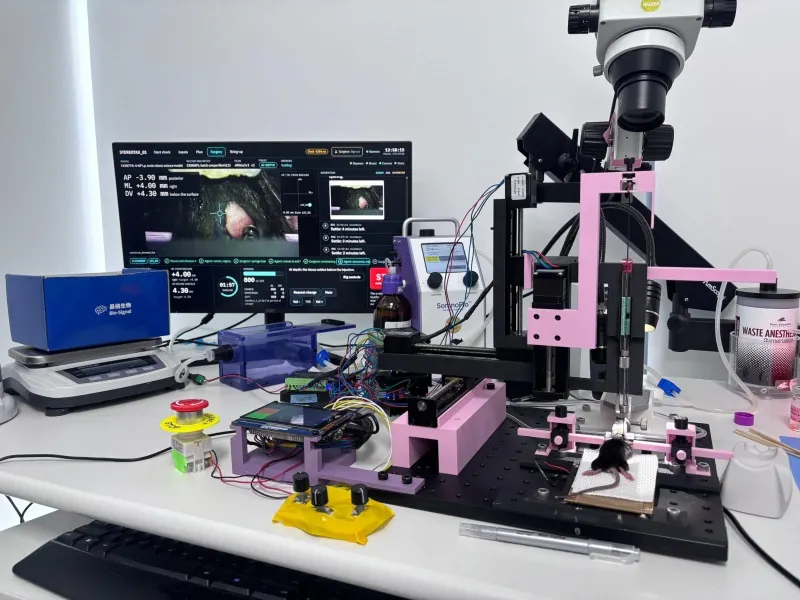
Exin Therapeutics, a startup developing next-generation neurotherapies, says an AI agent has autonomously carried out a brain procedure on a living mouse. According to the company, the agent selected the gene therapy vector, determined the dose and picked the brain region to target. It then controlled robotic manipulators that performed the injection. The mouse tolerated the intervention well and is moving around actively in its glass enclosure.
How the experiment worked
The mouse had been induced to develop epilepsy. The agent, based on Anthropic's Sonnet model, was given control of a robotic surgical rig and a table of 19 gene therapy vector options. It also received three scientific papers, which it used to decide where in the brain to treat.
Humans stayed in the loop. A licensed veterinarian monitored the procedure, and the AI needed approval before each irreversible step. An emergency stop button could cut power to all actuators. The veterinarian also performed the craniotomy, the opening of the skull, because that task is not yet entrusted to an AI agent for safety reasons. Some safeguards could not be overridden by the agents, or even by human operators, so the agent's code had to be edited by hand during the operation.
CEO Gabriel Ocana-Santero said autonomous surgical robots already exist, and some are mechanically superior to the lab's setup, but in those cases a human decided what operation to perform. Here, he said, nobody told the agent which drug to use or where to inject it. He added that he knows of no earlier case of an AI agent choosing the treatment and brain region and then administering it to a living mammal.
Why Sonnet and not Opus
The team had planned to use the more powerful Opus 5.5, but it refused as soon as it recognized a biological experiment. The earlier Opus 5 drafted a surgical plan on paper but declined to carry it out in real time. The startup therefore settled on the mid-tier Sonnet.
The result raises ethical questions. Language models are helping medical research, yet their use in sinus surgery reportedly led to a more than 12-fold rise in failures. Responsibility if something goes wrong remains unclear, as does the broader debate over animal testing. On the other side are patients who have lived for decades with epilepsy that drugs cannot control.
More from this day
See all →
Martorell Halts ID. Polo and Cupra Raval Output on Cell Shortage

Hanwha Ocean Develops Domestic Water-Ram Submarine Launcher

Hanwha Wins First US Navy Ship Contract at Philly Shipyard

KT Cloud Builds Its Own Liquid Cooling Tech for AI Data Centers
More in: AI
See all →
OpenAI, Google and Microsoft back one robots.txt signal for AI training

What AI Models Think of Humanity: 13 Chatbots Give Blunt Verdicts

Samsung Executives Meet OpenAI's Sam Altman on AI Strategy