AI chatbot trackers leak your chats: 21 of 42 services tested
Researchers checked 42 AI chat services, including ChatGPT, Claude and Gemini. Half sent auto-generated chat titles to third-party trackers, and some sent the prompt itself.
 SUMO· the number puzzle
 Dialo· learn languages by speaking
 ediviewer· read EDI files like documents
 giftdetect· the right gift in minutes
You tell a chatbot about a health scare or a legal problem and assume it stays between you and the machine. A new study suggests that for many AI chat services, ad and analytics trackers are quietly listening in.
Researchers at Stony Brook University in New York published the paper "Penny for Your Prompts: A Measurement Study of Contextual Leakage in AI Chat Platforms," accepted for IEEE S&P 2027. They tested 42 services: 25 general-purpose ones such as ChatGPT, Claude and Gemini, and 17 specialised ones for health, law and education.
What did the AI chatbot trackers actually collect?
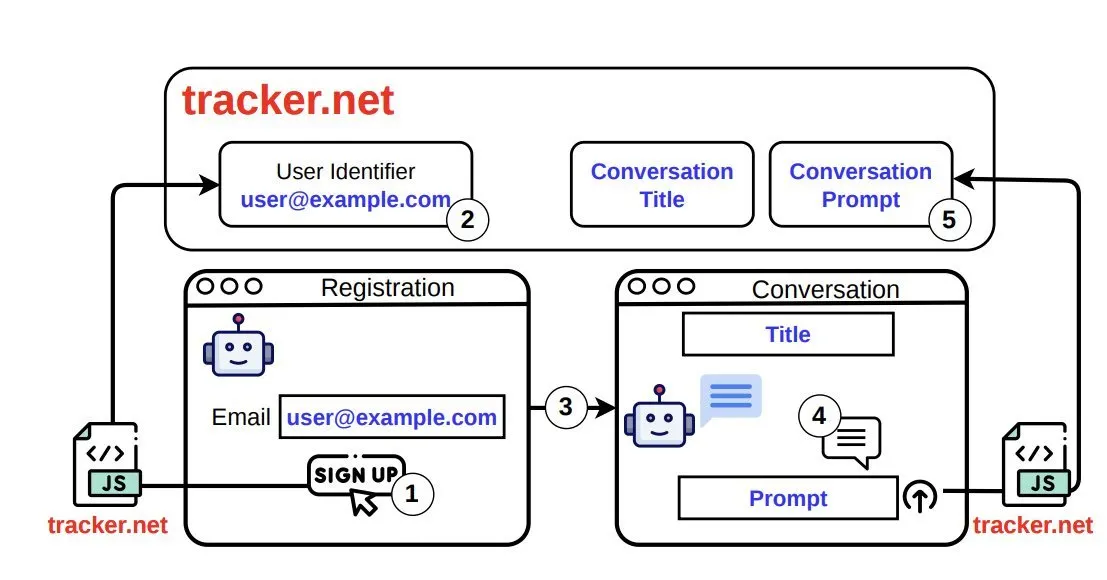
Twenty-one of the 42 services leaked the short, auto-generated summary title of a conversation to outside trackers. In nine of them, the prompt the user typed went out as it was. Among the services that leaked conversation content, 11 of 13 general-purpose ones and all 8 specialised ones also sent the email address used to sign up.
Trackers were everywhere. For the 25 general-purpose services, the browser made 540 requests on average, and about 22 percent of them (118) went to trackers. Google received 41.8 percent of that traffic, followed by Microsoft (12.2 percent), ByteDance (8.6 percent) and Meta (8.3 percent).
How does the leak happen?
No clever hacking is involved. To trace it, the team followed the browser's JavaScript engine step by step, which showed what action triggered a leak, what was read from the page and where it was sent.
Many chatbots turn your question into a short title and put it in the page's title tag. Standard tracking scripts routinely read the page title. So when you send a prompt or switch conversations, the tracker grabs a title that is basically your question and ships it out. Full prompts escaped in two other ways: session-recording tools that collect text on the page, and designs that put the prompt in the URL.
The study doesn't say which individual services did what. It does show that a chat window can be as leaky as a shopping site, because it is built on the same web plumbing.
Apps worth a look
SUMO: the number puzzleTap the right tiles, add them up, hit the target. Easy to learn, hard to master. Free, for all ages.
Dialo: learn languages by speakingTalk to an AI conversation partner; every sentence comes back corrected and explained in your language. 9 languages, A1 to C2.
ediviewer: read EDI files like documentsOpen EDIFACT and X12 messages, see every segment explained, convert to JSON/XML, export PDF and Excel. Runs locally, no upload.
giftdetect: the right gift in minutesPick who it is for, the occasion and their personality. The search engine reads product descriptions from local shops and ranks what fits. Free, no sign-up.
More from this day
See all →
Flipper Zero car theft patches sell for up to $1,000
floppy3.5: a Wi-Fi floppy reader for old Sony Mavica photos

DeepSeek free limits: 40,000-character cap and daily quota